

Green vs Brown Lenses: Which Tint Fits Your Activity?
Choose brown lenses when contrast and depth perception matter most for activities such as driving, golf, fishing, and any variable-light situation where you need to read terrain fast. Choose green when you want balanced color accuracy and a tint that holds up across everything from cycling to beach days to overcast afternoons. Chapeleyewear offers both tints in polarized and sport configurations, so you can match the lens to the activity rather than guessing.
Quick picks by activity:
- Driving and golf: Brown wins for edge detection and contrast in hazy or bright conditions
- Fishing and water sports: Brown for contrast on choppy water; polarized green for cleaner color when light is stable
- Cycling and trail running: Green for balanced color and reduced fatigue over long sessions
- Everyday mixed use: Green, because it distorts colors less and handles shifting light well
Key Takeaways
Brown lenses are the stronger choice for contrast-dependent tasks like driving and fishing; green lenses deliver better color accuracy and lower fatigue for everyday and sport use.
| Point | Details |
|---|---|
| Brown for contrast tasks | Choose brown for driving, fishing, and golf — blue-light filtering sharpens edges and depth cues. |
| Green for color and comfort | Green transmits middle wavelengths efficiently, preserving color accuracy and reducing fatigue on long wear. |
| UV protection is separate | Both tints can block 99–100% UVA/UVB; verify the rating on the label, not the tint color. |
| VLT and polarization matter | Match VLT to light conditions (8–25% for bright sun) and add polarization for water and driving glare. |
| Chapeleyewear covers both | Sport-polarized and designer-polarized collections offer brown and green tints with UV protection and polycarbonate lenses. |
Table of Contents
- How do green vs brown lenses compare at a glance?
- Why green lenses feel bright and natural
- Why brown lenses sharpen contrast and depth
- Which tint fits your activity?
- UV protection, polarization, and driving safety
- What to check before buying green or brown lenses
- How each tint affects depth perception and visual acuity in sports
- How green and brown lenses perform in fog, haze, and variable weather
- Does the tint color affect lens durability or scratch resistance?
- Do green or brown lenses reduce eye fatigue during long wear?
- The case for matching the lens to the moment
- Chapeleyewear has both tints covered, polarized and sport-ready
- Sources
How do green vs brown lenses compare at a glance?
Both tints block glare and cut brightness, but they do it differently. Brown shifts your view warmer and punches up contrast. Green keeps colors closer to natural and feels easier on the eyes over time.
- Brown: High contrast, warmer color shift, strong depth cues, best in variable or hazy light
- Green: Balanced color fidelity, neutral-to-bright feel, lower color distortion, versatile across light levels
- Glare reduction: Both tints work well; polarized versions of each cut surface glare on water and roads significantly
- Color shift: Brown warms everything; green keeps greens vivid and mutes extremes without a heavy cast
- Prescription and polarization compatibility: Both tints are available in polarized and prescription formats from most quality eyewear brands
According to VSP, brown lenses improve contrast and depth perception while green lenses provide even color transmission and balanced performance — and VLT, UV rating, polarization, and coatings remain the decisive buying criteria beyond tint color alone.
Why green lenses feel bright and natural
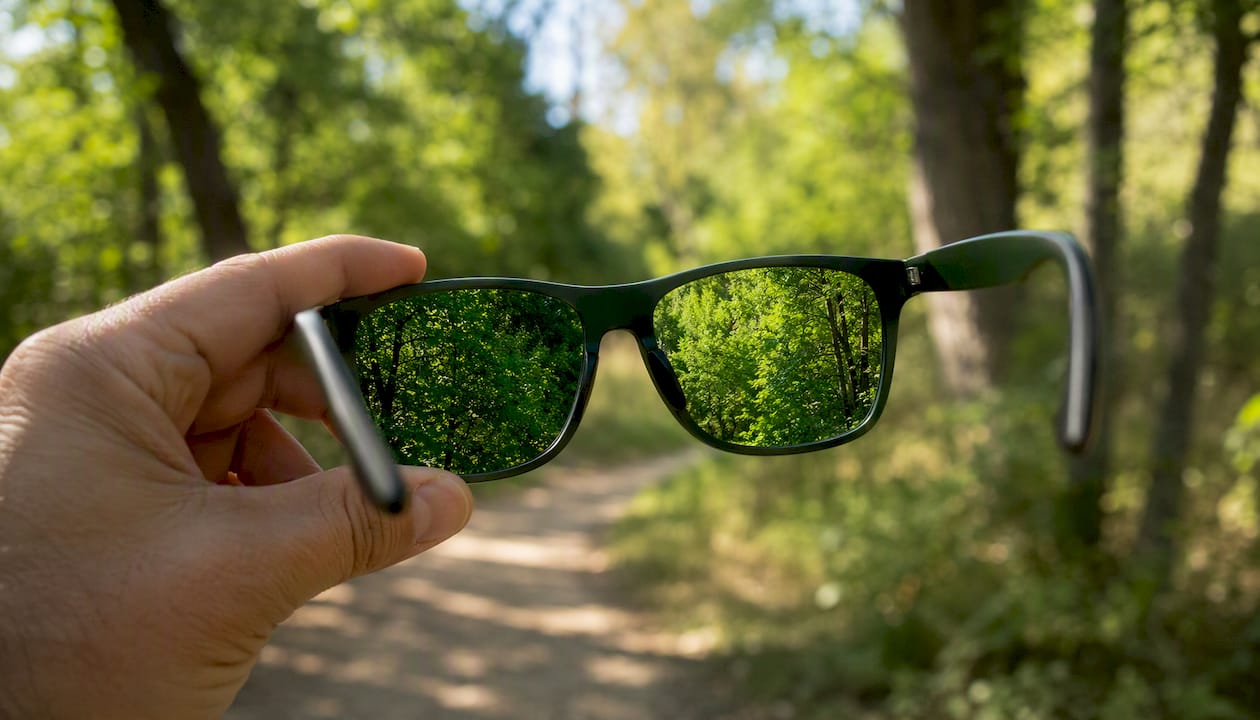
Green tints transmit middle wavelengths of the visible spectrum, which happens to be where your eye is most sensitive. That alignment is why a green lens can be fairly dark and still feel bright and open rather than dim.
Sunglass Science explains that green lenses transmit wavelengths near the eye’s peak sensitivity, producing a calming, bright-feeling view that preserves color accuracy and reduces eye fatigue in strong light. The practical result: you get glare reduction without the heavy, tunnel-vision feel that darker gray or brown lenses sometimes produce.
The trade-off is modest contrast enhancement. Green lenses don’t punch up edges and textures the way brown does. What they give you instead is color accuracy — comparative reviews find that green balances color accuracy and contrast better than gray and distorts colors less than brown across most conditions.
Green lenses work best for:
- Cycling and trail sports where color cues (trail surface, vegetation) matter
- Golf in consistent bright light when you want to read the green accurately
- Everyday wear across mixed lighting
- Water sports when light is stable and color fidelity helps you read depth
Why brown lenses sharpen contrast and depth
Brown tints emphasize red and yellow wavelengths while filtering blue light, and that combination is what makes distant edges pop. When you’re judging distance on a fairway or watching a lure drop through choppy water, brown gives you more visual information about texture and depth than green does.
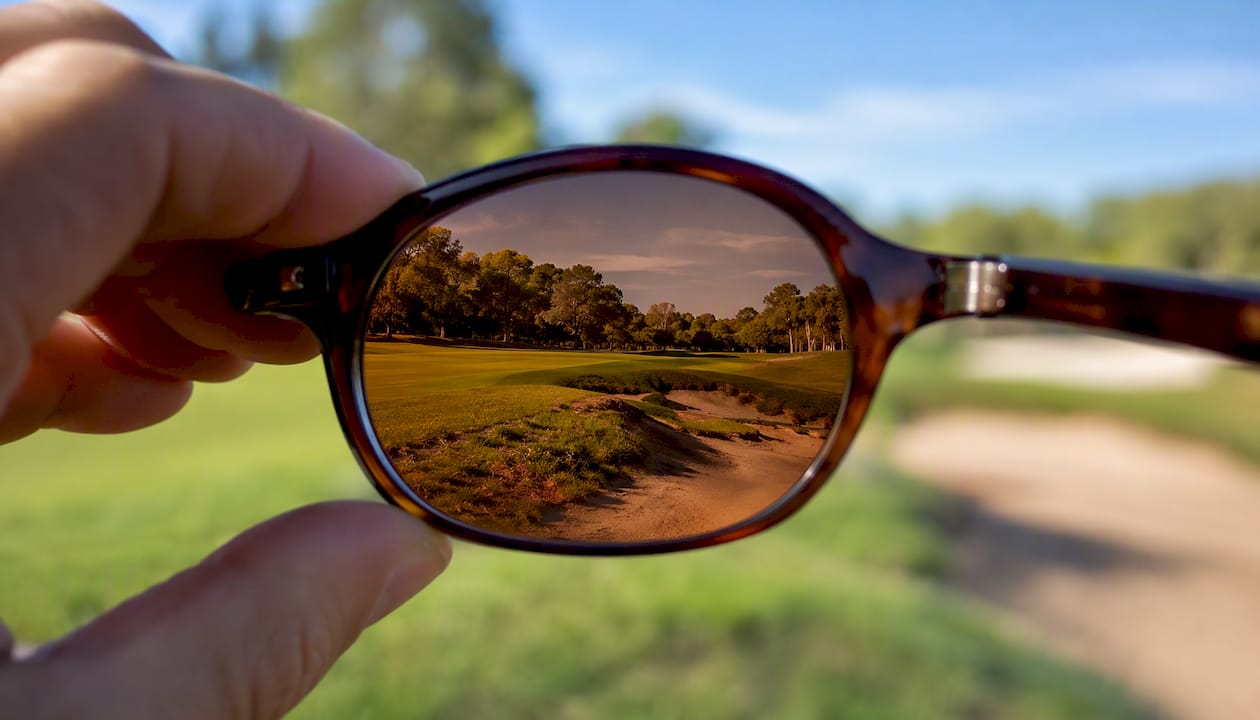
The blue-light filtering is the key mechanism. Blue light scatters more than other wavelengths, which softens edges and reduces contrast in hazy or variable conditions. Brown lenses suppress that scatter, which is why they feel so effective on overcast days or in the hour before sunset when light gets diffuse.
Brown lenses work best for:
- Driving, especially in variable or hazy conditions
- Fishing — contrast on water surface and depth cues for spotting fish
- Golf — reading terrain, judging distance to the pin
- Hiking in mixed or dappled light
The color trade-off is real. Brown shifts your entire view warmer. Most people adapt quickly, but if you need precise color discrimination — reading traffic signals, for example — an extreme brown tint can compress the red-green distinction. Stick to medium-darkness brown lenses for driving rather than very dark amber, and you avoid that problem. For more on how brown compares to other frame and lens color choices, the black vs brown sunglasses guide at Chapeleyewear covers the aesthetic and functional angles together.
Which tint fits your activity?
Driving
Brown is the stronger choice for most driving conditions. It sharpens road edges, improves depth judgment, and cuts through haze better than green.
Fishing and water sports
Polarized brown cuts glare on choppy water and boosts contrast for spotting fish beneath the surface. Polarized green works well when light is more consistent and you want accurate color rendering of the water and surroundings. Either way, polarization matters more than tint color for water use.
Golf
Brown for distance judgment and reading terrain texture. Green if you’re playing in bright, consistent light and want accurate color on the green itself.
Cycling and trail running
Green is the better everyday pick for long sessions. It reduces fatigue, keeps color cues accurate, and handles shifting light without the heavy warmth of brown.
Overcast and low-light days
Neither dark tint is ideal. If you’re committed to one, a lighter brown (higher VLT) handles overcast better than a dark green because the contrast boost compensates for flat light. A photochromic lens that adjusts automatically is the smarter solution for days when light swings between overcast and bright.
Pros of green lenses: Color accuracy, lower fatigue, versatile across light levels, less color distortion Cons of green lenses: Modest contrast boost, not ideal for hazy or variable conditions
Pros of brown lenses: Strong contrast, excellent depth cues, effective in haze and variable light Cons of brown lenses: Warmer color shift, possible color compression at extreme darkness
Pro Tip: For mixed-use — commuting, weekend hiking, casual sport — a polarized green lens covers the most ground. If you split time between driving and fishing, keep a polarized brown pair for those specific tasks.
UV protection, polarization, and driving safety
Both green and brown tints can deliver full UV protection. The tint color itself does not determine UV-blocking capability. The American Academy of Ophthalmology advises choosing sunglasses that block UVA and UVB rays effectively, and that standard applies regardless of whether the lens is green, brown, gray, or any other color.
Safety checklist before you buy:
- Confirm 100% UVA/UVB protection on the label — not just “UV protection”
- Check VLT: 8–25% for bright sun, 25–40% for variable conditions, above 75% for low light
- Polarization reduces glare but can wash out LCD displays and interact with some windshields — test before driving
- Avoid very dark tints (VLT below 10%) for driving; they reduce visibility in tunnels and shade
That combination cuts road glare and sharpens edges without darkening your view enough to cause problems in shade or tunnels.
Traffic-light safety is a real concern with extreme tints. A very dark amber or brown lens can compress the red-green contrast enough to make signals harder to read quickly. Medium-darkness lenses from reputable brands avoid this. If you wear prescription lenses, verify that your chosen tint is available in your prescription format before committing.
What to check before buying green or brown lenses
The tint is only one variable. These are the factors that actually determine whether a pair of sunglasses performs well for your use case.
- Activity match first: Identify your primary use (driving, water, sport, everyday) and let that drive the tint choice before you consider anything else
- VLT percentage: Darker lenses (lower VLT) for bright sun; lighter (higher VLT) for overcast or variable conditions
- Polarization: Worth it for water, driving, and snow; less critical for shaded or indoor-outdoor use
- Lens material: Polycarbonate is impact-resistant and lighter; glass offers superior optical clarity but adds weight and breaks more easily. For sport use, polycarbonate is the practical default
- Coatings: Anti-reflective, scratch-resistant, and hydrophobic coatings extend lens life and maintain optical quality. Check whether coatings are applied to both sides
- Prescription compatibility: Confirm the tint and lens material work with your prescription before ordering
- Warranty and returns: A brand that offers a trial period or clear return policy lets you test lenses in real conditions
Pro Tip: Test any new pair outside in the light conditions you’ll actually use them in — not under store fluorescents. A lens that looks great indoors can feel too dark or too warm the moment you step into direct sun.
For a broader shopping framework, Chapeleyewear’s 2026 sunglasses shopping guide covers what to look for across lens types and price points.
How each tint affects depth perception and visual acuity in sports
Brown lenses have a measurable edge in sports that require rapid distance judgment. The contrast boost from blue-light filtering makes it easier to pick out a ball against a bright sky, read the break of a green, or spot a fish holding in current. Depth cues come from edge contrast, and brown sharpens those edges.
Green lenses don’t match brown for raw depth perception, but they support visual acuity differently. Because they align with the eye’s peak spectral sensitivity, they keep the visual field bright and detailed without the color compression that comes with brown. For sports where you need to read color-coded information quickly — trail markers, jersey colors, court lines — green preserves that information more accurately.
The practical split: choose brown when you need to judge distance and terrain texture fast; choose green when you need to process color and detail across a wide field of view.
How green and brown lenses perform in fog, haze, and variable weather
Brown is the stronger performer in fog and haze. The blue-light filtering that makes brown effective in variable light also cuts through atmospheric scatter, which is what makes fog look flat and featureless. Brown lenses restore some edge definition in those conditions, which is why they’re the default recommendation for driving in overcast or hazy weather.
Green lenses hold up better in stable, bright conditions but don’t add much in fog. Their strength is color fidelity, and fog reduces color contrast to the point where that advantage disappears. In heavy overcast, a lighter-tinted green (higher VLT) is more useful than a dark one, but brown still tends to outperform it for contrast.
For genuinely variable weather — a day that swings from fog to bright sun — a photochromic option that adjusts VLT automatically is more practical than committing to either fixed tint.
Does the tint color affect lens durability or scratch resistance?
The tint itself — green or brown — does not determine how scratch-resistant a lens is. Durability comes from the lens material and the coatings applied to it, not the dye color.
Polycarbonate lenses in either tint are impact-resistant by nature but scratch more easily than glass without a hard coating. Glass lenses in either tint are optically superior and more scratch-resistant but heavier and more fragile on impact. The coating applied over the tint is what protects the surface: a quality scratch-resistant coating on a polycarbonate lens outperforms an uncoated glass lens in everyday handling.
What does vary by tint is how visible scratches appear. Lighter green lenses tend to show surface marks more visibly than darker brown lenses, simply because the contrast between a scratch and the lens surface is higher. For high-wear sport use, a darker tint with a hard coating is the more forgiving combination.
Do green or brown lenses reduce eye fatigue during long wear?
Green lenses have a consistent edge here. Because they transmit wavelengths near the eye’s peak sensitivity, the visual system doesn’t have to work as hard to process what it’s seeing. That efficiency translates to less strain over a long day outdoors. Cyclists, hikers, and anyone wearing sunglasses for four or more hours at a stretch tend to report less fatigue with green than with brown.
Brown lenses aren’t uncomfortable — the contrast boost actually reduces the squinting and accommodation effort that comes with flat, glare-heavy light. But the warmer color shift requires a small ongoing adjustment from the visual system, and over a full day that adds up. For prolonged wear in consistent bright light, green is the more comfortable choice. For shorter, high-intensity sessions in variable or hazy conditions, brown’s contrast advantage outweighs the fatigue difference.
If eye comfort during long wear is your primary concern, color-enhancing lens options at Chapeleyewear are worth reviewing alongside standard green and brown tints.
The case for matching the lens to the moment
Most people buy one pair of sunglasses and wear them everywhere. That’s understandable, but it’s also why so many people end up with a pair that’s great for one thing and mediocre for everything else.
The green vs brown decision isn’t really about which tint is better in the abstract. It’s about which trade-off you’re willing to live with. Brown gives you contrast and depth at the cost of color accuracy. Green gives you color accuracy and comfort at the cost of contrast in hazy conditions. Neither is wrong. Both are useful.
What I’d push back on is the idea that you need to pick one and commit forever. A polarized brown pair for driving and water, and a polarized green pair for everyday and sport use, covers nearly every situation without compromise. The cost of a second pair is lower than most people assume, and the performance difference in your primary activity is real enough to notice every time you put them on.
The brands that get this right are the ones that offer both tints in consistent quality across polarized, sport, and everyday formats — so you’re not mixing lens quality when you switch between pairs.
Chapeleyewear has both tints covered, polarized and sport-ready
Chapeleyewear’s sport-polarized collection is the right starting point for brown-tint buyers focused on driving, fishing, or golf — polarized lenses in impact-resistant polycarbonate, built for conditions where contrast and glare control matter most. For green-tint buyers who want versatility without sacrificing style, the designer-polarized collection pairs balanced color performance with frames that work as well on a trail as they do on a weekend out.
Both collections include UV protection and polarization as standard, not upgrades. If you’re still deciding between tints, the full range at Chapeleyewear lets you compare options side by side before committing. Pick the tint that fits your primary activity, and use the buying checklist above to confirm VLT, polarization, and lens material before you order.
Sources
- Choosing the Right Lenses for Your Sunglasses
- Sunglasses and eye protection
- How Green Sunglass Lenses Work
- Choosing the Right Sunglass Lens Color : Grey, Brown, or Green?
- Brown Vs. Green Polarized Sunglasses