

Color Enhancing Sunglasses: See the World More Vividly
Color enhancing sunglasses do something regular tinted sunglasses don’t: they selectively filter specific light wavelengths to actively boost color saturation, contrast, and depth perception rather than simply dimming everything down. The technical term you’ll see in optical circles is “selective wavelength filtering,” and it’s the core mechanism behind lenses from technologies like Knockterra+, Oakley Prizm, and AMP Color Enhancing Lenses. Here’s what that means in practice:
- Selective filtering: The lens blocks certain mid-spectrum wavelengths while allowing red, green, and blue light bands to pass through more intensely, making colors appear richer and more distinct.
- Contrast boost: By narrowing the overlap between color channels your eye perceives, these lenses sharpen the boundary between, say, a green fairway and a blue sky.
- UV protection: Quality color enhancing lenses carry UV400 or 100% UV certification, blocking both UVA and UVB rays. This is non-optional for eye health, regardless of how vivid the color effect is.
- Not the same as standard tinted sunglasses: A dark gray lens reduces overall brightness uniformly. A color enhancing lens is engineered to reshape the light spectrum you receive, not just turn down the volume on all of it.
What are the real benefits of color enhancing sunglasses?
The most immediate payoff is visual. Colors look more saturated, edges appear sharper, and depth perception improves noticeably, especially in high-contrast outdoor environments like open water, ski slopes, or dense forest trails. For anyone who spends real time outdoors, that translates directly into better performance and a more enjoyable experience.
Eye strain is another factor worth taking seriously. When your eyes constantly work to distinguish low-contrast details under bright, flat light, fatigue builds fast. Lenses that amplify contrast reduce that effort, which is why trail runners and cyclists often report feeling less tired after long sessions wearing enhanced vision eyewear.
The protective side matters just as much. The American Academy of Ophthalmology specifically recommends 100% UV protection sunglasses to lower the long-term risk of cataracts and macular degeneration. Ophthalmologist Michael Kutryb, MD, a spokesperson for the organization, puts it plainly: “UV radiation, whether from natural sunlight or indoor artificial rays, can damage the eye’s surface tissues as well as the cornea and lens.” Color enhancing lenses that also carry UV400 certification give you both the visual upgrade and the protection your eyes actually need.
Key benefits at a glance:
- Richer color perception for hiking, cycling, golf, fishing, and water sports
- Improved depth perception that helps with judging distances on trails or slopes
- Reduced eye strain during extended outdoor activity
- Lower long-term risk of cataracts and macular degeneration with proper UV400 protection
- Sharper detail recognition in variable lighting conditions like overcast days or bright snow glare
Statistic callout: The American Academy of Ophthalmology advises selecting sunglasses that provide 100% UV or UV400 protection, blocking both UVA and UVB rays, as the baseline standard for safe outdoor eyewear.
Which lens technologies and brands lead the color enhancement category?
The U.S. market has several well-established technologies worth knowing before you buy. They differ in how aggressively they filter wavelengths, which activities they’re optimized for, and whether prescription options are available.
-
Knockterra+: Designed to sharpen contrast and depth perception across a range of outdoor environments. Knockterra+ lenses target the wavelength bands that tend to wash out in bright sunlight, making terrain features and color boundaries more defined.
-
Oakley Prizm: One of the most widely recognized names in sport-specific color enhancement. Prizm lenses are tuned for particular environments, with distinct versions for green foliage (trail and field sports), snow glare, road cycling, and open water. The idea is that each environment has a predictable light signature, and the lens is calibrated to amplify what matters most in that setting.
-
AMP Color Enhancing Lenses: Available with prescription options, which makes them accessible to a broader audience. AMP lenses focus on boosting color vibrancy and contrast for everyday outdoor and sport use, and the prescription availability is a genuine differentiator for people who can’t wear non-corrective eyewear.
-
EnChroma SuperX: EnChroma’s SuperX lenses are built for people with normal color vision who want to push their outdoor visual experience further. They’re polarized, carry 100% UV protection, and include anti-scratch and anti-reflective coatings. One important clarification from EnChroma directly: SuperX is not designed to correct color blindness. It’s engineered to enhance color perception for those who already see color normally.
-
Maui Jim PolarizedPlus2: Combines glare elimination with natural color enhancement. The polarization layer handles reflected glare from water or pavement, while the color enhancement component restores the warmth and saturation that standard polarized lenses sometimes flatten.
-
Trivex Color Boosting: Trivex is a lens material, not just a coating, and certain Trivex formulations include color-boosting properties alongside impact resistance. This makes them a practical option for high-activity use where durability matters as much as optics.
For a deeper look at how these technologies perform in active settings, Chapeleyewear’s guide to high-performance eyewear covers the practical distinctions worth knowing before committing to a pair.
How to choose color enhancing sunglasses that actually fit your needs
The lens technology gets most of the attention, but the buying decision involves several other factors that determine whether a pair actually works for you.
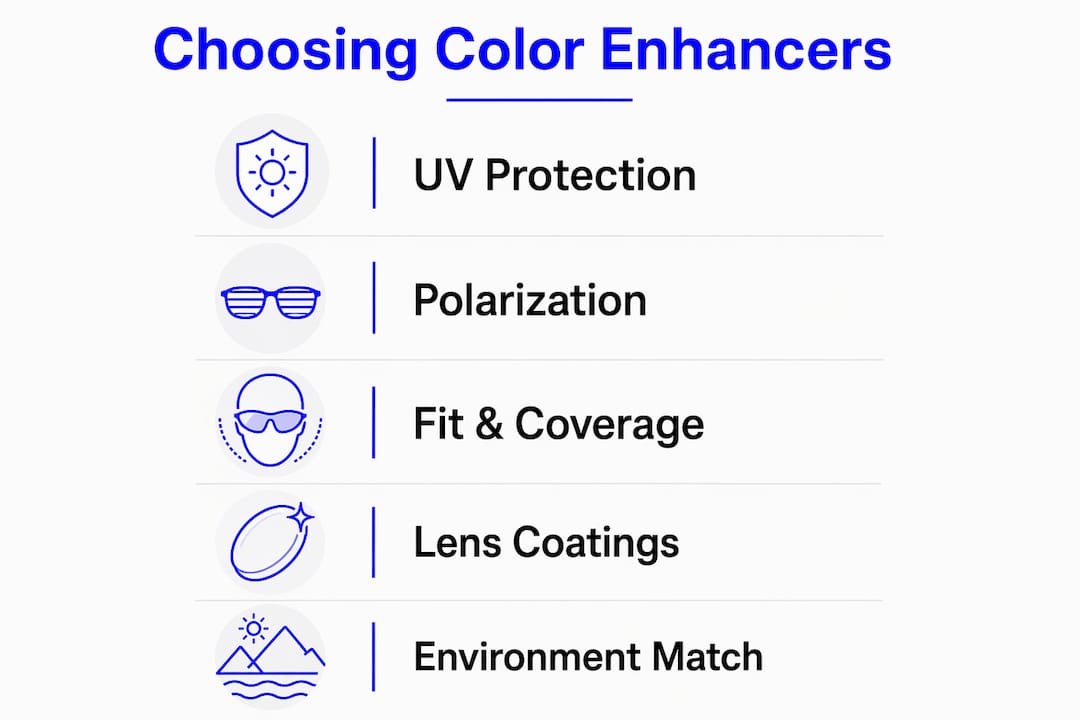
UV protection first, always. The UV400 label is the standard to look for. It indicates the lenses block 99–100% of UVA and UVB rays. Lens darkness has no bearing on UV protection; a lightly tinted lens with a proper UV coating protects your eyes far better than a dark lens without one. The American National Standards Institute (ANSI) regulates UV protection standards for eyewear sold in the U.S., so look for ANSI-compliant labeling alongside UV400.
Polarization and color enhancement together. Polarized color lenses address two separate problems simultaneously: polarization cuts reflected glare from flat surfaces like water, snow, and pavement, while the color enhancement layer boosts saturation and contrast. Not every color enhancing lens is polarized, so check the spec sheet if glare is a concern for your primary activity.
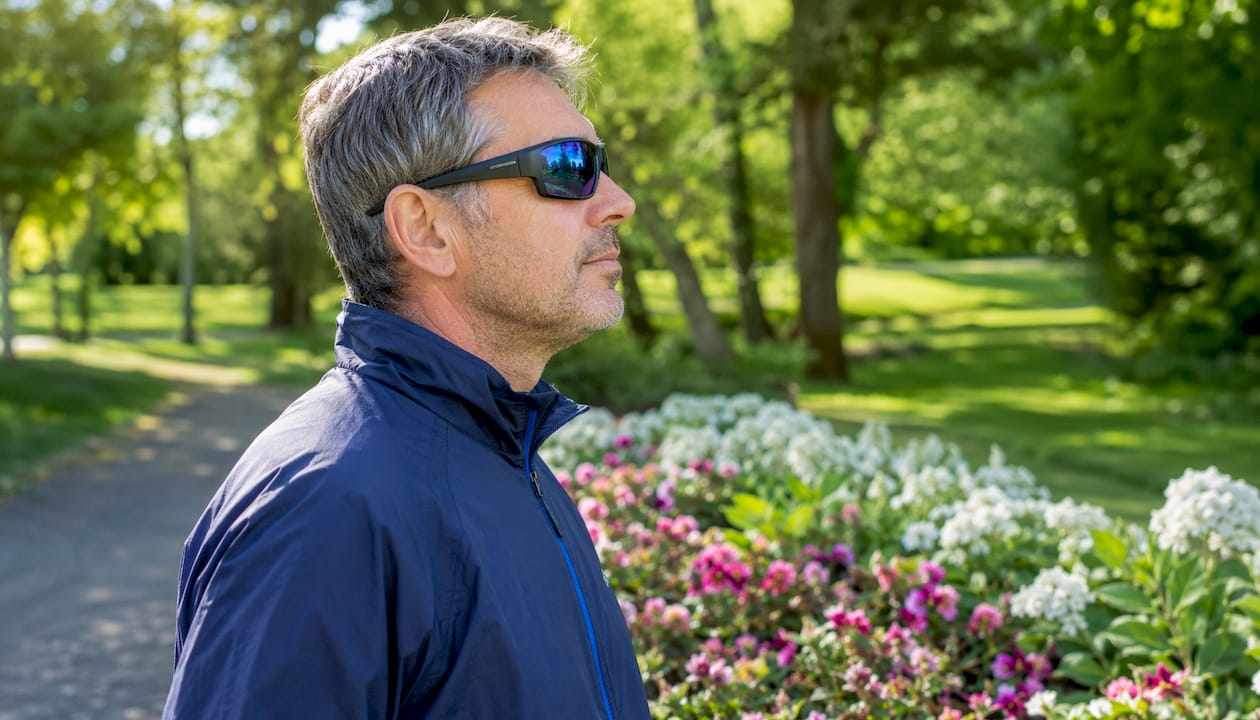
Frame fit and coverage. A lens that enhances color perception loses half its value if light pours in from the sides. Wraparound frames or sport-specific designs with peripheral coverage keep stray light out and maintain the controlled light environment the lens is engineered for. Adjustable nose pads help secure fit during movement.
Lens coatings that extend lifespan. Anti-scratch coatings protect the optical surface during active use. Anti-reflective coatings on the backside of the lens reduce UV reflection bouncing off the inner surface toward your eye, a detail that matters most in highly reflective environments like snow or open water. Backside UV protection is a feature worth asking about specifically.
Pro Tip: Match your lens technology to your primary environment before anything else. A lens tuned for green foliage and trail conditions will underperform on open water, and vice versa. Identify where you spend the most time outdoors, then choose accordingly.
Limitations to factor in. Color enhancing lenses can shift color perception in ways that feel unnatural in certain lighting, particularly indoors or in low-light conditions. They’re optimized for outdoor use in adequate light. They’re also designed for people with normal color vision; they don’t correct color vision deficiency and aren’t a substitute for lenses specifically engineered for that purpose. Some wearers notice a brief adjustment period when transitioning between environments.
For buyers weighing polarized options across different styles, Chapeleyewear’s designer polarized collection and sport polarized collection both combine UV protection with polarized lenses suited to different use cases.
What ophthalmologists want you to know before buying
The most persistent misconception in the sunglasses market is that a darker lens means better eye protection. It doesn’t. UV protection comes from coatings and lens materials, not from how much light a lens blocks visually. A nearly clear lens with a proper UV400 coating outperforms a very dark lens with no UV treatment.
Ophthalmologist Michael Kutryb, MD, warns directly against this assumption, noting that many consumers confuse darkness with protection and end up with sunglasses that lack real UV safety. The practical consequence: pupils dilate behind dark lenses, letting in more light overall, and if the lens lacks UV protection, that dilation actually increases UV exposure to the retina compared to wearing no sunglasses at all.
A few other distinctions worth getting straight:
- Color enhancing lenses vs. color blindness correction: These are entirely different categories. Lenses like EnChroma SuperX are built for people with normal color vision to amplify their outdoor experience. Lenses designed for color vision deficiency use a different filtering approach and serve a different purpose. Buying the wrong category won’t help either condition.
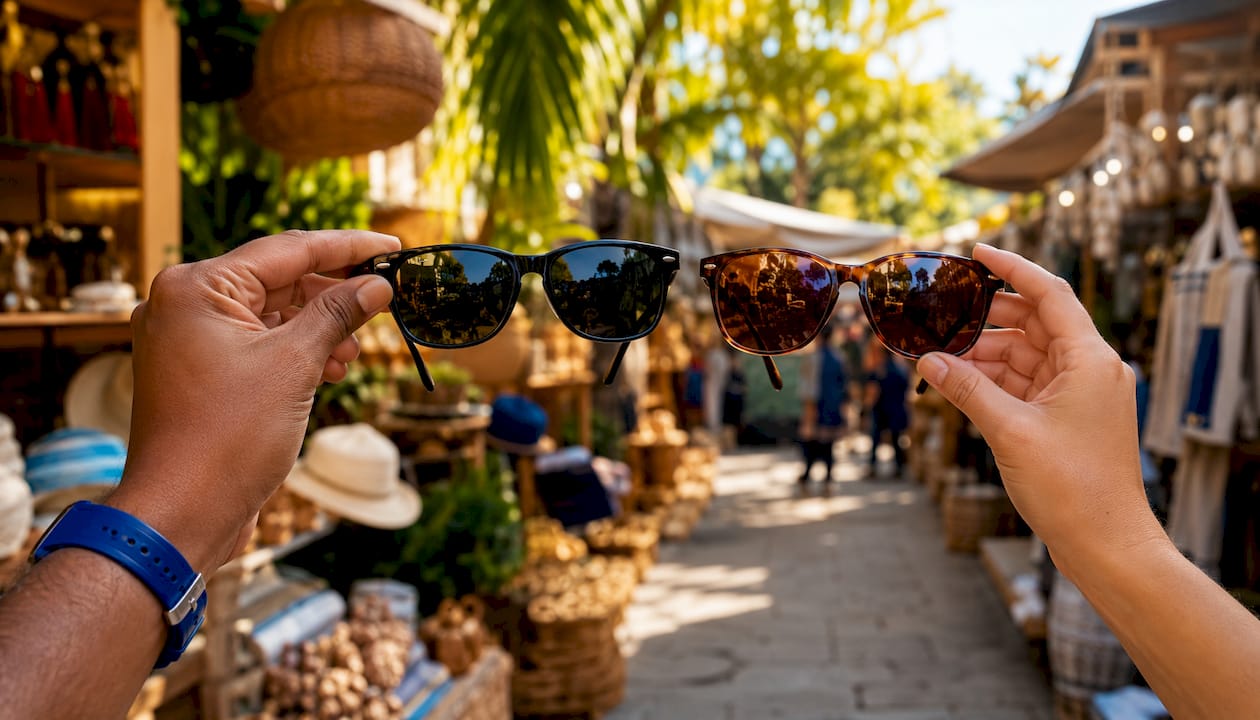
- Tint color affects what you see, not how protected you are: Brown and amber tints tend to boost contrast in variable light. Gray tints preserve more natural color balance. Green tints reduce glare while maintaining color accuracy. None of these tint choices determine UV protection level.
- Backside UV coatings matter in reflective environments: UV rays can reflect off the inner surface of a lens back toward the eye. Lenses with backside UV protection address this, and it’s a feature worth specifying if you spend time near water or snow.
Statistic callout: UV400 is the gold standard for sunglass protection, blocking 99–100% of UVA and UVB rays. The label “UV400” or “100% UV protection” is the only reliable indicator of safe UV filtering, regardless of lens color or darkness.
For buyers who want to understand how UV protection standards apply across price points, Chapeleyewear’s article on affordable protective sunglasses breaks down what to look for without overspending. And if you’re curious how color enhancement compares to other lens technologies like photochromic options, the photochromic sunglasses guide covers the tradeoffs clearly.
Streetwear and outdoor fashion brands are also starting to take lens technology seriously. A recent roundup of premium streetwear eyewear alternatives highlights how color-enhancing and high-contrast lenses are showing up in style-forward collections, not just performance gear.
Key Takeaways
Color enhancing sunglasses use selective wavelength filtering to boost color saturation and contrast, but UV400 certification is the non-negotiable baseline that determines whether a pair is actually safe to wear outdoors.
| Point | Details |
|---|---|
| How the lenses work | Selective wavelength filtering boosts red, green, and blue light to increase color saturation and contrast outdoors. |
| UV400 is the safety standard | Look for UV400 or 100% UV labeling; lens darkness alone does not indicate UV protection. |
| Polarization adds glare control | Polarized color lenses reduce reflected glare while enhancing depth perception for sports and water use. |
| Match lens to activity | Technologies like Oakley Prizm and Knockterra+ are tuned for specific environments; choose based on where you spend time. |
| Not for color vision deficiency | Lenses like EnChroma SuperX enhance color for normal vision; they are not designed to correct color blindness. |