

Hydrophobic Lens Coating: What Eyewear Buyers Need to Know
A hydrophobic lens coating is a thin water-repellent surface layer that causes water droplets to bead up and roll off the lens rather than spread across it. For sunglasses, sport goggles, and camera optics exposed to rain or spray, that single property translates directly to clearer vision and less time wiping your lenses mid-activity.
The quick verdict:
- Hydrophobic coatings are the right choice for sunglasses, cycling, boating, fishing, and any outdoor use where rain or spray is the main enemy.
- They are less useful when your priority is preventing fog in humid, mask-adjacent, or steam-heavy environments. That job belongs to hydrophilic anti-fog coatings.
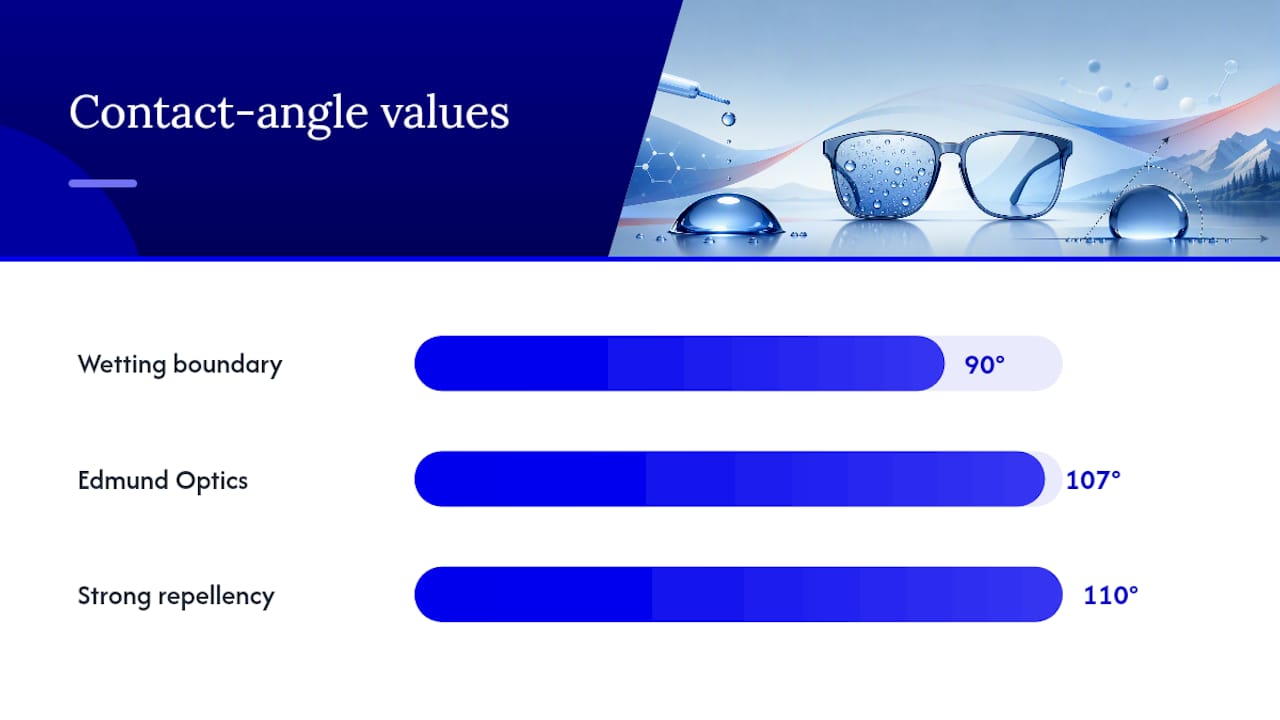
- Performance is measured by contact angle. Edmund Optics reports that their TECHSPEC hydrophobic windows produce contact angles above 107° even after mild abrasion, a reliable benchmark for strong repellency.
- Chapeleyewear applies water-repellent treatments across its sport and designer polarized collections, where wet-weather clarity is a genuine performance need.
Key Takeaways
A hydrophobic lens coating repels water by raising the contact angle above 90°, causing droplets to bead and roll off rather than spread, which is the single most important thing to understand before buying or recoating.
| Point | Details |
|---|---|
| Contact angle is the key metric | Coatings producing angles above 110° offer strong repellency; above 107° is documented even post-abrasion. |
| Hydrophobic vs. hydrophilic | Choose hydrophobic for rain and spray; choose hydrophilic anti-fog for humid, mask-adjacent, or steam environments. |
| Coatings degrade with abrasion | Clean with microfiber and lens-safe solution; avoid alcohol, acetone, and dry-wiping grit across the surface. |
| Factory beats aftermarket | Vacuum-deposited factory coatings outlast consumer sprays by months to years; professional recoating runs $30–$80. |
| Chapeleyewear’s coated collections | The sport polarized and designer polarized lines offer factory-applied water-repellent treatments for active outdoor use. |
Table of Contents
- How does a hydrophobic lens coating actually work?
- Hydrophobic vs. hydrophilic: which coating fits your situation?
- How long do hydrophobic coatings last, and how do you care for them?
- Factory coatings vs. aftermarket options: what are your choices?
- How is hydrophobic performance measured objectively?
- Environmental and safety considerations
- Types of hydrophobic coatings on the market
- How to get your lenses coated or recoated
- What are the real trade-offs of hydrophobic coatings?
- A practical take on hydrophobic coatings
- Chapeleyewear’s lens coating options for outdoor and sport use
- Sources
How does a hydrophobic lens coating actually work?
The physics comes down to two things: surface energy and surface structure. Water sticks to a surface when that surface has high energy. Hydrophobic coatings work by depositing an ultra-thin layer of low-surface-energy material, typically an organosilane, siloxane, or fluorinated compound, that repels water molecules rather than attracting them.
The result is measured as a contact angle: the angle a water droplet forms where it meets the lens surface. A flat puddle on an uncoated lens has a contact angle below 90°. A tight, nearly spherical bead on a well-coated lens sits above 90°, and strong hydrophobic treatments push that number past 110°. The higher the angle, the less the droplet wets the surface and the more easily it rolls off.
Surface texture amplifies this effect. At the micro and nano scale, a roughened surface reduces the actual contact area between water and the lens, which pushes the contact angle higher. This is the same principle behind the lotus leaf, whose microscopic surface bumps give it a contact angle above 150°. Eyeglass coatings don’t reach superhydrophobic territory, but engineered surface chemistry gets them well into the functional repellency range.
Common chemistries used on eyeglass lenses:
- Organosilanes and siloxanes: The most widely used class. They bond well to glass and polycarbonate and produce reliable contact angles in the 100–115° range.
- Fluorinated coatings: Fluorine’s extremely low surface energy produces strong repellency and low sliding angles, meaning droplets move off the lens with minimal tilt. The tradeoff is environmental: many fluorinated compounds fall under PFAS regulations, which are tightening across the US and EU.
- Fluorine-free alternatives: Canon Optron’s OR-510 is one documented example of a fluorine-free water-repellent coating deposited by vacuum evaporation that reports competitive contact-angle and sliding-angle results alongside post-wear measurements. This matters for buyers who want repellency without PFAS chemistry.
Factory coatings are almost never applied alone. A US patent describing multilayer lens stacks details how a hydrophobic organic silane topcoat is deposited over a hard coat and AR layers, with the combination yielding both low reflectance and improved abrasion resistance. The hard coat protects the lens substrate; the AR layers cut glare; the hydrophobic topcoat sits on the outside and handles water and oils.
Pro Tip: Contact angle is an engineered target, not a fixed property. Manufacturers design coatings to hit specific angles and report both static and post-abrasion values. When comparing products, ask for post-abrasion contact-angle data, not just the fresh-coating number, because that’s the figure that predicts real-world longevity.
Hydrophobic vs. hydrophilic: which coating fits your situation?
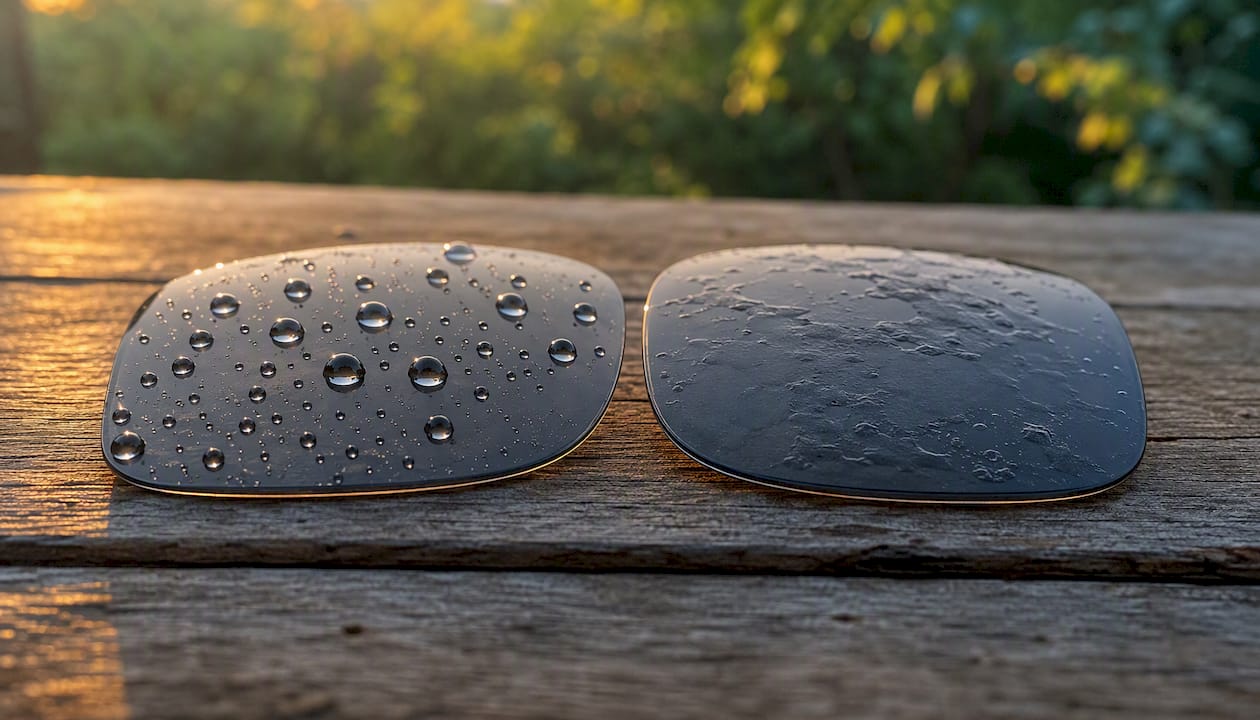
Hydromer explains the core difference clearly: hydrophobic coatings repel moisture so droplets bead and roll off, while hydrophilic coatings attract moisture and spread it into a thin, transparent film that prevents fogging.
Neither approach is universally better. They solve different problems.
| Feature | Hydrophobic | Hydrophilic (anti-fog) |
|---|---|---|
| Effect on droplets | Beads and rolls off | Spreads into thin transparent film |
| Best environments | Rain, spray, outdoor activity | Humid interiors, mask use, steam |
| Cleaning behavior | Oils and water wipe off easily | Requires gentle care; wiping can disrupt film |
| AR coating compatibility | Excellent; standard in multilayer stacks | Varies; some formulations conflict with AR |
| Durability | Degrades with abrasion and solvent exposure | Can be disrupted by aggressive cleaning |
When to choose hydrophobic:
- Sunglasses worn in rain, on the water, or during cycling and running
- Camera lenses and sport optics exposed to spray
- Any situation where you want fingerprints and oils to wipe off quickly
When to choose hydrophilic anti-fog:
- Safety goggles or ski goggles where fogging is the primary hazard
- Eyewear worn with a face mask
- Indoor environments with high humidity or rapid temperature changes
For most outdoor sunglasses wearers, hydrophobic is the right default. Anti-fog coatings are purpose-built for enclosed or humid conditions where water vapor, not liquid water, is the problem.
How long do hydrophobic coatings last, and how do you care for them?
Factory-applied hydrophobic coatings on quality sunglasses typically hold their performance for one to three years under normal use, though heavy outdoor exposure, frequent cleaning, or contact with solvents shortens that range. The coating doesn’t disappear all at once. It degrades gradually as abrasion removes the thin surface layer and as oils, sunscreen, and environmental contaminants foul the surface chemistry.
Edmund Optics notes that contact-angle measurements can shift measurably after even mild abrasion, which is why cleaning technique matters as much as the coating itself.
Stat to know: Edmund Optics’ TECHSPEC hydrophobic windows maintain contact angles within the strong repellency range after mild abrasion, illustrating that well-engineered coatings retain meaningful repellency through normal wear, but that the margin narrows with each cleaning cycle.
Cleaning steps that preserve the coating:
- Use a lens-safe spray cleaner or a drop of dish soap diluted in water. Avoid alcohol-based cleaners and acetone.
- Wipe with a clean microfiber cloth using light, circular strokes. Never use paper towels, shirt fabric, or tissues.
- Rinse with lukewarm water before wiping to float off grit that would otherwise scratch the surface.
- Pat dry rather than rubbing aggressively.
Signs the coating needs reapplication:
- Water no longer beads. It sheets across the lens instead.
- Fingerprints smear and don’t wipe off cleanly.
- The lens surface looks hazy or streaky even after cleaning.
Pro Tip: Test coating performance at home by placing a small water droplet on the lens surface. On a healthy hydrophobic coating, the droplet should sit tall and round, with a contact angle that visibly exceeds 90°. If it flattens and spreads, the coating has degraded past its useful range.
Factory coatings vs. aftermarket options: what are your choices?
Factory vacuum deposition
The most durable hydrophobic treatments are applied during lens manufacturing using vacuum deposition or organosilane vapor processes. The coating bonds at a molecular level to the hard coat beneath it, producing the multilayer AR + hard coat + hydrophobic stack described in the patent literature. Optical quality is highest here because the process is controlled and the layers are engineered to work together.
Aftermarket sprays and wipes
Consumer spray and wipe products are widely available and cost a few dollars per application. They deposit a thin hydrophobic film on the lens surface, and most produce a measurable improvement in water beading. The tradeoff is durability: these films sit on top of the existing coating rather than bonding into it, and they typically last days to a few weeks under regular use before needing reapplication. They’re a reasonable short-term fix or a way to refresh a fading factory coating.
Professional recoating services
Some optical labs and specialty coating services offer professional recoating using vacuum deposition equipment. This produces results closer to factory quality than consumer sprays. Cost varies, but professional recoating generally runs in the range of $30–$80 depending on lens type and the service provider, though prices are not standardized across the industry.
Decision factors:
- Lens material: Polycarbonate lenses (standard in sport and impact-resistant eyewear) accept hydrophobic coatings well. High-index glass requires chemistry matched to the substrate.
- Existing layers: If the hard coat is scratched or the AR layer is compromised, recoating the hydrophobic layer won’t restore optical clarity.
- Warranty: Aftermarket recoating may void manufacturer warranties. Check before proceeding.
- Frame condition: Professional recoating sometimes requires lens removal, which adds complexity for rimless or semi-rimless frames.
For high-performance eyewear used in demanding outdoor conditions, starting with a quality factory-coated lens is almost always the better investment than trying to retrofit a consumer spray onto a basic lens.
How is hydrophobic performance measured objectively?
Three metrics matter most when evaluating a water-repellent lens coating in a lab or technical spec sheet.
Contact angle is the primary metric. It measures how a droplet sits on the surface. Above 90° indicates repellency; above 110° indicates strong repellency. Edmund Optics documents contact angles above 107° for their coated optics even post-abrasion.
Contact-angle hysteresis is the difference between the advancing contact angle (as a droplet expands) and the receding contact angle (as it contracts). A low hysteresis means the droplet moves easily across the surface. High hysteresis means the droplet sticks even if the static contact angle looks impressive. Two coatings with identical static angles can behave very differently in rain if their hysteresis values differ.
Sliding angle measures the tilt required to make a droplet roll off the surface. A coating with a 5° sliding angle sheds water almost immediately; one requiring 30° of tilt will hold droplets in place during most real-world conditions.
The t50p metric comes from contact-lens wettability research. A dewetting study published on arXiv defines t50p as the time required for 50% of a lens surface to dewet, and shows that t50p scales with the product of receding contact angle and contact-angle hysteresis. Lower hysteresis and higher receding angle both accelerate dewetting, which is exactly what you want from a water-repellent surface.
| Contact angle range | Practical meaning |
|---|---|
| Below 90° | Surface wets; water spreads |
| 90°–110° | Moderate repellency; droplets bead but may stick |
| Above 110° | Strong repellency; droplets bead and roll off readily |
Stat to know: OphirOpt’s AquaShieldIR hydrophobic coating for maritime IR optics is tested to MIL-STD-810 and salt-fog chamber standards, illustrating that the most demanding hydrophobic applications are validated against military durability benchmarks, not just lab contact-angle readings.
Environmental and safety considerations
The main environmental concern with hydrophobic coatings centers on fluorinated chemistry. Many high-performance coatings historically relied on perfluorinated or polyfluoroalkyl compounds, which fall under the PFAS category. PFAS chemicals are persistent in the environment and in human tissue, and US regulatory attention on this class of compounds has increased significantly. The EPA has been tightening PFAS rules, and several states have enacted their own restrictions.
For consumers, the practical implication is worth knowing: fluorinated lens coatings on eyewear represent a small total volume of PFAS compared to industrial uses, but the trend in the optics industry is toward fluorine-free alternatives. Canon Optron’s OR-510 is one documented example of a fluorine-free vacuum-deposited coating that achieves competitive water-repellent performance without PFAS chemistry. Buyers who want to avoid fluorinated compounds can ask manufacturers directly whether their coatings use fluorine-free formulations.
Application safety is less of a concern for factory-applied coatings, since vacuum deposition happens in controlled industrial environments. Consumer spray products warrant more attention: aerosol hydrophobic sprays should be used in ventilated spaces, kept away from eyes during application, and allowed to cure before the eyewear is worn. Most consumer products are safe when used as directed, but the instructions on the label are there for a reason.
Types of hydrophobic coatings on the market
The market broadly divides into three tiers, each with different chemistry, application method, and performance profile.
Factory multilayer coatings are the standard on quality sunglasses and prescription lenses. These are organosilane or siloxane-based topcoats deposited over AR and hard coat layers during manufacturing. They produce the most consistent optical quality and the longest service life. Most premium sunglasses brands, including Chapeleyewear’s sport polarized and designer polarized collections, use factory-applied multilayer stacks.
Fluorinated coatings offer the lowest sliding angles and the strongest initial repellency. They’re common in high-end camera lenses, military optics, and specialty eyewear. The AquaShieldIR coating from Ophir is an example of a fluorinated system engineered for maritime and naval IR optics, tested to MIL-STD-810. For consumer eyewear, fluorinated coatings are effective but increasingly being phased toward fluorine-free alternatives due to PFAS concerns.
Fluorine-free coatings are the emerging standard for environmentally conscious manufacturers. Canon Optron’s OR-510 demonstrates that vacuum-deposited fluorine-free coatings can match fluorinated performance on contact-angle and sliding-angle metrics while avoiding PFAS chemistry. Expect this category to grow as regulatory pressure increases.
Consumer aftermarket products (sprays, wipes, and pen applicators) sit at the accessible end of the market. Brands like Rain-X have long offered automotive glass treatments that some users apply to eyewear, though these are not formulated specifically for optical coatings. Dedicated eyewear spray products are available from optical retailers and online. Performance is real but temporary.
How to get your lenses coated or recoated
Step 1: Assess your current lenses. Check whether your lenses already have a hydrophobic coating by doing the water-droplet test described above. Also inspect for scratches in the hard coat or AR layer. If the underlying layers are compromised, recoating the hydrophobic surface won’t restore full performance.
Step 2: Decide between new lenses and recoating. If your lenses are scratched, optically distorted, or more than a few years old, buying new lenses with a factory coating is usually the better value. If the lenses are in good shape and the coating has simply worn off, recoating is worth considering.
Step 3: Choose your recoating route.
- Consumer spray: Apply at home for $5–$20. Expect weeks of performance, not months.
- In-store optical service: Some optical retailers offer lens cleaning and coating refresh services. Ask specifically whether they use vacuum deposition or a topical spray, since the answer determines durability.
- Professional optical lab: Labs that offer vacuum deposition recoating produce factory-quality results. Expect to pay in the $30–$80 range and to wait several days for turnaround.
Step 4: Verify compatibility. Confirm the coating chemistry is compatible with your lens material (polycarbonate, high-index, glass) and that the service won’t void any existing warranty.
Step 5: Maintain the new coating. Follow the cleaning protocol above from day one. The first few weeks of a new coating are when cleaning habits matter most, since the surface layer is still reaching full cure.
For new sunglasses with factory coatings already in place, browsing Chapeleyewear’s photochromic and sport collections gives a sense of how hydrophobic treatments integrate with other lens technologies.
What are the real trade-offs of hydrophobic coatings?
Hydrophobic coatings are genuinely useful, but they come with trade-offs worth knowing before you buy.
Scratch resistance: The hydrophobic topcoat is the outermost layer and the first thing that contacts abrasives. It’s thinner than the hard coat beneath it, so it wears faster. A lens with a hydrophobic coating is not more scratch-resistant than one without. In some multilayer stacks, the hydrophobic layer can actually reduce the effective hardness of the outermost surface slightly, though a well-engineered hard coat underneath compensates for this.
Optical clarity: A properly applied factory coating has negligible impact on optical clarity. Poorly applied aftermarket sprays can introduce haze, uneven thickness, or interference patterns that degrade vision. This is the strongest argument for factory coatings over consumer sprays on prescription or high-quality optical lenses.
Cost: Factory hydrophobic coatings add cost to lenses, typically bundled into premium lens packages rather than priced separately. Professional recoating adds $30–$80 per pair. Consumer sprays are cheap but require frequent reapplication, so the cost-per-month of maintaining repellency with sprays can approach or exceed the cost of a quality factory coating amortized over its lifespan.
Anti-fog limitation: A hydrophobic coating does nothing to prevent fogging. In cold weather, moving from a cold exterior to a warm interior, or wearing a face mask, a hydrophobic lens will fog just as readily as an uncoated one. If fogging is your primary problem, a hydrophilic anti-fog coating is the right tool.
Solvent sensitivity: Many hydrophobic coatings are damaged by alcohol, acetone, and harsh cleaning agents. This is a practical limitation for anyone who reaches for hand sanitizer to clean their glasses.
A practical take on hydrophobic coatings
The conversation around lens coatings tends to get pulled toward contact-angle numbers and chemistry debates, which is useful for engineers but misses what most eyewear buyers actually need to know.
Here’s the honest version: a hydrophobic coating on a quality pair of sunglasses makes a real, noticeable difference in wet conditions. Rain beads off instead of smearing. Fingerprints wipe clean in one pass. You spend less time fussing with your lenses and more time seeing clearly. That’s the practical payoff, and it’s worth having.
What gets oversold is durability. Consumer spray products are not a substitute for factory coatings, and even factory coatings degrade. The cleaning habits you build in the first year of owning a pair of coated sunglasses determine whether the coating lasts one year or three. Harsh solvents, paper towels, and dry-wiping grit across the lens are the three fastest ways to destroy a coating that cost real money to put there.
The hydrophobic vs. hydrophilic question is also worth taking seriously rather than defaulting to “get both.” They solve different problems. If you’re buying sunglasses for outdoor and sport use, hydrophobic is the right call. If you’re buying safety eyewear or goggles for humid indoor environments, anti-fog is the priority. Trying to get both in one coating is possible but involves compromises in each direction.
At Chapeleyewear, the recommendation for outdoor and sport buyers is consistent: start with a quality factory-coated lens, treat it well, and replace it when the coating shows clear signs of degradation rather than trying to revive it with consumer sprays indefinitely.
Chapeleyewear’s lens coating options for outdoor and sport use
Chapeleyewear builds its sport and designer collections around lenses that are ready for real outdoor conditions, not just fair-weather use. The sport polarized collection pairs impact-resistant polycarbonate lenses with polarization and water-repellent treatments designed for cycling, fishing, and active outdoor wear where rain and spray are routine. The designer polarized line brings the same lens performance into styles built for everyday outdoor use.

Every pair ships with UV protection and lenses engineered to handle the conditions where sunglasses actually get used. If you’re replacing a pair with a worn coating or buying your first pair with serious outdoor use in mind, browse the full Chapeleyewear collection to find the right lens and coating combination for your activity. The sport polarized and designer polarized pages are the best starting points for buyers who want water-repellent performance built in from the factory.
Sources
- Hydrophobic Coatings | Edmund Optics
- Hydrophilic anti-fog coating versus hydrophobic lens coatings | Hydromer
- Dewetting characteristics of contact lenses coated with wetting agents (arXiv)
- AquaShieldIR Hydrophobic Coating for Infrared Maritime & Naval Optics | OphirOpt