
Polycarbonate vs Glass: Lenses, Greenhouses, and Safety
For impact resistance and lightweight applications, polycarbonate is usually the better choice. For long-term optical clarity and scratch resistance, glass typically wins. The right call depends on what you’re actually building or buying.
- Safety and eyewear: Polycarbonate is up to 10× more impact-resistant than standard plastic lenses and blocks UV inherently, making it the standard for safety glasses, kids’ eyewear, and sport sunglasses.
- Greenhouses and insulated glazing: Multiwall polycarbonate panels offer better thermal insulation than single-pane glass, weigh far less, and survive hail without shattering.
- Decorative, optical-critical, or long-life applications: Glass holds its clarity for 50+ years without yellowing, resists scratching without coatings, and suits aquariums, tabletops, and display cases where optical perfection matters.
One important exception: scratch-resistant coatings and laminated assemblies can shift the practical choice in either direction. Coated polycarbonate closes much of the scratch gap; laminated glass closes much of the safety gap.
Pro Tip: If you’re choosing between glass and polycarbonate for a project that involves both impact risk and optical clarity (think a storefront skylight or a sport sunglass lens), ask specifically about coated polycarbonate or laminated glass before defaulting to either material alone.
Key takeaways
Polycarbonate is the right material when impact resistance, weight, and UV protection matter most; glass is the right material when long-term optical clarity, scratch resistance, and lifespan are the priority.
| Point | Details |
|---|---|
| Impact resistance gap | Polycarbonate tests at roughly 250× the impact resistance of standard glass in standardized comparisons. |
| Lifespan difference | Glass lasts 50+ years outdoors with minimal degradation; polycarbonate typically needs replacement after 10–20 years. |
| Scratch resistance | Glass resists scratching without coatings; polycarbonate requires an abrasion-resistant hard coat for exposed applications. |
| Total cost of ownership | Polycarbonate’s faster installation and lower breakage rate can reduce 15-year project costs by roughly 25–40% versus glass. |
| Chapeleyewear lenses | Chapeleyewear uses impact-resistant polycarbonate lenses with built-in UV protection across its sunglasses collections. |
Table of Contents
- What polycarbonate and glass actually are
- How polycarbonate vs glass compares across key performance dimensions
- Which material fits your specific application
- Practical fabrication, cutting, and installation guidance
- How to tell polycarbonate from glass in the field
- Downsides and safety considerations for each material
- Material cost, total cost of ownership, and environmental impact
- How to choose: a decision checklist and real-world scenarios
- Why polycarbonate dominates sunglasses and safety eyewear
- A perspective on the polycarbonate vs glass debate
- Chapeleyewear’s polycarbonate sunglasses: built for impact and UV protection
- Sources
What polycarbonate and glass actually are
Polycarbonate is a transparent thermoplastic polymer. It comes in solid sheets, twin-wall panels (two layers with air channels), and multiwall panels (three or more layers). In eyewear, it’s formed into lens blanks. The material is lightweight, flexible enough to cold-bend on site, and naturally absorbs UV radiation.
Glass covers several distinct products:
- Annealed (float) glass: Standard, unstrengthened glass. Breaks into sharp shards.
- Tempered glass: Heat-treated to be roughly 4× stronger than annealed; shatters into small, less dangerous pieces.
- Laminated glass: Two or more panes bonded with a plastic interlayer (usually PVB). Holds together when broken.
- Optical glass: Precision-formulated for lenses; higher refractive index and tighter tolerances than float glass.
In practice, you’ll encounter polycarbonate as 4mm–25mm solid or multiwall sheets, or as 1mm–3mm lens blanks. Glass glazing typically runs 3mm–12mm for single panes, with laminated assemblies reaching 20mm+.
How polycarbonate vs glass compares across key performance dimensions
The numbers below tell most of the story, but the narrative after the table is where the practical trade-offs become clear.
| Dimension | Polycarbonate | Glass |
|---|---|---|
| Impact resistance | ~250× stronger than standard glass in standardized impact tests | Tempered is ~4× annealed; laminated holds together but still cracks |
| Weight / density | ~6× lighter than glass of equivalent thickness | Heavy; requires heavier framing and lifting equipment |
| Optical clarity | Good; slight haze possible over time; lower Abbe value (chromatic aberration risk) | Excellent; high Abbe value; no yellowing for decades |
| UV protection | Inherent UV blocking (100% UV protection in lens form) | Requires UV-blocking coatings or interlayers |
| Scratch resistance | Soft surface; scratches easily without hard coating | Mohs ~6–7; highly scratch-resistant without coatings |
| Thermal insulation | Multiwall panels offer better thermal insulation than single-pane glass | Double-pane IGU typically 1.2–2.0 W/m²K; single pane ~5.8 W/m²K |
| Fire behavior | Combustible; burns with dripping; check local fire codes | Non-combustible; preferred in fire-rated assemblies |
| Material cost | Generally lower per square foot for sheet goods | Varies widely; specialty glass (tempered, laminated) costs more |
| Lifespan (outdoor) | 10–20 years depending on UV-stabilizer quality | 50+ years with minimal optical degradation |
| Fabrication | Cuts with standard woodworking tools; cold-bends on site | Requires scoring/snapping or wet saw; curved glass needs thermal forming |
| Recyclability | Recyclable (resin code 7); less common in municipal programs | Widely recyclable; established cullet markets |
Polycarbonate’s strength advantage is genuinely striking. The roughly 250× impact performance figure comes from standardized drop and ballistic tests, not casual comparisons. That gap is why polycarbonate is standard in safety shields, riot barriers, and performance eyewear. But that same molecular structure that absorbs impact energy is also softer on the surface, which is why abrasion-resistant coatings are strongly recommended for any exposed polycarbonate application.
Glass holds its optical edge over decades. A glass greenhouse pane installed in 1980 still transmits light at nearly the same rate today. A polycarbonate panel from the same year is likely yellowed and hazy unless it had a thick co-extruded UV-stabilizer layer.
Pro Tip: For any polycarbonate installation exposed to direct sunlight, specify panels with a co-extruded UV-protective layer on both sides, not just one. Single-sided UV protection is a common cost-cutting move that cuts panel lifespan roughly in half.
Which material fits your specific application
Eyewear and safety glasses
Polycarbonate is the standard for safety eyewear and most sport sunglasses. It’s lighter, thinner, and up to 10× more impact-resistant than standard plastic lenses, and it blocks UV without any added coating. For children’s glasses, the impact resistance alone makes it the obvious choice.
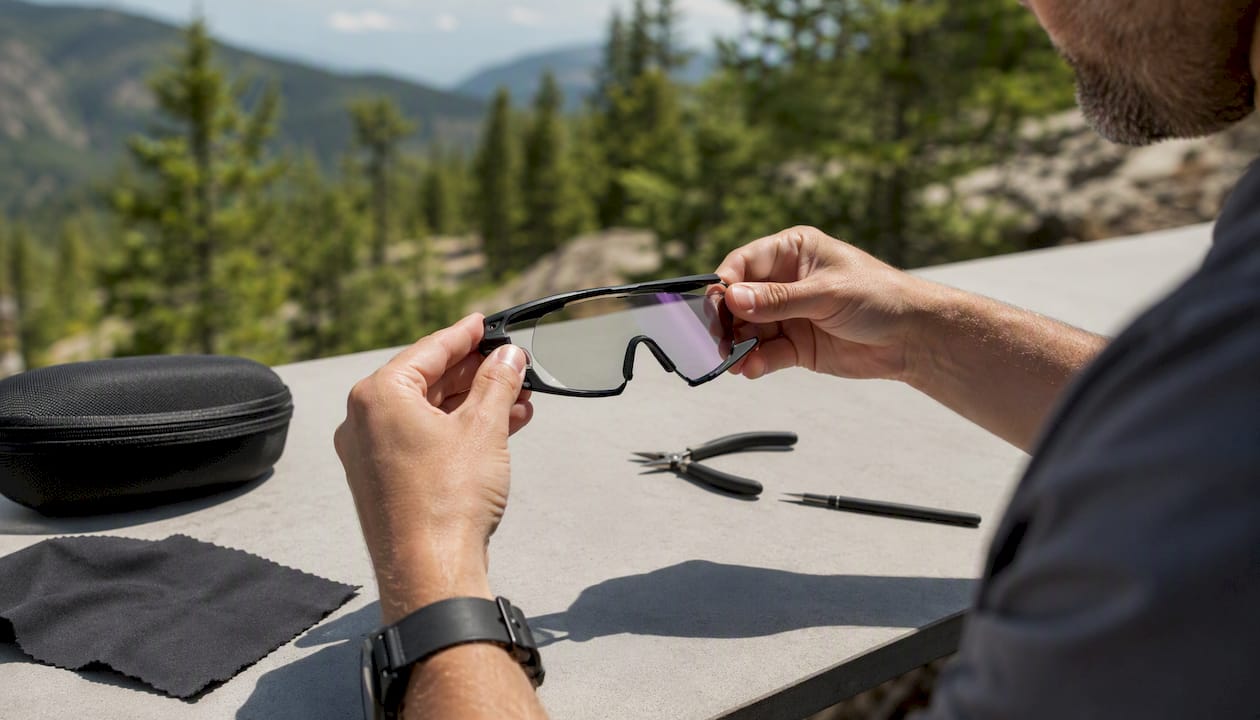
Glass lenses still appear in high-end optical applications where chromatic aberration is unacceptable, or for wearers who prioritize scratch resistance and are willing to accept the weight. High-index glass lenses are thinner than standard glass but still heavier than polycarbonate equivalents.
Greenhouses and conservatories
Multiwall polycarbonate wins for most residential and commercial greenhouses. It diffuses light (reducing plant scorching), blocks harmful UV, and insulates far better than single-pane glass. Installation is faster because panels weigh a fraction of equivalent glass. The trade-off is lifespan: expect 15–20 years from quality polycarbonate versus 40+ from glass.
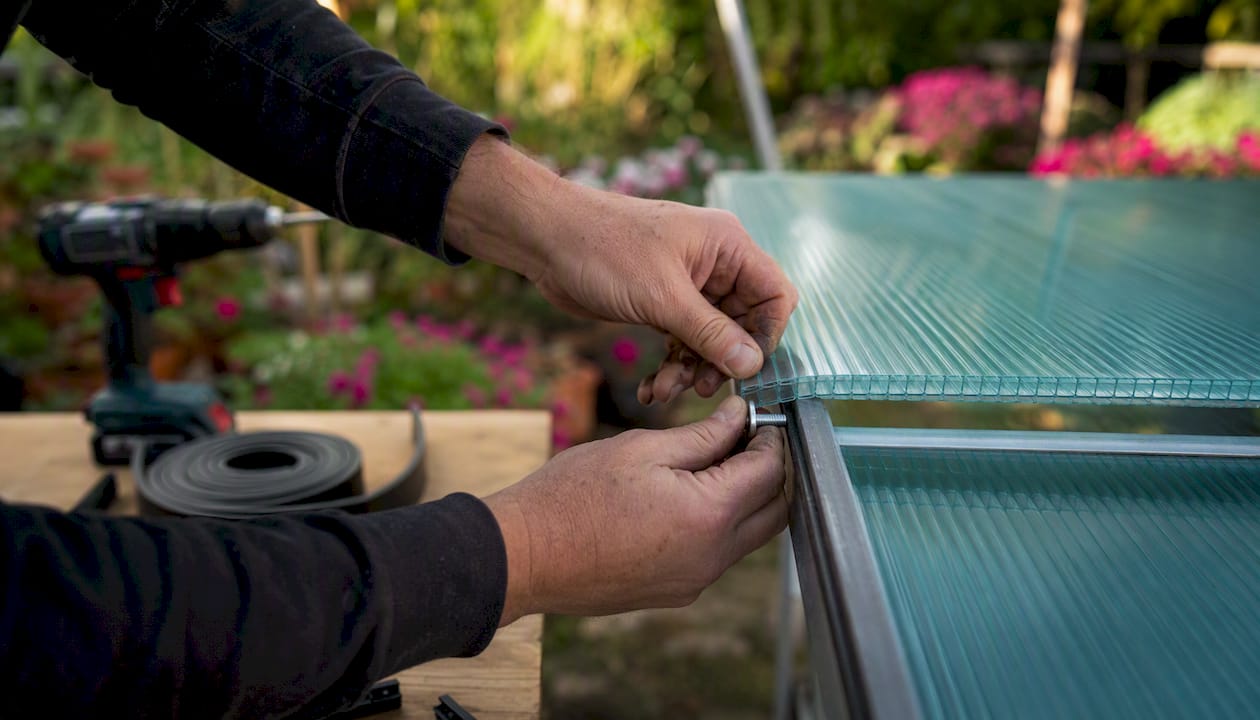
Glass is still chosen for heritage conservatories, botanical gardens where optical clarity matters for visitor experience, or structures where the aesthetic of glass is non-negotiable.
Architectural glazing and skylights
- Hurricane zones and high-impact areas: Polycarbonate or laminated glass; polycarbonate is lighter and easier to install but may not meet all fire codes.
- Skylights: Polycarbonate multiwall is common for residential skylights because of weight and insulation; commercial skylights often use laminated glass for fire rating and longevity.
- Storefronts and facades: Tempered or laminated glass dominates for scratch resistance, clarity, and long-term appearance.
Aquariums and tabletops
Glass is usually the right call here. Scratch resistance matters enormously for aquariums (cleaning equipment will scratch polycarbonate quickly) and tabletops (everyday objects scratch soft surfaces). Glass also maintains optical clarity without yellowing, which is critical when you’re looking through it at fish or a decorative surface underneath.
Polycarbonate makes sense for aquariums only when weight or safety is a primary concern, such as a large tank in a building with floor-load limits, or a children’s touch tank where breakage risk is real.
Practical fabrication, cutting, and installation guidance
Working with polycarbonate
Polycarbonate cuts cleanly with a circular saw, jigsaw, or table saw fitted with a fine-tooth blade. Score-and-snap works for thin sheets. Cold-bending on site is one of polycarbonate’s biggest practical advantages: a 4mm sheet can be curved around a radius without heat, making curved rooflines and barrel-vault skylights feasible without specialty fabrication.
Fasten polycarbonate with pre-drilled oversized holes to allow thermal expansion (polycarbonate expands roughly 3× more than glass per degree of temperature change). Use neoprene or EPDM gaskets, not rigid metal clips, at contact points. Seal cut edges with aluminum tape to prevent moisture and insects from entering multiwall channels.
Never use solvent-based cleaners, acetone, or aromatic solvents on polycarbonate. They cause stress crazing and surface damage. Use mild soap and water or cleaners specifically labeled safe for polycarbonate.
Working with glass
Glass cutting requires a scoring tool and snap, or a wet saw for thicker panes. Curved glass must be thermally formed before installation; there is no field-bending option. Handling requires suction cups, edge protection, and often two people or mechanical lifting for anything over 3mm or larger than about 24"×36".
Heavier framing is non-negotiable. Glass loads transfer directly to the frame, so structural calculations must account for dead load, wind load, and thermal movement.
Coatings for both materials
- Scratch-resistant (abrasion-resistant) coatings: Strongly recommended for polycarbonate in any exposed application. For eyewear, most quality polycarbonate lenses come with a factory-applied hard coat.
- Anti-reflective (AR) coatings: Reduce surface glare on both materials; more impactful on polycarbonate lenses because of polycarbonate’s slightly higher reflectance.
- UV stabilizers: Built into polycarbonate at the molecular level for lenses; for sheet goods, specify co-extruded UV layers rather than surface-applied coatings, which wear off.
Pro Tip: For polycarbonate eyewear, always ask whether the AR coating is applied to both sides of the lens. Single-side AR is common in budget lenses and noticeably less effective at reducing glare in bright conditions.
How to tell polycarbonate from glass in the field
If you’re looking at an installed panel or lens and aren’t sure what material you’re dealing with, these tests work without specialized equipment.
- Weight test. Pick up a loose panel or hold a lens. Polycarbonate is dramatically lighter. A 4mm polycarbonate sheet weighs roughly 0.48 kg/m²; a 4mm glass pane weighs about 10 kg/m². The difference is immediately obvious.
- Flex test. Apply gentle hand pressure to a corner of a loose panel. Polycarbonate flexes noticeably; glass does not flex and will crack if forced. Never flex an installed pane.
- Edge inspection. Glass edges are typically smooth, slightly sharp, and show a faint green or gray tint on thick panes. Polycarbonate edges look more like plastic, sometimes with a slight waxy or matte finish.
- Optical distortion check. Look through the material at a straight line (a door frame, a window mullion). Polycarbonate multiwall panels often show slight diffusion or a faint grid pattern from the internal channels. Glass shows minimal distortion.
- Stamped markings. Safety glass (tempered or laminated) carries a permanent etched or ceramic-printed mark in a corner listing the manufacturer, standard (e.g., ANSI Z97.1 or CPSC 16 CFR 1201), and glass type. Polycarbonate sheet often has a printed or embossed label on the protective film.
- Scratch test (use cautiously). Run a fingernail lightly across a hidden edge. Polycarbonate scratches easily; glass does not. Only do this on an inconspicuous area and never on installed glazing.
Safety note: Do not perform flex or impact tests on installed glazing. If you need to confirm material for a safety-critical application (a hurricane-rated window, a safety barrier), consult the building documentation or a glazing professional.
Downsides and safety considerations for each material
Polycarbonate risks and limitations
- Surface scratching: Polycarbonate is significantly softer than glass. Without an abrasion-resistant coating, it scratches from everyday cleaning. Abrasion-resistant coatings are the standard mitigation, but those coatings have their own lifespan and can delaminate.
- UV coating lifespan: Even with UV stabilizers, outdoor polycarbonate panels yellow and haze over time. Quality varies significantly by manufacturer.
- Chemical sensitivity: Solvents, some cleaning products, and certain adhesives attack polycarbonate, causing crazing or clouding.
- Flammability: Polycarbonate is combustible and may not meet fire-rated glazing requirements. Check local building codes before specifying it in fire-separation assemblies.
- Optical limitations: Lower Abbe value than glass means more chromatic aberration at the lens periphery, which some wearers notice as color fringing.
Glass risks and limitations
- Shattering hazard: Annealed glass breaks into large, sharp shards. Always specify tempered or laminated glass in any application where breakage could injure someone.
- Weight: Glass is heavy. Structural framing, installation equipment, and labor costs all increase with glass weight.
- Thermal shock: Rapid temperature changes can crack glass, particularly annealed glass near heat sources or in cold climates with direct sun exposure.
- Installation risk: Large glass panes are difficult to handle safely without proper equipment and training.
On safety standards: Look for ANSI Z87.1 compliance on safety eyewear lenses (the primary U.S. standard for occupational eye protection), ANSI Z97.1 or CPSC 16 CFR 1201 markings on architectural safety glazing, and ASTM F1233 for security glazing. Tempered glass carries a permanent etched mark; polycarbonate safety shields should carry the manufacturer’s impact rating. If a product claims safety compliance but carries no marking, treat that claim with skepticism.
Material cost, total cost of ownership, and environmental impact
Upfront material costs
Polycarbonate sheet generally costs less per square foot than tempered or laminated glass of comparable thickness. Solid polycarbonate sheet runs roughly $3–$8 per square foot for standard grades; multiwall panels are often in a similar range depending on thickness and UV-layer quality. Tempered glass typically runs $8–$15 per square foot for standard sizes; laminated glass runs higher. Specialty optical glass for lenses is priced differently and not directly comparable to sheet goods.
Total cost of ownership over 10–15 years
- Installation: Polycarbonate installs faster and with less equipment. Manufacturers report installation time reduced by 30–50% for polycarbonate versus glass in comparable glazing projects.
- Replacement frequency: Polycarbonate panels in outdoor applications typically need replacement after 10–20 years. Glass, if unbroken, can last 50+ years with minimal maintenance.
- Energy costs: Multiwall polycarbonate panels outperform single-pane glass on insulation, which reduces heating and cooling costs in greenhouses and conservatories.
- Breakage: Polycarbonate rarely breaks in service; glass replacement after impact events adds unplanned cost.
For many commercial greenhouse and glazing projects, total cost of ownership over 15 years favors polycarbonate by roughly 25–40% when factoring installation, energy, and replacement costs together.
Environmental considerations
- Polycarbonate is recyclable (resin identification code 7) but is not accepted in most curbside programs. It requires industrial recycling. Manufacturing is energy-intensive and involves bisphenol A (BPA) chemistry, which raises some environmental concerns.
- Glass has well-established recycling infrastructure. Cullet (crushed recycled glass) is widely used in new glass production. Glass is inert in landfills and does not off-gas.
For projects where environmental impact is a priority, glass has a clearer recycling pathway. Polycarbonate’s energy savings during use (better insulation) can offset some of its manufacturing footprint over time.
How to choose: a decision checklist and real-world scenarios
Work through these questions before committing to either material.
- Is impact resistance or safety the primary concern? If yes, polycarbonate is the starting point.
- Is long-term optical clarity non-negotiable? If yes, glass (or high-index plastic for lenses) is the better fit.
- What is the budget for installation, not just materials? Polycarbonate installs faster and cheaper; glass requires more labor and equipment.
- How long does the installation need to last without replacement? Glass wins for 30+ year horizons; polycarbonate is practical for 10–20 years.
- Is the application exposed to direct UV and weather? Specify UV-stabilized polycarbonate or UV-coated glass; unprotected polycarbonate degrades quickly outdoors.
- Are there fire code requirements? Glass is non-combustible; polycarbonate may not qualify for fire-rated assemblies.
- Does the project involve curved or complex shapes? Polycarbonate cold-bends on site; curved glass requires factory thermal forming.
- Will the surface be cleaned frequently or exposed to abrasion? Glass resists scratching without coatings; polycarbonate needs a hard coat.
Three quick scenarios
- Kid’s eyewear: Impact resistance and UV protection are the priorities. Polycarbonate lenses with a scratch-resistant hard coat are the standard recommendation. Polycarbonate lenses are up to 10× more impact-resistant than standard plastic, and children’s frames take a beating.
- Commercial greenhouse: Multiwall polycarbonate panels for the roof (insulation, weight, impact), tempered glass for vertical side walls if aesthetics matter. Expect to replace polycarbonate panels after 15–20 years.
- Storefront glazing: Laminated or tempered glass for the long-term clarity, scratch resistance, and fire-code compliance that storefronts require. Polycarbonate is an option only where impact risk is extreme (a security barrier, for example).
For applications that fall between these scenarios, laminated glass and coated polycarbonate are both worth specifying. Laminated glass adds safety without sacrificing optical quality; coated polycarbonate adds scratch resistance without sacrificing impact performance.
Why polycarbonate dominates sunglasses and safety eyewear
The eyewear industry’s preference for polycarbonate isn’t just about cost. Three technical properties drive it.
Impact resistance at thin cross-sections. A common misconception is that thicker lenses are stronger. Polycarbonate’s molecular structure lets thin sheets absorb and distribute impact energy far more effectively than glass of any practical lens thickness. That’s why polycarbonate is the standard for ANSI Z87.1-rated safety eyewear and for sport sunglasses where a flying object or a fall is a real risk.
Inherent UV protection. Polycarbonate absorbs UV radiation at the molecular level, providing 100% UV protection without a separate coating. Glass requires a UV-blocking coating or interlayer to achieve the same protection. For sunglasses, this is a meaningful built-in advantage.
The trade-off is optical: polycarbonate has a lower Abbe value (around 30) compared to standard optical glass (Abbe values of 58–60). A lower Abbe value means more chromatic aberration at the lens periphery, which some wearers notice as slight color fringing when looking off-center. Anti-reflective coatings and careful lens design reduce this effect, but it doesn’t disappear entirely. For most sunglasses wearers, it’s a non-issue. For precision optical work or high-power prescriptions, it’s worth discussing with an optician.
Chapeleyewear’s polycarbonate-lens sunglasses are built around these material strengths: impact resistance, UV protection, and lightweight comfort for active wear. For readers comparing glass vs polycarbonate sunglasses for sport or outdoor use, the material case for polycarbonate is clear.
A perspective on the polycarbonate vs glass debate
The framing of polycarbonate vs glass as a simple competition misses what actually matters in practice: neither material is universally better. The question is always “better for what?”
What frustrates me about most comparisons is that they lead with the impact number (250× stronger!) and then bury the optical trade-off in a footnote. For glazing applications where you’re looking through the material every day, that trade-off is real. A greenhouse grower who switches from glass to polycarbonate and then complains about haze after 12 years didn’t make a bad choice; they made an uninformed one. The haze was predictable from day one.
The same logic applies to eyewear. Polycarbonate is the right lens material for most active and safety applications, full stop. But the lower Abbe value is a genuine optical limitation that some wearers notice, particularly in strong prescriptions. Dismissing that concern doesn’t serve the reader.
The most underrated factor in this whole comparison is coatings. A well-coated polycarbonate lens or panel closes most of the gap with glass on scratch resistance and optical performance. A poorly coated one degrades faster than uncoated glass. Specifying the right coating, from the right manufacturer, with the right maintenance protocol, matters more than the base material choice in many real-world applications.
Chapeleyewear’s polycarbonate sunglasses: built for impact and UV protection
If this comparison has you leaning toward polycarbonate for your next pair of sunglasses, Chapeleyewear makes that decision straightforward. The collections are built around impact-resistant polycarbonate lenses with full UV protection, in styles that move from casual wear to sport performance without looking like safety equipment.
The sport polarized collection is the place to start if you prioritize durability and glare reduction for outdoor activities. For a more fashion-forward option that doesn’t sacrifice lens performance, the designer polarized collection covers that ground. Both lines use polycarbonate lenses that deliver the impact resistance and UV blocking this article covers, in frames designed to actually stay on your face during activity. Browse the full range at Chapeleyewear and check current product pages for warranty and returns details.