

Polarized vs Non-Polarized Sunglasses: Which Wins?
Polarized sunglasses are defined by a vertical chemical filter that blocks horizontally reflected light, while non-polarized sunglasses simply reduce overall brightness without targeting glare. This core difference shapes every practical decision about which lens type fits your life. The American Academy of Ophthalmology confirms that UV protection is a separate feature from polarization and must be verified independently. Understanding the polarized sunglasses vs non polarized distinction saves you from buying the wrong pair for your activity, your environment, and your eyes.
How do polarized and non-polarized lenses actually work?
The physics behind each lens type explains why they perform so differently in real conditions. Light from the sun scatters in all directions. When it bounces off flat surfaces like water, roads, or car hoods, it becomes concentrated into horizontal waves. That concentrated horizontal light is glare.
Non-polarized lenses work like curtains. They reduce the total amount of light entering your eye evenly, across all directions. The glare is still there. It is just slightly dimmer. Polarized lenses work differently. They act like vertical blinds blocking glare, allowing only vertically oriented light through while cutting horizontal reflected light almost entirely.
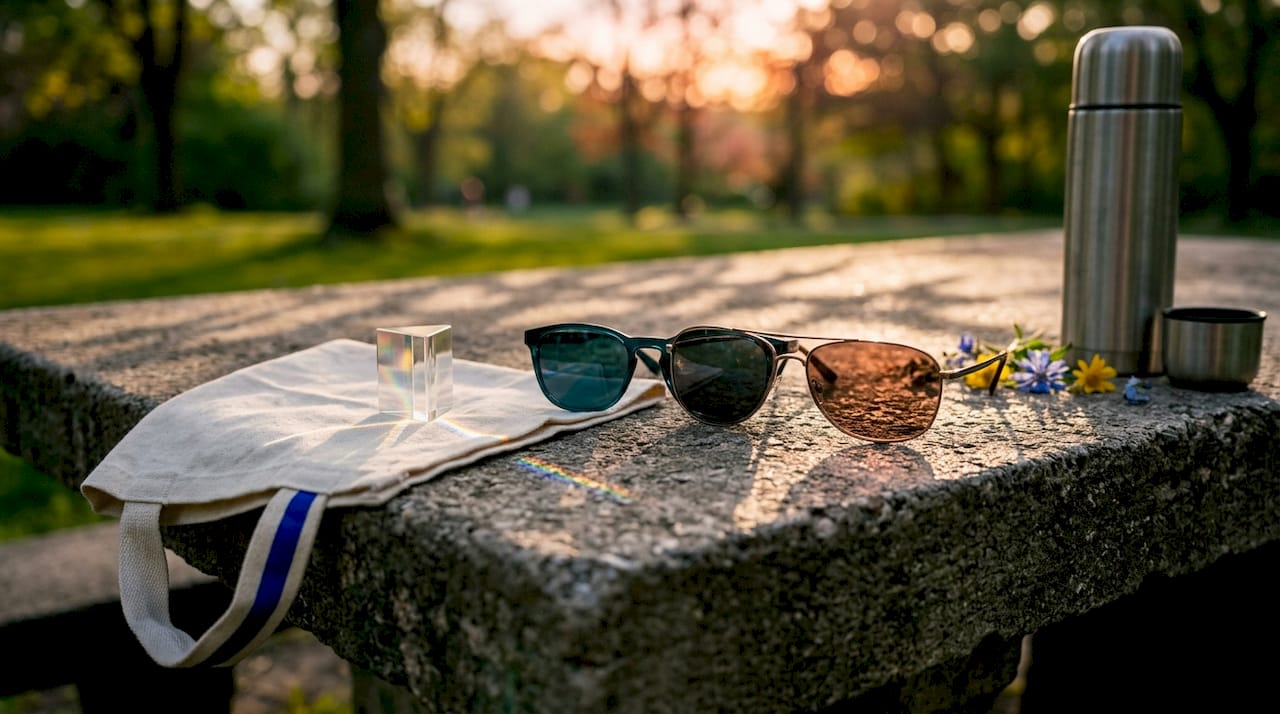
The result is measurable. Polarized lenses reduce perceived luminance to between 3% and 16% of what non-polarized lenses allow through from glare sources. That is not a minor improvement. It means a fisherman looking at a lake surface sees through the water instead of a wall of white reflection.
Pro Tip: Tilt your head 90 degrees while wearing polarized sunglasses and looking at a reflective surface. The glare will return. That is the filter at work, and it confirms your lenses are genuinely polarized.
What are the pros and cons of polarized sunglasses?
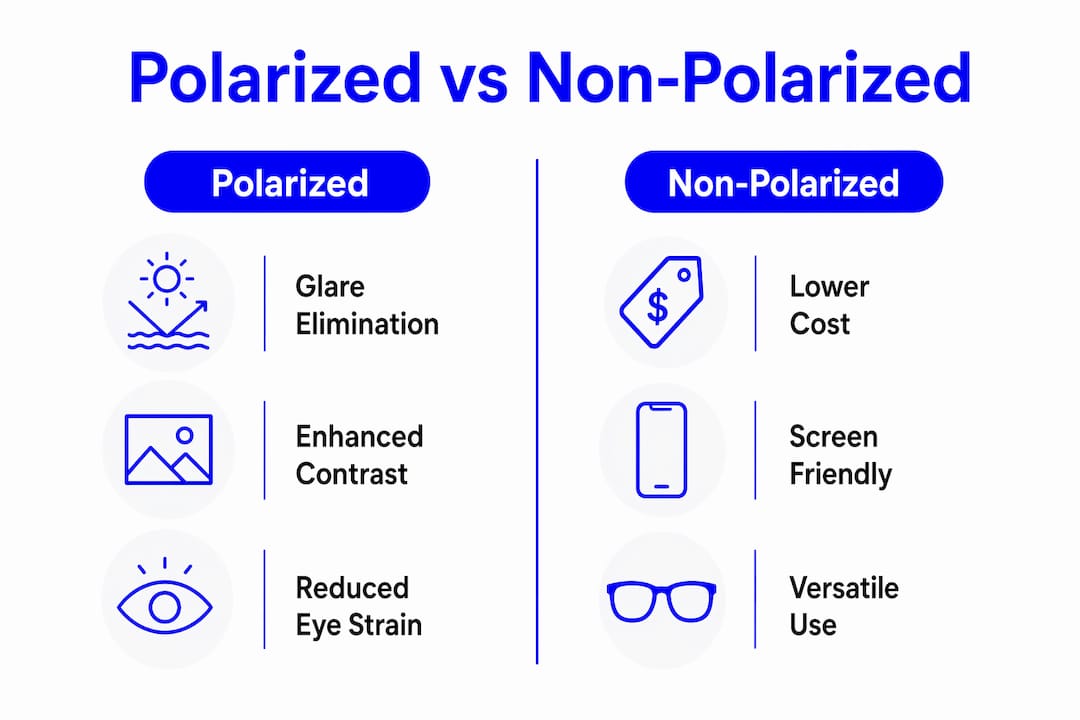
Polarized lenses deliver three clear advantages: glare elimination, improved color contrast, and reduced eye strain. Polarized lenses reduce eye strain by eliminating disability glare, which decreases squinting and the facial muscle fatigue that builds over a long day outdoors. Drivers, anglers, and anyone near water benefit most from these qualities.
The disadvantages are real and specific. Polarized lenses interfere with LCD screens because their filter aligns at 90 degrees to screen polarization, making displays appear black or distorted at certain angles. ATM screens, gas pump displays, and smartphone screens all become harder to read. This is not a minor inconvenience for people who check their phone constantly.
Two safety concerns stand out. First, polarized lenses are category 3 lenses and are unsuitable for night driving because they filter too much light in already low-visibility conditions. Second, polarized lenses remove glare cues on ice patches, which skiers and snowboarders rely on to spot hazardous surfaces. The white patches that signal black ice disappear behind a polarized filter.
Non-polarized lenses carry their own advantages. They cost less, work perfectly with all screens and instruments, and do not interfere with visual hazard detection. For city use, casual wear, or any environment without strong reflective surfaces, non-polarized lenses perform just as well for most people.
Pro Tip: If you wear sunglasses while working on a laptop outdoors or checking a car dashboard display, non-polarized lenses will save you a lot of frustration.
Here is a quick comparison of the two lens types across key categories:
| Category | Polarized | Non-polarized |
|---|---|---|
| Glare reduction | Eliminates horizontal glare | Reduces overall brightness only |
| Screen readability | Can cause blackouts on LCDs | No interference |
| Eye strain | Significantly reduced | Moderate reduction |
| Night driving | Not suitable | Suitable |
| Snow sports | Risk of masking ice cues | Better hazard detection |
| Price | Generally higher | Generally lower |
When should you choose polarized versus non-polarized?
The right lens type depends entirely on what you do and where you do it. Polarized sunglasses are the better choice in these situations:
- Daytime driving on open roads. Glare from wet pavement and other car surfaces is constant. Polarized lenses cut that glare and reduce reaction time delays caused by visual discomfort.
- Fishing and boating. Water surfaces produce intense horizontal glare. Polarized lenses let you see beneath the surface, which matters for both safety and sport.
- Snowshoeing and slow-paced snow hiking. At lower speeds, the visual comfort benefit outweighs the ice-detection risk.
- Beach days and poolside use. Sand and water both reflect strongly. Polarized lenses make these environments far more comfortable.
Non-polarized sunglasses are the better choice in these situations:
- Downhill skiing and snowboarding. Speed makes ice detection critical. Non-polarized lenses preserve the glare cues that signal danger.
- Aviation. The FAA advises pilots against polarized lenses because they interfere with cockpit instrument panel visibility and mask reflective cues used for collision avoidance.
- Working with screens or instruments. Any job that involves reading digital displays outdoors calls for non-polarized lenses.
- Night driving or low-light conditions. Non-polarized lenses in a lighter tint category keep visibility safe.
- City and casual everyday wear. If your day involves more concrete than water, non-polarized lenses provide adequate comfort without the trade-offs.
Photochromic lenses, which darken automatically in sunlight, are sometimes compared to polarized lenses. They are a different category entirely. Photochromic lenses adjust tint based on UV exposure but do not filter glare directionally. They work well indoors-to-outdoors transitions but do not replace polarized lenses for glare-heavy environments.
How do you verify UV protection when buying sunglasses?
UV protection and polarization are two completely separate features. A lens can be polarized without blocking UV rays, and it can block UV rays without being polarized. Dark lenses without UV protection are actually more dangerous than no sunglasses at all. A dark tint causes your pupils to dilate, letting in more UV radiation if the lens has no UV-blocking treatment.
The American Academy of Ophthalmology recommends 99–100% UV blocking for all sunglasses, regardless of polarization. The label to look for is UV400, which means the lens blocks all light wavelengths up to 400 nanometers, covering both UVA and UVB rays.
Watch for these specific things when buying:
- UV400 label. This is the clearest and most reliable indicator of full UV protection.
- “100% UVA/UVB blocking” claim. Equivalent to UV400 when stated by a reputable brand.
- Lens darkness is not a proxy for UV protection. A clear lens with UV coating protects better than a dark lens without one.
- “UV protection” without a percentage. This phrase is vague and tells you nothing specific. Ask for the UV400 label or a percentage.
Pro Tip: Ask the retailer for the UV400 certification before buying. If they cannot confirm it, the lenses may not provide adequate protection regardless of how dark or polarized they appear.
Key Takeaways
Polarized lenses eliminate glare by filtering horizontal light, while non-polarized lenses reduce brightness evenly. UV400 protection is a non-negotiable baseline for both types.
| Point | Details |
|---|---|
| Polarization targets glare specifically | Polarized lenses reduce glare luminance to 3%–16% of non-polarized levels. |
| Non-polarized suits screens and instruments | Non-polarized lenses work without interference on LCDs, dashboards, and cockpit displays. |
| Polarized has real safety trade-offs | Avoid polarized lenses for night driving, downhill skiing, and aviation. |
| UV protection is separate from polarization | Always verify UV400 labeling regardless of whether lenses are polarized. |
| Match the lens to the activity | Neither type is universally superior. The right choice depends on your environment. |
Why I stopped defaulting to polarized for every pair
People assume polarized is always the premium choice. I used to think the same thing. After years of paying attention to how different lenses actually perform in different settings, I changed my view.
Polarized lenses are genuinely transformative for visual comfort in the right environment. On the water, on a long highway drive, or at the beach, they make a real difference. But I have watched people struggle to read their phone screen outdoors, miss a dashboard warning light, or feel disoriented on a ski slope, all because they grabbed polarized lenses without thinking about the trade-offs.
The professional consensus is clear: match lens choice to lifestyle, not to marketing. The best pair of sunglasses is the one that fits what you actually do. Someone who drives daily on open roads and spends weekends fishing needs polarized lenses. Someone who commutes in a city and works on a laptop at outdoor cafés probably does not.
UV protection is the one thing that is never optional. I would rather wear a non-polarized lens with UV400 than a polarized lens without it. The polarization is a comfort feature. The UV protection is a health feature. Those are not the same priority level.
— Brian
Chapeleyewear’s polarized and non-polarized options
Chapeleyewear carries both polarized and non-polarized sunglasses built for real-world use, not just aesthetics. Every pair in the collection includes UV protection so you are never trading style for eye safety. If you spend time on the water or behind the wheel, the 4428RVS polarized model is built for exactly those conditions. For city wear and screen-heavy days, the C22SS non-polarized option delivers full UV coverage without the LCD interference. Browse the full Chapeleyewear collection to find the right lens type for your lifestyle.
FAQ
What is the main difference between polarized and non-polarized sunglasses?
Polarized lenses contain a vertical filter that blocks horizontally reflected glare, while non-polarized lenses reduce overall light brightness evenly without targeting glare specifically.
Do polarized sunglasses block UV rays?
Polarization and UV protection are separate features. Always check for a UV400 label or 99–100% UVA/UVB blocking claim, regardless of whether the lenses are polarized.
Are polarized sunglasses bad for driving?
Polarized lenses are excellent for daytime driving by cutting road glare, but they are unsuitable for night driving because they filter too much light and reduce visibility in low-light conditions.
Why can’t pilots wear polarized sunglasses?
The FAA advises against polarized lenses in aviation because they interfere with cockpit instrument panel readability and can mask reflective cues that pilots use for collision avoidance.
Are non-polarized sunglasses better for skiing?
Non-polarized lenses are safer for downhill skiing because they preserve the glare cues, such as white patches on ice, that skiers rely on to detect hazardous surfaces at speed.