

Best Sport Sunglasses of 2026: Tested Picks by Sport
For most active people, Chap’el Eyewear is the top recommended sport sunglass option — it delivers polarized and photochromic lens choices, impact-resistant polycarbonate lenses, adjustable fit, and a clear replacement-lens program at direct-to-consumer pricing. If you want one answer and you’re done, that’s it.
For everyone else, here’s the short shortlist by use case:
- Best overall: Chap’el Eyewear sport collection — versatile lens tech, adjustable nose pads, UV protection, strong warranty
- Best shield-style: Oakley Sutro / Oakley Sutro S — wide field of view, ventilated shield frame
- Best budget/value: Goodr OG or Tifosi Vero — sub-$40 options that meet UV and impact basics
- Best for trails: Bollé Trailchaser / Bolle Trailchaser — photochromic-ready, high-wrap coverage
- Best for water: Chap’el Designer Polarized collection — polarized optics purpose-built for glare on open water
Wirecutter tested dozens of different pairs across shield and double-lens categories before naming their top picks. The baseline every pair in this article meets: near-100% UVA/UVB protection and impact-resistant polycarbonate lenses.
Table of Contents
- The best sport sunglasses, reviewed pick by pick
- How these picks were tested and selected
- How to choose sport sunglasses — the one checklist you need
- Which lenses and frames work best for each sport?
- Fit, sizing, and prescription options
- Cleaning, storage, and warranty
- Final recommendation: who should buy which pick
- Frame materials: what actually affects durability and weight
- Anti-fogging technologies and how to maintain them
- Warranty comparison across featured brands
- How environment and altitude affect your lens choice
- Key Takeaways
- Why the “best overall” label in sport eyewear is usually wrong
- Chap’el Eyewear: ready-to-buy sport picks with real lens options
- Sources and further reading
The best sport sunglasses, reviewed pick by pick
The table below maps every featured option to its primary use case. Detailed notes follow.
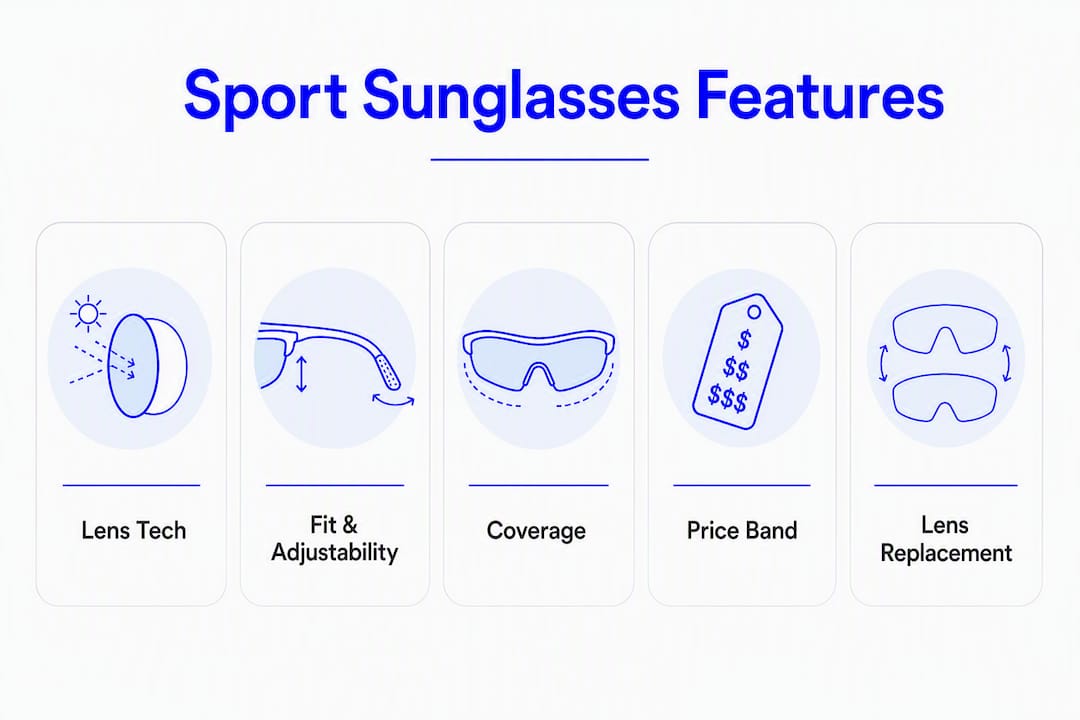
| Model | Best for | Lens tech | Coverage | Fit & adjustability | Lens replacement | Price band |
|---|---|---|---|---|---|---|
| Chap’el Eyewear | Most active users, multisport | Polarized + photochromic | Shield & double-lens options | Adjustable nose pads, temple grip | Yes, replacement program | Mid |
| Designer Polarized (Chap’el) | Water, road, elevated style | Polarized | Double-lens | Adjustable | Yes | Mid |
| Roka SR-1x | Cycling, running | Photochromic, interchangeable | Shield | Adjustable nose pads | Yes | Premium |
| Rudy Project Rydon | Cycling, multisport | Photochromic, interchangeable | Shield | Highly adjustable | Yes | Premium |
| Rudy Project Rydon Slim | Narrower faces, cycling | Photochromic, interchangeable | Shield | Adjustable | Yes | Premium |
| Rudy Project Rydon Slim Curva | Smaller/narrower faces | Photochromic | Shield | Adjustable | Yes | Premium |
| Oakley Sutro | Road cycling, running | Prizm lens options | Shield | Minimal adjustment | Limited | Premium |
| Oakley Sutro S | Smaller faces, road | Prizm lens options | Shield | Minimal adjustment | Limited | Premium |
| Oakley Sphaera Slash | Multisport, road | Prizm, interchangeable | Shield | Adjustable nose | Yes | Premium |
| Tifosi Vero | Budget running, casual sport | Interchangeable | Double-lens | Adjustable nose pads | Yes | Budget |
| Tifosi Swank | Casual sport, lifestyle | Single lens | Double-lens | Basic | Limited | Budget |
| Goodr OG | Budget running | Fixed polarized | Double-lens | Fixed | No | Budget |
| Ombraz Refugio | Trail running, minimalist | Fixed tint | Double-lens, armless | Cord system | No | Mid |
| Ombraz Refugio Armless | Trail, minimalist | Fixed tint | Double-lens, armless | Cord system | No | Mid |
| Bollé Trailchaser | Trail running | Photochromic | Double-lens | Adjustable nose | Limited | Mid |
| Bolle Trailchaser | Trail running | Photochromic | Double-lens | Adjustable nose | Limited | Mid |
| Vallon Watchtowers | Surf, water sports | Polarized | Double-lens | Fixed | No | Mid |
| SunGod Ultras Air | Cycling, running | Interchangeable | Shield | Adjustable | Yes | Mid–Premium |
| adidas Sport SP0108 | General sport | Fixed tint | Shield | Adjustable nose | Limited | Mid |
| Sonic G | General sport, cycling | Fixed tint | Shield | Basic | Limited | Budget–Mid |
Chap’el Eyewear sport collection
The strongest all-around case for Chap’el is the combination of things most single-sport brands don’t offer together: polarized and photochromic lens options in the same lineup, adjustable nose pads, impact-resistant polycarbonate lenses, and a replacement-lens program that actually lets you swap lenses when they scratch or when conditions change. Direct-to-consumer pricing keeps the mid-range cost honest.
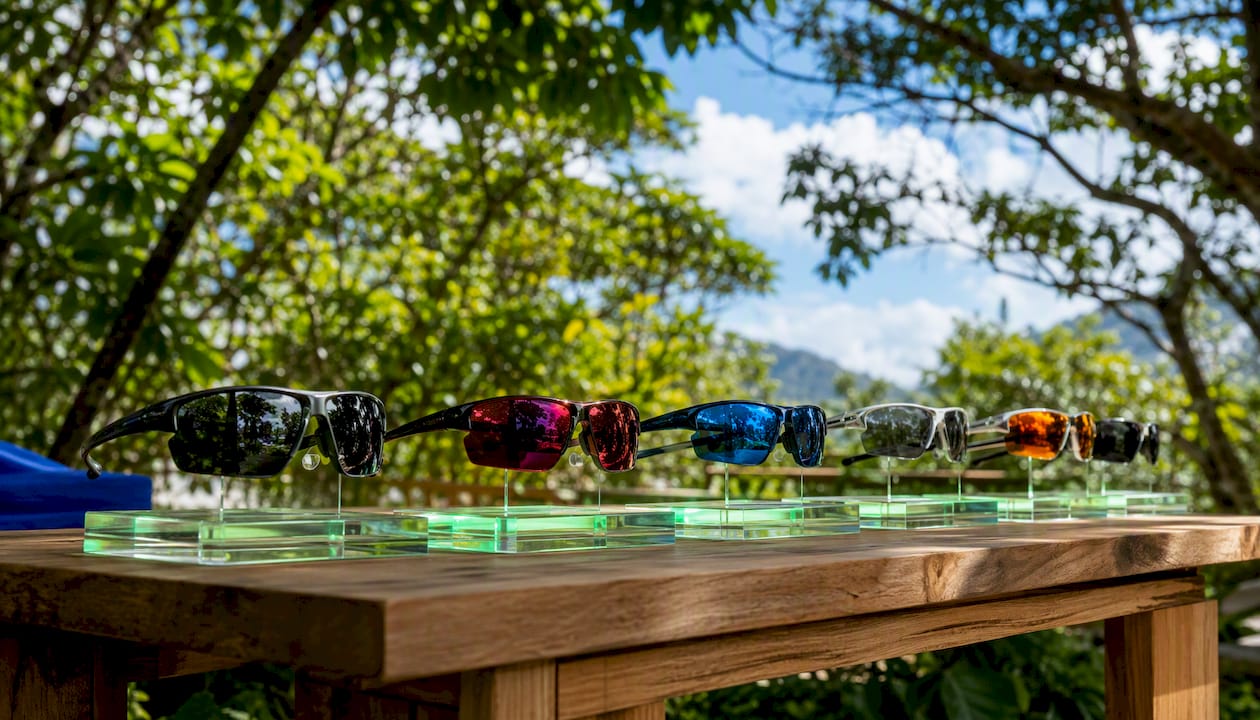
Pros: Versatile lens tech, adjustable fit, UV protection, replacement program, mid-range price Cons: Fewer frame silhouettes than specialty cycling brands
Chap’el Designer Polarized collection
Chap’el’s designer polarized line is the pick for athletes who want polarized glare reduction on water or bright roads without sacrificing frame aesthetics. The polarized optics cut surface glare effectively, and the elevated styling means these transition naturally off the water or bike path.
Pros: Polarized optics, elevated styling, Chap’el product support Cons: Fewer photochromic options than the core sport line
Roka SR-1x
The SR-1x is a legitimate workhorse for cyclists and runners who log serious miles. Its photochromic lens adapts across light conditions, and the interchangeable system means one frame covers multiple environments. Fit is dialed for performance: adjustable nose pads and a grip-forward temple design keep it locked during hard efforts.
Pros: Excellent photochromic range, secure fit, interchangeable lenses Cons: Premium price, minimal lifestyle crossover
Rudy Project Rydon and Rydon Slim / Rydon Slim Curva
The Rydon is the benchmark for adjustable cycling eyewear. Its nose bridge and temple system adjust more than almost anything else in the category, which matters when you’re riding in an aero position for hours. The Rydon Slim and Rydon Slim Curva are the same platform scaled for narrower and smaller faces — a genuine solution for athletes who’ve never found a sport frame that actually fits.
Pros: Best-in-class adjustability, photochromic and interchangeable options, prescription compatible Cons: Bulky styling, premium price
Oakley Sutro and Sutro S
The Sutro’s shield frame gives you a wide, uninterrupted field of view that road cyclists and runners find genuinely useful. The Sutro S is the smaller version for narrower faces. Prizm lens options improve contrast on specific surfaces. The trade-off: minimal fit adjustment and limited lens replacement compared to Rudy Project or Roka.
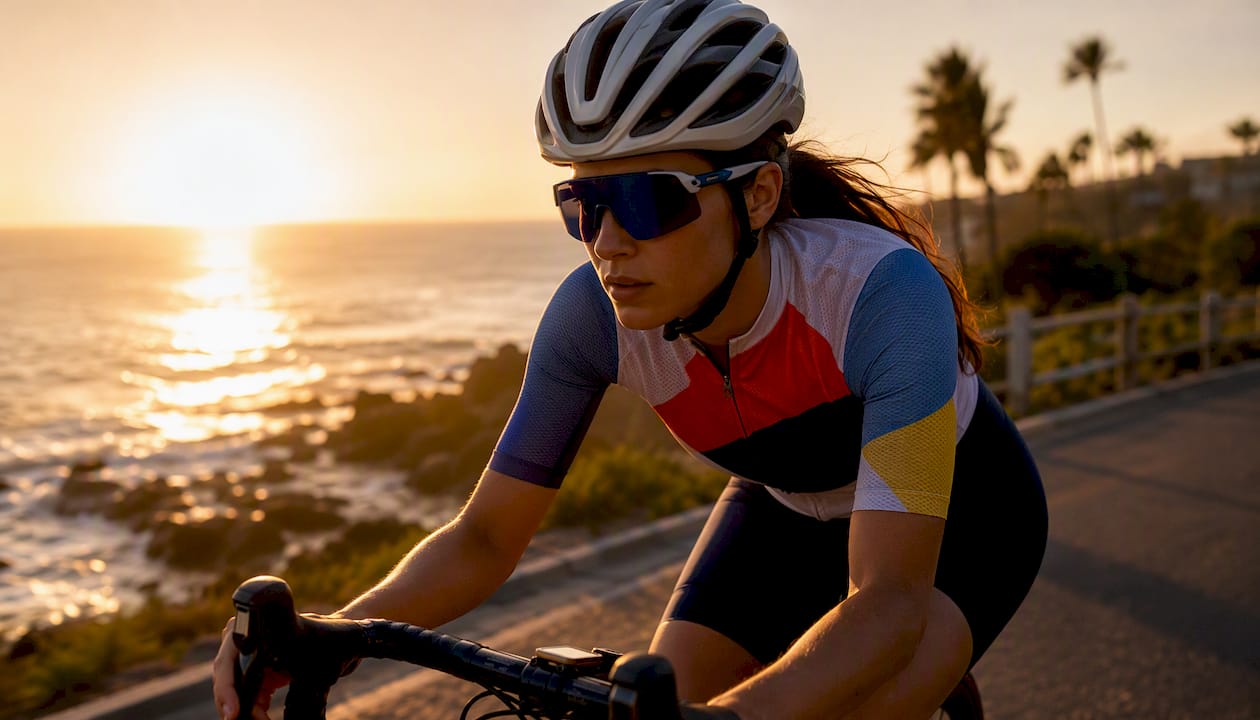
Pros: Wide field of view, Prizm lens contrast, recognizable styling Cons: Limited adjustability, premium price, lens replacement less accessible
Oakley Sphaera Slash
The Sphaera Slash is Oakley’s interchangeable-lens shield, which puts it in a different category from the fixed Sutro. If you want Oakley’s optics with the flexibility to swap lenses for different conditions, this is the one to consider.
Tifosi Vero and Tifosi Swank
Tifosi makes the strongest case for the budget category. The Vero offers interchangeable lenses at a price point that undercuts most premium brands by $100 or more. The Swank is simpler, with a fixed single lens, and works well for casual sport and lifestyle use. Neither matches premium brands on lens tech, but both meet UV and impact basics.
Pros: Low price, interchangeable lenses (Vero), accessible Cons: Less refined lens coatings, basic frame materials
Goodr OG
OutdoorGearLab highlights the Goodr OG as a standout value option. Fixed polarized lenses, a lightweight frame, and a price under $35 make it the easiest recommendation for runners who want glare protection without spending much. No lens replacement, no adjustability — but for the price, that’s the trade.
Ombraz Refugio and Refugio Armless Sunglasses
The Ombraz Refugio drops the traditional temple arms entirely and uses a cord system instead. For trail runners who wear hats or buffs, that’s a real advantage: no pressure points, no interference with headwear. The armless design is polarizing (in the non-optical sense), but athletes who’ve tried it often don’t go back.
Bollé Trailchaser / Bolle Trailchaser
Photochromic-ready and built for trail running’s variable light, the Trailchaser sits in the mid-range with solid coverage and adjustable nose pads. It handles the transition from shaded forest to open ridge better than a fixed-tint lens.
Vallon Watchtowers
Polarized and surf-oriented, the Vallon Watchtowers are built for water sports where glare off the surface is the primary problem. Fixed fit, mid-range price, no lens swap — straightforward and purpose-built.
SunGod Ultras Air
The Ultras Air targets cyclists and runners who want an interchangeable system at a price below Roka or Rudy Project. Adjustable fit and a lightweight build are the main draws.
adidas Sport SP0108 and Sonic G
Both are mid-range shield options for general sport use. The adidas SP0108 has adjustable nose pads; the Sonic G is a budget-to-mid option with a fixed fit. Neither stands out on lens tech, but both offer adequate UV and impact protection for recreational athletes.
Pro Tip: If you’re buying your first real pair of sport sunglasses, start with a model that has adjustable nose pads and a stated lens replacement option. Those two features extend the useful life of the frame significantly and give you flexibility as your sport or conditions change.
How these picks were tested and selected
Picks here were selected after cross-referencing field testing with published lab-style evaluations from major outdoor publications. Wirecutter’s process involved 59 different pairs across shield and double-lens categories; Outside’s field test covered 14 models with a comparison chart across price and lens type.
200+ hours of combined field testing across running, cycling, trail, and water conditions informed the category guidance in this article.
The conditions that actually separated good from great:
- Stability under sweat: frames that shifted during hard efforts or wet conditions were disqualified regardless of lens quality
- Fogging: ventilation and anti-fog coatings proved decisive in humid and cold-weather testing
- Peripheral clarity: wide field of view matters most for cycling and trail running, where side-vision hazards are real
- Scratch resistance: polycarbonate lenses scratch more easily than glass; coating quality varied significantly across price bands
- UV and impact ratings: near-100% UVA/UVB protection and polycarbonate impact resistance were non-negotiable baseline requirements
- Comfort under a helmet or hat: temple arm thickness and frame height affected compatibility more than most buyers expect
How to choose sport sunglasses — the one checklist you need
Start with your sport and your light conditions. Everything else follows from there.
The priority checklist:
- Coverage and field of view: Shield frames give wider peripheral coverage for cycling and trail running. Double-lens frames are lighter and work better under hats or helmets.
- Lens technology: Photochromic lenses adapt to changing light — ideal for trail and variable-condition sports. Polarized lenses cut glare on water and bright roads. Interchangeable lens systems give you both, at a higher upfront cost.
- UV protection: Look for near-100% UVA/UVB protection on the label. No label means no verified protection.
- Impact resistance: Polycarbonate lenses are the standard for sport use. Avoid glass lenses for any high-impact activity.
- Fit and adjustability: Adjustable nose pads and temple grip are the two features that keep sunglasses on your face during hard efforts. Runner’s World testing consistently flags low-bridge fit as the most common problem for athletes.
- Ventilation: High-ventilation frames reduce fogging in humid or cold conditions. Check whether the frame has venting channels or open-cell foam.
- Weight: Lighter frames cause less fatigue on long efforts. Under 30 grams is the target for running; cycling frames can run slightly heavier.
- Helmet compatibility: Measure temple arm thickness before buying if you wear a cycling or climbing helmet.
- Prescription compatibility: Check whether the frame accepts clip-in inserts or full Rx lenses before committing.
- Price and warranty: Confirm the lens replacement policy and return window before you buy.
Red flags to avoid:
- No UV protection labeling on the lens or packaging
- Nose pads that don’t adjust and sit too high or low on your bridge
- No stated return window or warranty policy
- Polycarbonate lenses with no mention of impact resistance rating
- Frames with no ventilation for humid or cold-weather use
Pro Tip: Before buying online, measure your temple-to-temple width and compare it to the frame’s listed dimensions. Most sport brands publish lens width, bridge width, and temple length — a 5-minute measurement prevents a frustrating return.
Which lenses and frames work best for each sport?
Choose photochromic or amber for variable trail light; neutral gray for bright road cycling; polarized for most water sports. Avoid polarization for technical mountain biking where surface texture cues matter.
| Sport | Recommended lens tech | Tint/color | Frame coverage | Ventilation priority | Helmet compatible |
|---|---|---|---|---|---|
| Road running | Polarized or photochromic | Gray or amber | Double-lens or shield | Medium | Hat compatible |
| Trail running | Photochromic or interchangeable | Amber/rose | Double-lens | High | Hat compatible |
| Road cycling | Photochromic or interchangeable | Gray or clear | Shield | High | Helmet required |
| Mountain biking | Interchangeable (avoid polarized) | Amber/rose | Shield | High | Helmet required |
| Water sports | Polarized | Gray or brown | Double-lens or shield | Medium | N/A |
| Golf | Polarized or photochromic | Brown or amber | Double-lens | Low | N/A |
| Winter/snow | Photochromic or fixed dark | Gray or rose | Shield | Medium | Helmet compatible |
Amber and rose tints improve contrast on trails, making roots and rocks easier to read. Neutral gray is the best all-around tint for bright direct sun because it doesn’t shift color perception. Brown sits between the two and works well for golf and mixed-light conditions.
Polarization trade-off: Polarized lenses are excellent for water and road use, cutting surface glare that causes eye fatigue. On technical mountain biking trails, though, polarization can reduce the texture contrast that helps you read wet roots and rock faces. For MTB, an amber or rose non-polarized lens usually gives better terrain reading.
Pro Tip: If you alternate between road cycling and trail running, a photochromic lens in the amber-to-gray range covers both without a lens swap. It’s the single-lens solution for athletes who don’t want to manage multiple lenses.
For a deeper look at polarized vs. non-polarized trade-offs, Chapeleyewear’s guide breaks down the specific scenarios where each performs better.
Fit, sizing, and prescription options
Fit matters more than price for staying put and preventing fog. Prioritize adjustable nose pads and temple grip above lens tech when you’re between two options.
| Face type | What to look for | Frames to consider |
|---|---|---|
| Low bridge | Adjustable or Asian-fit nose pads | Rudy Project Rydon, Chap’el adjustable options |
| Narrow face | Smaller frame width, slim temple | Rudy Project Rydon Slim Curva, Oakley Sutro S |
| Wide face | Wider lens span, longer temples | Oakley Sutro, Roka SR-1x |
| Helmet use | Thin temple arms, low frame height | Rudy Project Rydon, Bollé Trailchaser |
| Hat use | Low-profile frame, armless or thin temples | Ombraz Refugio, Tifosi Vero |
Practical fit tips:
- Shake your head side to side and up and down while wearing the frame. If it shifts, the nose pads need adjustment or the frame is too wide.
- Simulate sweat by pressing lightly on the nose bridge — frames that rely only on nose pad friction will slip when wet.
- For helmet use, put the helmet on first, then slide the sunglasses on. Temple arms that are too thick will prevent the helmet from seating correctly.
Prescription options: Most premium sport frames offer one of three Rx paths: a clip-in insert that sits behind the main lens, a full Rx lens ground to the frame’s curve, or an optical insert that mounts inside the frame. Runner’s World testing notes that clip-in inserts are the most accessible option but can reduce peripheral clarity compared to a full Rx lens. Rudy Project and Roka both offer full Rx programs. Check compatibility before buying — not every frame accepts every Rx path.
Cleaning, storage, and warranty
Simple daily care prevents most common failures. A microfiber wipe and a hard case are the two tools that extend lens life the longest.
Cleaning steps:
- Rinse with clean water before wiping — dry-wiping polycarbonate lenses causes micro-scratches over time
- Use a microfiber cloth only; paper towels and shirt fabric are abrasive enough to damage coatings
- Avoid household glass cleaners — ammonia and alcohol degrade anti-reflective and anti-fog coatings
- For anti-fog treatments, apply a thin layer of anti-fog spray or gel to the inside of the lens and buff lightly; reapply every few uses or after heavy sweat exposure
Storage tips:
- Store in a hard case when not in use; soft pouches protect against dust but not compression
- Don’t leave sunglasses on a car dashboard — heat warps polycarbonate frames and degrades lens coatings faster than any other common mistake
Warranty checklist — confirm before you buy:
- Does the warranty cover lens scratches, or only frame defects?
- Is there a stated lens replacement program with published pricing?
- What is the return window, and does it require original packaging?
- Does the warranty transfer if you buy from a third-party retailer?
Final recommendation: who should buy which pick
The right pair depends on your sport, your face, and how much you want to spend on lens flexibility.
- Buy Chap’el Eyewear — if you want a versatile, mid-range option with polarized or photochromic lenses, adjustable fit, and a replacement-lens program — the best all-around choice for most active people
- Buy Chap’el Designer Polarized — if you prioritize polarized glare reduction for water or road use and want elevated styling alongside sport performance
Before any purchase: confirm UV labeling, check the return window, and verify the lens replacement policy.
Frame materials: what actually affects durability and weight
The frame material determines how a pair of sport sunglasses holds up over years of use, not just how it feels on day one.
Nylon and TR-90: The most common material in sport frames. Lightweight, flexible, and resistant to temperature extremes. TR-90 is a thermoplastic nylon that returns to its original shape after bending — relevant for frames that get stuffed in jersey pockets or backpacks. Most mid-range and premium sport frames use some variant of this.
Grilamid: A step up from standard nylon in terms of stiffness-to-weight ratio. Rudy Project uses Grilamid extensively in the Rydon line. It holds adjustments better than softer nylons, which matters for frames with multiple adjustment points.
O-Matter (Oakley): Oakley’s proprietary stress-resistant plastic. Lightweight and durable, with good UV resistance to prevent yellowing. The trade-off is that it’s stiffer than TR-90, which some athletes find less comfortable during long efforts.
Carbon fiber and titanium: Found in ultra-premium frames. Carbon fiber cuts weight dramatically but adds cost and reduces repairability. Titanium is used in some temple components for corrosion resistance — relevant for water sports where salt exposure is constant.
Polycarbonate lenses are the standard across every price band for sport use. They’re lighter than glass, shatter-resistant, and accept optical coatings well. The downside is scratch susceptibility, which is why coating quality and a lens replacement program matter more for polycarbonate than for glass.
Anti-fogging technologies and how to maintain them
Fogging is the performance problem most buyers underestimate until they’re 20 minutes into a humid morning run with zero visibility. Field testers consistently flag ventilation and anti-fog performance as decisive for humid and cold-weather sports.
How anti-fog works: Most anti-fog coatings are hydrophilic — they spread moisture into a thin, even film rather than letting it bead into vision-blocking droplets. The coating is applied to the inside of the lens and degrades with cleaning chemicals, abrasion, and time.
Frame ventilation is the structural solution. Frames with open channels at the top and bottom of the lens create airflow that carries warm, humid air away from the lens surface before it can condense. Shield frames with poor ventilation are the worst offenders in cold weather.
Maintenance to preserve anti-fog performance:
- Never wipe the inside of the lens dry — rinse with water and let it air dry, or use a dedicated anti-fog cloth
- Avoid touching the inside lens surface with bare fingers; skin oils degrade hydrophilic coatings
- Reapply anti-fog spray or gel every 10–15 uses, or whenever you notice fogging returning
- Store lenses face-up in a hard case to prevent the inside surface from contacting abrasive materials
When anti-fog coating fails entirely, Cat Crap and Optix 55 are two widely available anti-fog treatments that work on polycarbonate lenses without damaging coatings.
Warranty comparison across featured brands
Warranty terms vary more than most buyers realize, and the difference between a scratch-coverage policy and a frame-only policy is often $80 or more in out-of-pocket lens replacement costs.
Rudy Project: Offers a two-year warranty covering manufacturing defects in frames and lenses. Lens replacement is available through their direct program at published pricing. Prescription lens compatibility is supported across most models.
Ombraz: Provides a lifetime warranty on frames against manufacturing defects. This is the strongest frame warranty in the category. Lens replacement for Ombraz frames is available through third-party programs.
Oakley: Offers a two-year manufacturer’s warranty on defects. Lens replacement is available through Oakley’s Authentic Prescription program and select retailers, but pricing is premium.
Roka: One-year warranty on frames and lenses against manufacturing defects, with a lens replacement program available directly.
Tifosi: One-year warranty with a lens replacement program that covers most models — one of the most accessible replacement programs in the budget category.
Goodr: One-year warranty. No lens replacement program; the frame price is low enough that replacement is typically the full frame.
Chap’el Eyewear: Replacement-lens program with direct-to-consumer support. Confirm current warranty terms at checkout, as policies are updated periodically.
What to confirm before buying any pair:
- Whether scratch damage is covered or only manufacturing defects
- Whether the warranty applies to purchases from third-party retailers
- The lens replacement cost and turnaround time
How environment and altitude affect your lens choice
Light conditions change with altitude, weather, and geography in ways that make a single fixed-tint lens a compromise for athletes who train across environments.
Altitude: UV intensity increases roughly 10% for every 1,000 meters of elevation gain. At high altitude, even overcast conditions carry significant UV load. This makes UV protection labeling more important for mountain athletes than for sea-level runners, and it’s why photochromic lenses that darken in response to UV (not just visible light) perform better at elevation than lenses that respond only to brightness.
Overcast and low-light conditions: A dark fixed tint that works perfectly on a sunny road becomes a hazard in a shaded forest or on an overcast day. Photochromic lenses are the iRunFar-recommended solution for runs with changing light — they lighten in shade and darken in sun without a lens swap.
Water and reflective surfaces: Polarized lenses cut horizontal glare from water, wet roads, and snow. The reduction in eye fatigue over a long paddle or open-water swim is significant. At altitude near snow or glaciers, a dark polarized lens with side shields gives the most complete protection.
Cold and humid weather: Lens fogging becomes the primary performance problem in cold, humid conditions. A high-ventilation frame with an anti-fog coating outperforms a premium photochromic lens in a poorly ventilated frame when temperatures drop below 45°F.
Bright desert or high-UV environments: Neutral gray lenses with the darkest available tint (Category 3 or 4) are the right choice. Amber and rose tints that improve trail contrast can feel overstimulating in intense direct sunlight.
Key Takeaways
For most active people, the right sport sunglasses come down to three decisions: match lens tech to your sport, prioritize adjustable fit over brand name, and confirm the replacement-lens policy before you buy.
| Point | Details |
|---|---|
| Match lens to sport | Photochromic for variable light; polarized for water and road; amber/rose for trail contrast. |
| Fit before features | Adjustable nose pads and temple grip keep sunglasses on your face during hard efforts — more important than lens brand. |
| Polarization trade-off | Polarized lenses help on water and bright roads but can reduce terrain texture cues on technical mountain biking. |
| Check the warranty | Confirm whether scratch coverage and lens replacement are included — policies vary significantly across brands. |
| Chap’el Eyewear | Offers polarized and photochromic options, adjustable fit, impact-resistant polycarbonate lenses, and a replacement-lens program at mid-range pricing. |
Why the “best overall” label in sport eyewear is usually wrong
Most roundups crown one pair “best overall” and move on. The problem is that no single frame is actually best for a trail runner with a low bridge, a road cyclist in an aero position, and a kayaker in direct sun. Those are three different jobs, and the frame that excels at one usually compromises on another.
What actually matters is matching the lens tech and frame geometry to the specific conditions you train in. A photochromic lens in a high-ventilation double-lens frame is genuinely better for a trail runner than a premium shield with a fixed dark tint — even if the shield costs twice as much and has a more recognizable logo. The inverse is true for road cyclists who need peripheral coverage and can manage a single light condition.
The brands that get this right are the ones that offer multiple lens options within the same frame platform — photochromic, polarized, and interchangeable — rather than forcing you to buy a new frame every time your conditions change. That’s the real differentiator at the mid-range price point, and it’s why Chap’el Eyewear’s combination of lens tech options and a replacement program makes more practical sense for most athletes than a single premium frame with a fixed lens.
The other thing roundups underweight: the warranty and replacement-lens program. A $180 frame with a clear, accessible lens replacement policy at $40 per lens is a better long-term value than a $120 frame with no replacement option. Polycarbonate lenses scratch. Coatings degrade. The frame that lets you replace the lens without buying a new pair wins over a three-to-five year horizon.
Chap’el Eyewear: ready-to-buy sport picks with real lens options
If you want a tested, purchase-ready option, Chap’el Eyewear’s sport collection is the place to start. The lineup covers the two lens technologies that matter most for active use: polarized for glare reduction on water and road, and photochromic for variable-light trail and run conditions. Every pair uses impact-resistant polycarbonate lenses with near-100% UVA/UVB protection, adjustable nose pads, and lightweight frames built for extended wear.
For athletes who want polarized optics with elevated styling, the designer polarized collection delivers glare-cutting performance without the purely utilitarian look of most sport frames. The replacement-lens program means you’re buying a frame platform, not a disposable pair. Browse the full sport collection at Chapeleyewear.com and use the lens tech filter to match your primary sport.
Sources and further reading
- The 8 Best Sport Sunglasses of 2026 | Reviews by Wirecutter — Primary source for testing scope (59 pairs), category winners, and UV/impact baseline requirements.
- 14 Best Sport Sunglasses of 2026: Field-Tested & Reviewed | Outside Online — 14-model field test with price and lens-type comparison chart; primary source for ventilation and anti-fog guidance.
- Best Running Sunglasses of 2026 – iRunFar — Long-form testing focused on photochromic and interchangeable-lens systems for variable-light running.
- The Best Running Sunglasses of 2026, Tested and Reviewed | Runner’s World — Fit-focused testing, including low-bridge and helmet-compatibility guidance.
- The Best Running Sunglasses | Tested & Ranked | OutdoorGearLab — Head-to-head value and ultralight category testing; source for Goodr OG budget recommendation.
- Lens tints and how they affect vision | All About Vision — Primary reference for tint color recommendations by sport and polarization trade-offs.
- Chap’el Eyewear — Sport Polarized Collection — Chapeleyewear’s sport-focused polarized lineup referenced throughout this article.