


Are Sunglasses FSA Eligible? Use Your FSA for Prescription Shades
Yes, prescription sunglasses are FSA-eligible when a licensed eye doctor prescribes them for vision correction. That single fact, grounded in IRS Publication 502 and confirmed by FSAFEDS for federal employees, is the answer most people are searching for. Over-the-counter sunglasses without a prescription are generally not covered, but the moment a prescription enters the picture, your flexible spending account funds can pay for the frames and lenses.
If you want to act right now:
- Confirm you have a current, valid prescription from your eye doctor.
- Request an itemized receipt from the retailer that lists patient name, date, product description, and price.
- Check your specific plan rules with your FSA administrator before purchasing.
- Pay with your FSA card at checkout, or pay out-of-pocket and submit a reimbursement claim with your receipt and prescription.
Table of Contents
- Are sunglasses FSA eligible? The IRS and FSAFEDS rules explained
- When non-prescription sunglasses might qualify for FSA reimbursement
- What parts of prescription sunglasses are covered by FSA funds
- How to pay at checkout and submit an FSA reimbursement claim
- What your itemized receipt and prescription must include
- How Chap’el Eyewear supports your FSA purchase
- Key Takeaways
- The part most people skip
- Ready to use your FSA on prescription sunglasses from Chap’el?
- Authoritative sources to verify your FSA coverage
Are sunglasses FSA eligible? The IRS and FSAFEDS rules explained
IRS Publication 502 classifies prescription eyewear as a qualified medical expense, and that classification is what makes prescription sunglasses reimbursable through a flexible spending account. The governing test is straightforward: the eyewear must be prescribed for vision correction or a documented medical purpose, not purchased for fashion or general UV comfort.
FSAFEDS, which administers FSA benefits for federal employees, is explicit: prescription sunglasses are listed as eligible with a detailed receipt, while over-the-counter sunglasses appear on the ineligible list. That distinction mirrors the IRS framework and applies broadly across most private-sector FSA plans as well.
A few things worth knowing about how the rules work in practice:
- The prescription must be from a licensed provider (optometrist or ophthalmologist).
- The sunglasses must serve a corrective vision function, not just block sunlight.
- Plan-level rules can add requirements beyond the IRS baseline, so your employer’s FSA administrator has the final word on what your specific plan covers.
- Both FSA and HSA funds can pay for prescription eyewear, though FSA funds typically expire at year-end unless your plan includes a grace period or rollover.
Pro Tip: Check your FSA balance and expiration date before ordering. Many plans run on a calendar year, and unused funds disappear on December 31.
When non-prescription sunglasses might qualify for FSA reimbursement
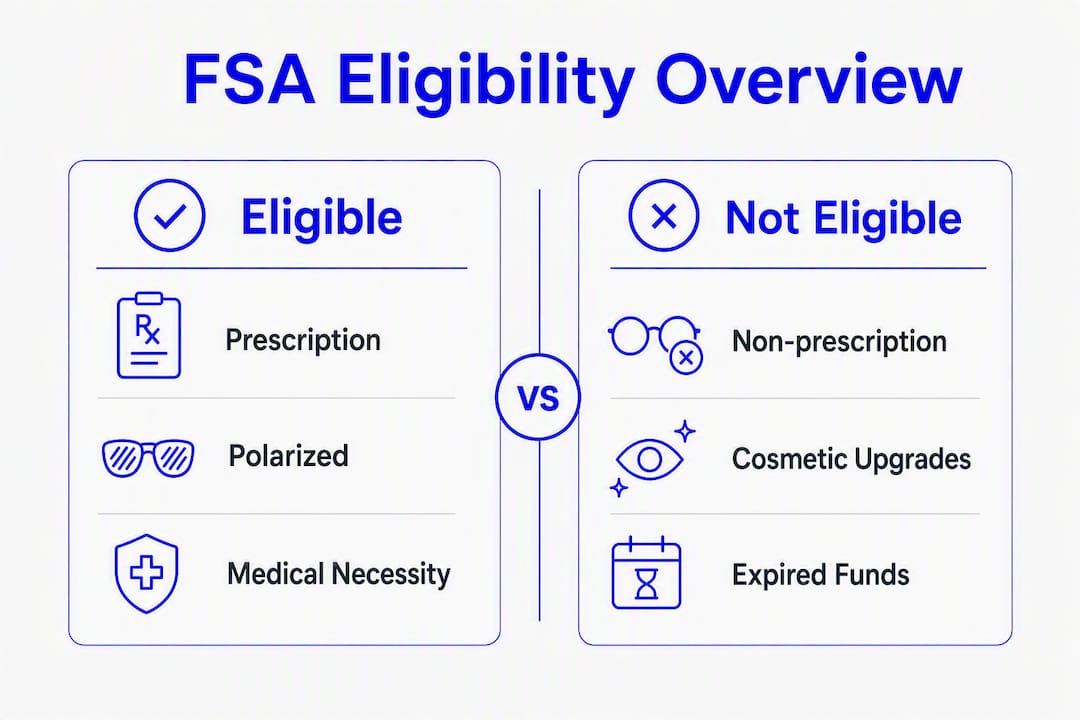
Over-the-counter sunglasses are not eligible under standard FSA rules. That said, there is a documented exception: if a licensed provider certifies that non-prescription sunglasses are medically necessary, an administrator may approve the expense. An IRS private letter ruling addressed exactly this scenario and confirmed that the outcome depends entirely on the quality of documentation and the procedures followed.
Medical conditions that can support a Letter of Medical Necessity (LMN) for non-prescription sunglasses include:
- Severe photophobia (light sensitivity) caused by a diagnosed condition such as migraine disorder or iritis.
- Post-surgical eye protection following cataract surgery or LASIK.
- Specific retinal conditions where UV exposure poses a documented clinical risk.
The LMN must be signed by your treating provider and should state the diagnosis, the medical reason sunglasses are required, and why prescription lenses are not applicable. Diagnosis codes strengthen the letter considerably. An itemized receipt from the retailer is still required alongside the LMN.
Pro Tip: Ask your doctor to use specific clinical language in the LMN: “medically necessary to prevent further damage to [condition]” carries more weight than a general recommendation. Request the letter before you purchase, not after, and submit it to your administrator for pre-approval when that option exists. Administrators can still deny the claim even with an LMN, so pre-approval removes that risk.

What parts of prescription sunglasses are covered by FSA funds
Frames and prescription lenses are the core eligible items. When those lenses are tinted for sun protection as part of a corrective prescription, the tint is generally covered too, because it is integral to the prescribed eyewear rather than a cosmetic choice.
“The expense must be primarily for the prevention or alleviation of a physical or mental defect or illness.” — IRS Publication 502. When prescription sunglasses meet that standard, the frames, lenses, and medically necessary lens treatments all qualify.
Commonly covered items on a prescription sunglass order:
- Frames (any style, provided they hold the prescription lenses)
- Single-vision or progressive prescription lenses
- Sunglass tint applied to prescription lenses
- Basic scratch-resistant coating when bundled with the prescription
- Anti-reflective coating when tied to the corrective lens order
Gray areas include polarization and premium cosmetic upgrades. Polarized lenses attached to a prescription are often approved because the polarization enhances the corrective function in bright conditions, but some administrators treat them as an elective upgrade. Premium mirror coatings and fashion tints with no corrective purpose are more likely to be flagged.
The safest approach for any expensive add-on: get pre-approval from your plan administrator before you pay. That one step prevents a denial after the fact.
How to pay at checkout and submit an FSA reimbursement claim
Use your FSA card directly at checkout whenever the retailer accepts it. That is the cleanest path: no claim to file, no waiting for reimbursement. Vision retailers and eye-care practices commonly accept FSA and HSA cards, and many online eyewear stores do as well.
Path 1: Pay with your FSA card
- Confirm the retailer accepts FSA/HSA cards before you add items to your cart.
- Select your prescription sunglasses and enter your prescription details.
- Choose your FSA card as the payment method at checkout.
- Save the order confirmation and itemized receipt for your records.
- Your administrator may request documentation later; keep everything for at least three years.
Path 2: Pay out-of-pocket and submit a reimbursement claim
- Pay with any personal card and request a detailed, itemized receipt at the time of purchase.
- Log in to your FSA administrator’s portal and start a new reimbursement claim.
- Upload the itemized receipt, your prescription, and any LMN if applicable.
- Submit the claim and note the confirmation number.
- Reimbursement typically processes within 5–10 business days, though timelines vary by administrator.
Pro Tip: If your claim is denied, do not simply accept it. Request the specific denial reason in writing, add any missing documentation (a copy of the Rx, a more detailed receipt, or an LMN), and file an appeal. Most administrators have a formal appeals process, and a denial on incomplete paperwork is often reversible.
What your itemized receipt and prescription must include

The single most common reason FSA claims for eyewear get denied is an insufficient receipt. A generic order summary that says “sunglasses, $180” will not pass. FSAFEDS requires a detailed receipt that identifies the patient, the provider or seller, the date, and an accurate description of each item purchased.
Your receipt checklist:
- Provider/retailer name and address
- Patient name (must match the FSA account holder or a covered dependent)
- Date of purchase or service
- Itemized product descriptions (e.g., “prescription sunglass frames,” “single-vision prescription lenses,” “sunglass tint”)
- Individual price for each line item
- Prescription details (sphere, cylinder, axis, add power) or a note that the Rx is attached
A well-formatted invoice line looks like this:
| Line Item | Description | Price |
|---|---|---|
| Frames | Prescription sunglass frames — full-rim | $95.00 |
| Lenses | Single-vision prescription lenses | $60.00 |
| Tint | Sunglass tint (gradient brown) | $25.00 |
| Total | $180.00 |
Online retailers often provide an order summary rather than a formal invoice; for detailed purchase documentation and guidance on receipts, see Premium Employee Uniforms: Elevate Your Team’s Professional Look which includes helpful vendor receipt advice. If that summary lacks itemized line items or your prescription details, contact customer service and request a detailed invoice explicitly. Most retailers will generate one on request, and keeping a copy of your prescription on file makes the process faster.
How Chap’el Eyewear supports your FSA purchase
Chap’el Eyewear offers prescription-ready sunglasses with impact-resistant polycarbonate lenses, UV protection, and a range of styles suited to both everyday wear and active outdoor use. For FSA purposes, that means you can order frames and prescription lenses together and receive the kind of itemized purchase documentation your administrator needs.
Here is how to use FSA funds when ordering from Chap’el:
- Browse the collection and select frames compatible with prescription lenses.
- Have your current prescription from your eye doctor ready to upload or reference during checkout.
- At checkout, use your FSA or HSA card as the payment method if your plan card is accepted, or pay with a personal card and request a detailed invoice for reimbursement.
- Contact Chap’el’s customer service team if you need an itemized invoice that breaks out frames, lenses, and any add-ons separately — the team can provide documentation formatted for FSA claim submission.
- Save the invoice and your prescription together before submitting your claim.
Chap’el’s polarized and designer collection includes options with polarized lenses, which can be attached to a prescription and submitted for FSA reimbursement when your plan administrator approves the add-on. For readers comparing lens options, the polarized vs. non-polarized breakdown on the Chap’el blog explains the functional difference clearly.
Pro Tip: Before placing a large order, call your FSA administrator and confirm that polarized prescription sunglasses are covered under your specific plan. A two-minute call can save you a reimbursement headache later.
Key Takeaways
Prescription sunglasses are FSA-eligible under IRS Publication 502 when prescribed for vision correction, and the itemized receipt plus a valid prescription are the two documents that make or break a claim.
| Point | Details |
|---|---|
| Prescription required | Only sunglasses prescribed for vision correction qualify; OTC sunglasses are generally not eligible. |
| Documentation matters | You need an itemized receipt with patient name, date, item descriptions, and prices, plus a copy of your Rx. |
| Two payment paths | Use your FSA card at checkout or pay out-of-pocket and submit a reimbursement claim with your receipt. |
| Non-Rx exceptions exist | A Letter of Medical Necessity from your doctor may allow OTC sunglasses, but pre-approval is strongly advised. |
| Chap’el Eyewear option | Chap’el offers prescription-ready sunglasses and can provide itemized invoices for FSA claim submission. |
The part most people skip
There is a gap between knowing prescription sunglasses are FSA-eligible and actually getting reimbursed without friction. Most claim denials come down to one of two things: a receipt that does not itemize correctly, or a plan administrator who applies stricter rules than the IRS baseline. The IRS framework is permissive. Your specific plan may not be.
The practical advice here is not to assume your plan mirrors the IRS standard exactly. Call your administrator before you spend, especially for anything over $150 or for add-ons like polarization. That call takes three minutes and eliminates the most common source of post-purchase frustration. Chap’el’s customer service team can also help you get the right invoice format if you are ordering from them, which removes one more variable from the claim process.
Ready to use your FSA on prescription sunglasses from Chap’el?
Chap’el Eyewear gives you prescription-ready frames with UV protection and impact-resistant lenses, plus the purchase documentation your FSA administrator actually needs. No hunting for a separate itemized invoice or chasing down receipt details.
Here is what to have ready before you check out:
- Your current prescription from your eye doctor.
- Your FSA or HSA card, or a personal card if you plan to submit a reimbursement claim.
- A note of your plan’s coverage rules for polarized lenses or add-ons, if applicable.
Visit Chap’el Eyewear to browse prescription-compatible styles, or go straight to the designer polarized collection if you want polarized lenses with your prescription. Contact the team at checkout if you need a line-item invoice for your FSA claim. And before you finalize your order, confirm your plan’s specific rules with your FSA administrator — plan policies vary, and a quick check protects your reimbursement.
This article provides general information about FSA eligibility rules and is not professional tax or financial advice. Confirm current rules with IRS Publication 502, your plan administrator, or a qualified benefits professional.
Authoritative sources to verify your FSA coverage
These are the primary sources to consult when confirming eligibility, checking your plan, or preparing a claim:
- IRS Publication 502: The governing IRS document that defines qualified medical expenses, including prescription eyewear. Check here for the legal basis of FSA and HSA eligibility.
- FSAFEDS Eligible HC FSA Expenses: The federal employee FSA administrator’s official eligible-expense list. Confirms prescription sunglasses are eligible and OTC sunglasses are not; also details receipt requirements.
- AllAboutVision: FSA/HSA for glasses and eyewear: Practical guidance on payment paths, plan variation, and how to handle reimbursement when a retailer does not accept FSA cards directly.
- IRS private letter ruling on non-prescription sunglasses: Historical IRS precedent showing how medical-necessity exceptions for OTC sunglasses are evaluated and what documentation is required.
- Your plan administrator: The final authority on your specific plan’s rules, covered add-ons, and claim submission procedures. When in doubt, call them before you purchase.