

Best Running Sunglasses of 2026: Tested Picks
For most runners, the Chap’el Sport Polarized is the strongest all-around choice: polarized optics, sport-specific grip, and 100% UVA/UVB protection in a frame built to stay put on a sweaty face. If your routes mix sun and shade, the Chap’el Photochromic option removes the need to swap lenses mid-run. For changing light on technical trails, a fast-adapting photochromic model is the smart call. On a tight budget, a quality polarized runner under $30 still delivers full UV protection. For style that crosses over from road to coffee shop, the Chap’el Designer Polarized handles both without looking like a cycling kit.
| Model | Best For | Lens Tech | Price Band | Fit Note |
|---|---|---|---|---|
| Chap’el Sport Polarized | Road, coastal, bright sun | Polarized | $$ | Adjustable nosepad; suits most face widths |
| Chap’el Photochromic | Mixed light, trail, dawn/dusk | Photochromic | $$ | Stable temple grip; works on low-bridge faces |
| Chap’el Designer Polarized | Crossover: road + everyday | Polarized | $$ | Fashion-forward frame; medium to wide face |
| Budget polarized runners | Casual road, recreational | Polarized | $ | Basic nosepad; limited adjustability |
| Photochromic trail sunglasses | Long trail, variable light | Photochromic | $$–$$$ | Wraparound; suits medium to wide face |
TL;DR: Chap’el Eyewear suits runners who want performance optics and everyday style without buying two separate pairs. Runners with extreme prescription needs or ultra-specific trail requirements should also check dedicated performance brands.
Table of Contents
- Why do running sunglasses actually affect your performance?
- How these sunglasses were tested
- What are the best running sunglasses right now?
- Side-by-side specs: how do the top models compare?
- How do you choose the right running sunglasses?
- What lens technology is right for your runs?
- Key Takeaways
- Chap’el running sunglasses: performance features and where to buy
Why do running sunglasses actually affect your performance?
Running sunglasses are functional equipment, not just accessories. Squinting into sun or wind tightens the muscles around your eyes and forehead, which can trigger headaches on longer efforts. Quality lenses reduce that strain by cutting glare and improving contrast so your eyes do less work.
The concrete effects matter:
- Glare reduction: Polarized lenses cut reflected glare from roads, water, and wet pavement, reducing visual fatigue on exposed routes.
- Debris and wind protection: Wraparound coverage shields eyes from grit, insects, and wind, especially on trail descents at speed.
- UV protection: Prolonged UV exposure accumulates over years of outdoor running. Quality running sunglasses deliver 100% UVA/UVB protection, and impact-resistant polycarbonate lenses add a layer of safety against flying debris.
- Peripheral awareness: A well-fitted frame with adequate coverage keeps your field of view clear without creating blind spots at the edges.
Field testing by Runner’s World consistently flags ventilation, hydrophobic coatings, and wrap coverage as the features that separate a pair you reach for every run from one that stays in the drawer. Nosepad height and vent channels are small details with outsized impact: they determine whether your lenses fog up at mile two or stay clear through a tempo effort.
One standard worth knowing: ANSI Z87.1 sets impact-resistance requirements for protective eyewear. Not every running sunglass carries this rating, but frames built to that standard offer meaningful protection against debris on trail runs and road hazards.
How these sunglasses were tested
Testing combined real-world runs with a structured checklist of fit and lens checks. The goal was to replicate what actually happens on a run, not just what looks good in a lab.

Field runs covered road intervals, trail loops with mixed sun and shade, and early-morning commutes in low light. Each pair logged at least several sessions before any verdict. Conditions included direct midday sun, overcast skies, and shaded forest trails where light shifts every few seconds.
Fit checks focused on bounce and slip. A pair that moves even slightly on a downhill stride is a distraction. Temple grip, nosepad contact, and how the frame behaves with a running cap or visor all factored in. Frames were also checked for pressure points during longer efforts.
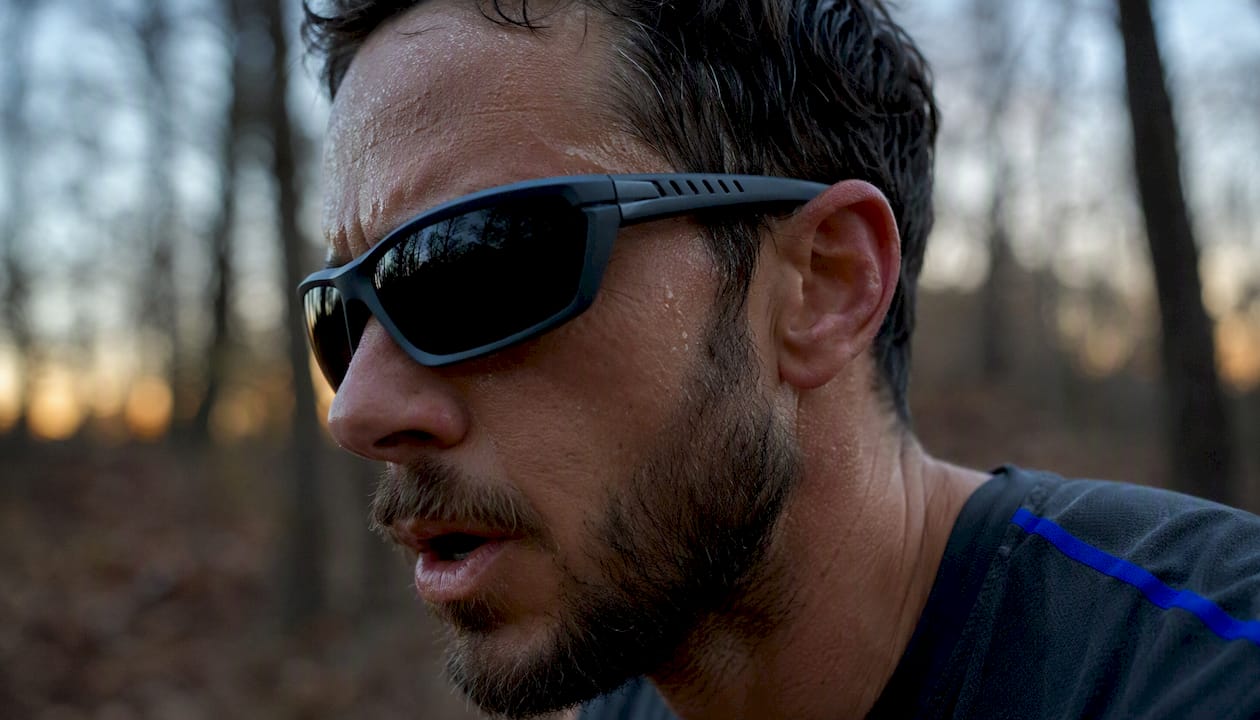
Ventilation and fog tests happened during high-exertion intervals and humid conditions. Small design details matter here: raised nosepads that create airflow between lens and face, vent channels in the frame, and hydrophobic coatings that shed sweat rather than letting it pool on the lens. Field reports confirm that these details materially reduce fogging during hard efforts.
Optical clarity and lens tech were assessed by checking for distortion at the lens edges, color rendering on trail surfaces, and how quickly photochromic lenses adapted between open sun and tree cover.
Durability was checked over short-term field use: frame flex, hinge quality, and lens scratch resistance after being tossed in a pack. Long-term scratch resistance beyond this window was not tested.
- Stability under movement (bounce, slip, temple/nose grip)
- Coverage and peripheral protection
- VLT and lens category (Cat 0–4)
- Lens tech adaptability (photochromic speed, polarized clarity)
- Weight and on-face comfort over distance
- Ventilation and anti-fog performance
- Durability and impact resistance
- Price-to-performance value
Pro Tip: Test any new pair on a short, sweaty run before committing. A frame that fits perfectly standing still can shift on a downhill. Most retailers offer a return window — use it.
What are the best running sunglasses right now?
Chap’el Sport Polarized
The Chap’el Sport Polarized is built for runners who spend most of their miles on roads, coastal paths, or any route where reflected glare is the main enemy. The polarized lenses cut horizontal glare cleanly, and the sport-specific temple and nosepad grip keeps the frame locked during tempo runs and long efforts alike.
Pros:
- Polarized optics reduce road and water glare effectively
- Adjustable nosepad fits a range of face shapes, including lower bridge profiles
- Impact-resistant polycarbonate lenses with 100% UVA/UVB protection
- Stable fit that holds through high-cadence running
Cons:
- Polarized lenses can reduce screen readability (GPS watches, phone maps)
- Less versatile in rapidly shifting light compared to photochromic options
Key specs: Polarized lens, polycarbonate, adjustable nosepad, price band $$. Prescription insert compatibility: check current listings.
Chap’el Photochromic option
For runners who start before sunrise, finish in full sun, or run trails where the light flips between deep shade and open sky, the Chap’el Photochromic option is the most practical choice in the lineup. Field reports describe rapid-adapting photochromic lenses as functionally seamless on mixed trails — the tint shifts before you consciously notice the light has changed.
Pros:
- Auto-adjusting tint removes the need to swap lenses mid-run
- Handles dawn-to-midday light shifts without any manual adjustment
- Stable temple grip works well on low-bridge faces
- 100% UVA/UVB protection across the full tint range
Cons:
- Photochromic lenses respond more slowly in very cold temperatures
- Slightly higher price than a single-tint polarized option
Key specs: Photochromic lens, polycarbonate, stable temple grip, price band $$. Prescription compatibility: check current listings.
Chap’el Designer Polarized
The Chap’el Designer Polarized is the crossover pick: a frame that looks at home on a run and equally good at brunch afterward. The polarized lenses handle road glare, and the fashion-forward design means you’re not walking into a café wearing something that looks like a cycling helmet accessory.
Pros:
- Style-forward frame that works beyond the run
- Polarized lenses with full UV protection
- Medium-to-wide face fit with a clean, modern aesthetic
- Lightweight construction for all-day wear
Cons:
- Less wraparound coverage than dedicated sport frames
- Not the first choice for technical trail running
Key specs: Polarized lens, lightweight frame, medium-to-wide fit, price band $$. Prescription compatibility: check current listings.
Category alternatives
High-coverage wraparound sport sunglasses are the right call for trail runners, ridge runners, and anyone doing exposed high-speed descents. Extended peripheral coverage reduces wind and debris exposure in ways a standard frame simply cannot match. Wraparound designs that extend to the periphery are consistently preferred for trail and exposed conditions. Fit note: suits medium to wide faces; look for adjustable nosepads if you have a lower bridge.
Budget polarized runners prove that UV protection does not require a premium price. Budget options often deliver 100% UVA/UVB protection but trade off lens coatings, scratch resistance, and long-term optical clarity. For recreational road runners who replace sunglasses every season, that trade-off is entirely reasonable. Fit note: limited adjustability; best for average face widths.
Photochromic trail sunglasses are purpose-built for long runs where light conditions change constantly. The best versions shift across a wide VLT range fast enough that you never notice the transition. Fit note: typically wraparound; suits medium to wide faces.
Frameless low-weight long-run sunglasses are the choice for ultra-distance runners who want the least possible on-face sensation over many hours. The trade-off is reduced frame durability and sometimes less peripheral coverage. Fit note: often one-size-fits-most; check temple length.
Prescription-ready performance frames accept prescription inserts or custom lenses, making them the only real option for runners who need vision correction. Verify compatibility before purchase — not all sport frames accept inserts.
Pro Tip: Pair any running sunglass with a sun-protective hat for complete facial coverage. A wide-brim or running cap with UPF-rated sun protection complements your lenses on exposed routes.
Side-by-side specs: how do the top models compare?
| Model | Best For | Lens Tech | UV / VLT | Fit & Stability | Weight | Ventilation | Durability | Price |
|---|---|---|---|---|---|---|---|---|
| Chap’el Sport Polarized | Road, coastal, bright sun | Polarized | 100% UVA/UVB, Cat 3 | Adjustable nosepad, sport temple grip | Light | Moderate venting | Polycarbonate, impact-resistant | $$ |
| Chap’el Photochromic | Mixed light, trail, dawn/dusk | Photochromic | 100% UVA/UVB, Cat 1–3 | Stable temple, low-bridge friendly | Light | Moderate venting | Polycarbonate, impact-resistant | $$ |
| Chap’el Designer Polarized | Road + everyday crossover | Polarized | 100% UVA/UVB, Cat 3 | Medium-wide fit, fashion frame | Light | Standard | Polycarbonate | $$ |
| High-coverage wraparound | Trail, ridge, high-speed | Polarized/photochromic | 100% UVA/UVB, Cat 3–4 | Wide coverage, adjustable nosepad | Medium | High venting | High-impact frame | $$–$$$ |
| Budget polarized runners | Casual road, recreational | Polarized | 100% UVA/UVB, Cat 3 | Basic nosepad, limited adjust | Light | Basic | Standard | $ |
| Photochromic trail | Long trail, variable light | Photochromic | 100% UVA/UVB, Cat 1–3 | Wraparound, medium-wide | Medium | High venting | High-impact frame | $$–$$$ |
| Frameless low-weight | Ultra-distance road | Non-polarized/polarized | 100% UVA/UVB, Cat 2–3 | Minimal frame, one-size-fits-most | Ultra-light | Open frame | Moderate | $$–$$$ |
| Prescription-ready frames | Prescription runners | Varies | 100% UVA/UVB | Secure fit, insert-compatible | Light–medium | Varies | Varies | $$$–$$$$ |
Fit tip: Runners with a low or narrow bridge should prioritize adjustable nosepads (Chap’el Sport Polarized and Photochromic both offer this). Wide-face runners benefit from wraparound or wider-temple designs. Thin temples on any model make it easier to wear under a running cap or cycling helmet.
The specific models in the broader market that populate these categories include names like the Ombraz Refugio (frameless, ultra-light), Goodr OG (budget polarized), Bolle Trailchaser and Julbo Spark (trail photochromic), SunGod Ultras Air and Roka SR-1x (ultralight performance), Rudy Project Rydon, Rudy Project Rydon Slim, and Rudy Project Rydon Slim Curva (prescription-compatible sport frames), Oakley Sutro and Oakley Sutro S (high-coverage road), Tifosi Swank, Tifosi Moab, Tifosi Sanctum, Tifosi Vero Sunglasses, and Tifosi Swick (value-to-mid range), Smith Shift Split MAG and Smith Vert Pivlock (interchangeable lens systems), Rudy Project Propulse and ROKA Oslo High Performance (performance road), Vallon Watchtowers and Zeal Boone (trail/outdoor), adidas Sport SP0108 (sport-specific fit), Smith Motive and SMITH Westward Sunglasses (trail crossover), Method Seven Silverton Trail26 (contrast-enhancing trail), Roka Braker 2.0 (lightweight road), Knockaround Fast Lanes (budget), Oakley Frogskins (lifestyle crossover), Bolle Victus Pro Sunglasses and Bolle Sonic G (performance sport), WearIQ Smart Glasses (tech-integrated), and Polarized Sports Sunglasses as a broad category. Each fits one of the eight category rows above.
How do you choose the right running sunglasses?
Start by matching your typical run conditions to a lens type and frame style. That single decision eliminates most of the field.
- Assess your run conditions. Road runner in full sun? Polarized. Trail runner with constant light shifts? Photochromic. Early-morning or evening commuter? Low-VLT photochromic or a Cat 1–2 lens. Multi-terrain athlete? Photochromic covers the most ground.
- Pick your lens technology. Photochromic vs. polarized is the core decision. Photochromic adapts automatically; polarized cuts glare more aggressively on bright, reflective surfaces. Non-polarized lenses work fine for low-light or overcast runs.
- Evaluate fit. Put the frame on and shake your head. If it moves, it will move on a downhill. Check nosepad contact (adjustable pads help low-bridge faces), temple grip, and whether the frame presses uncomfortably at the temples during longer wear.
- Check ventilation and anti-fog. Look for raised nosepads that create an air gap, vent channels in the frame or lens, and hydrophobic coatings. These details matter most during hard intervals and humid conditions.
- Verify UV and impact protection. Any running sunglass worth buying delivers 100% UVA/UVB protection. Impact-resistant polycarbonate lenses are the standard for sport use; frames meeting ANSI Z87.1 add meaningful debris protection on trail runs.
- Confirm prescription compatibility. If you need vision correction, check whether the frame accepts a prescription insert or is available through a prescription lens service before you buy.
- Set your budget. Budget options deliver full UV protection but sacrifice lens coatings and long-term optical clarity. Premium pricing buys better optics, coatings, and durability. Decide which trade-off fits your mileage and replacement frequency.
Face-size quick guide:
- Narrow face: Look for smaller frame widths, thin temples, and adjustable nosepads.
- Medium face: Most sport frames fit; prioritize fit over size.
- Wide face: Wraparound designs and wider-bridge frames prevent pressure at the temples.
- Low bridge: Adjustable silicone nosepads are non-negotiable to prevent the frame from sliding down mid-run.
Buying tips: Always try sunglasses with your usual run cap or visor — some frames don’t clear the brim. Test while sweating if possible. Check the return window before ordering online; fit is the one thing you cannot assess from a product page.
What lens technology is right for your runs?
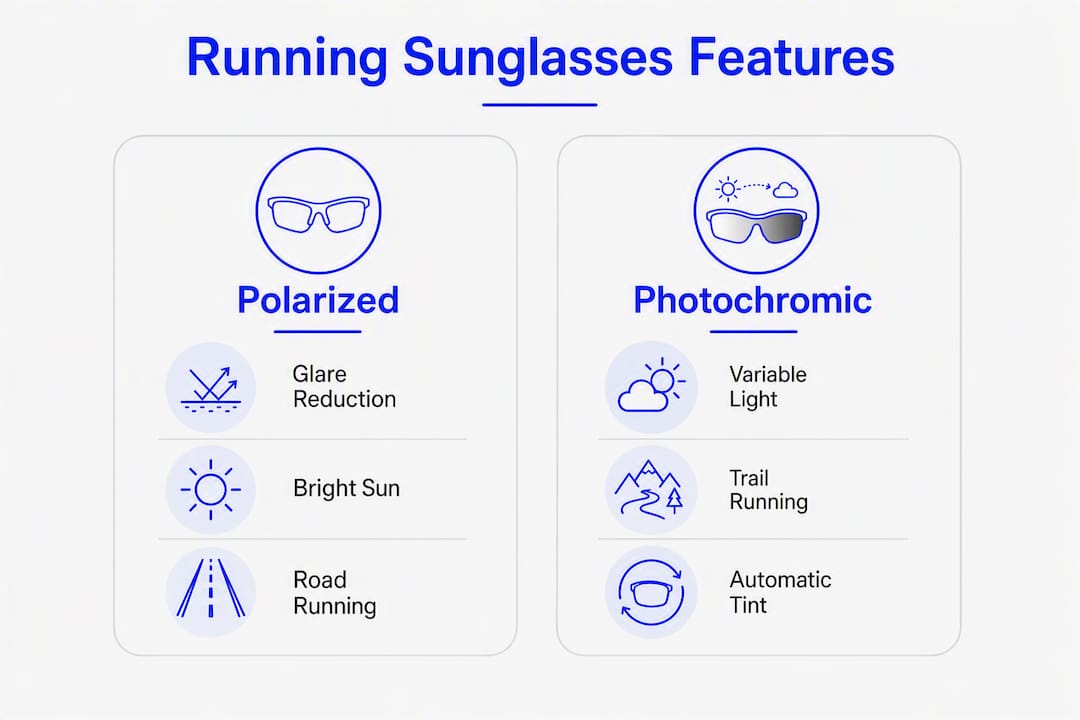
The short answer: photochromic for variable light, polarized for steady bright sun and glare-heavy routes, color-enhancing tints for trail contrast. Here’s what each actually does.
Polarized lenses
Polarized lenses contain a filter that blocks horizontally polarized light, which is the type that reflects off flat surfaces like roads, water, and wet pavement. The result is a dramatic reduction in glare without darkening the overall image. For road runners near water or on exposed coastal routes, polarized lenses are the clearest upgrade. The trade-off: they can make LCD screens (GPS watches, phones) harder to read at certain angles, and they don’t adapt to changing light.
Photochromic lenses
Photochromic lenses shift tint automatically in response to UV light. In full sun they darken to Cat 3; in shade or cloud cover they lighten toward Cat 1. iRunFar recommends photochromic as the gold standard for variable-light conditions, and interchangeable-lens systems as the alternative for athletes who want manual control. The practical advantage for trail runners is that the transition happens without any action on your part. Cold temperatures slow the adaptation slightly, which is worth knowing for winter runs.
Non-polarized lenses
Non-polarized lenses in a tinted category (Cat 2–3) work well for overcast days, early mornings, and runs where glare is not the primary concern. They’re lighter on the wallet and don’t interfere with screen readability.
VLT and lens categories
VLT (visible light transmission) measures how much light reaches your eye. Lower VLT means darker lenses.
- Cat 0–1 (VLT 80–43%): Low light, dawn, dusk, overcast. Minimal tint.
- Cat 2 (VLT 43–18%): Mixed conditions, partly cloudy.
- Cat 3 (VLT 18–8%): Bright sun, most road and trail running.
- Cat 4 (VLT 8–3%): Extreme brightness (high altitude, snow). Not suitable for driving.
Coatings and features
Anti-fog venting, hydrophobic and oleophobic coatings, and scratch-resistant treatments are the details that separate a lens that performs at mile 15 from one that fogs up at mile 2. Hydrophobic coatings shed sweat and rain rather than letting them bead and distort vision. Oleophobic coatings resist fingerprint smudges. Scratch-resistant coatings extend lens life but don’t make lenses indestructible.
For trail runners specifically: contrast-enhancing tints (amber, copper, rose) improve depth perception on uneven terrain by filtering blue light and increasing the visual definition of roots, rocks, and trail edges. Color-enhancing lenses can meaningfully reduce the chance of a misstep on technical ground.
Practical recommendation matrix:
- Road runner, full sun: Polarized, Cat 3, hydrophobic coating
- Trail runner, mixed light: Photochromic, Cat 1–3, wraparound coverage
- Morning/evening commuter: Photochromic or Cat 1–2 non-polarized
- Multisport traveler: Photochromic covers the most scenarios without carrying multiple pairs
Key Takeaways
The Chap’el Sport Polarized is the strongest all-around pick for road runners, while the Chap’el Photochromic option is the most versatile choice for anyone whose routes cross changing light conditions.
| Point | Details |
|---|---|
| Match lens tech to your route | Polarized for bright sun and glare; photochromic for mixed or trail light; Cat 1–2 for dawn/dusk. |
| Fit beats brand every time | A frame that bounces or slips on a downhill is a distraction — test with your run cap and while sweating. |
| Budget options cover the basics | Affordable polarized runners deliver 100% UVA/UVB protection; premium pricing buys better coatings and durability. |
| Ventilation details matter | Raised nosepads, vent channels, and hydrophobic coatings prevent fogging during hard intervals. |
| Chapeleyewear covers all three profiles | The Sport Polarized (road/glare), Photochromic (variable light), and Designer Polarized (crossover) address the three most common runner needs. |
What the gear guides miss about running sunglasses
Most roundups spend their energy ranking frames by weight and price, then bury the one decision that actually changes your run: whether your lens tech matches your typical light conditions. A polarized lens on a shaded forest trail does nothing useful. A photochromic lens on a flat coastal road is overkill. The mismatch is more common than it should be, and it’s why runners end up with a drawer full of pairs that “almost work.”
The other thing that gets glossed over is fit for non-average faces. Low-bridge runners, narrow-face runners, and anyone who wears a cap with a close-fitting brim will find that most sport frames are designed for a medium Caucasian face profile. Adjustable silicone nosepads are not a luxury feature — they’re the difference between a frame that stays put and one that slides down every half mile. Chapeleyewear’s adjustable nosepad design on the Sport Polarized and Photochromic models addresses this directly, which is why those two frames work for a wider range of runners than their price point might suggest.
Spend more if you run technical trails in variable light and want a photochromic lens that shifts fast enough to be genuinely seamless. Save money if you’re a recreational road runner who replaces sunglasses every year or two — a quality budget polarized frame with full UV protection will serve you fine. The frame that fits your face and your light conditions beats the most expensive pair on the shelf every time.
Chap’el running sunglasses: performance features and where to buy
Chap’el Eyewear gives runners a focused lineup that covers the three scenarios most people actually face: steady glare on roads, shifting light on trails, and the need for a frame that doesn’t look out of place off the run.
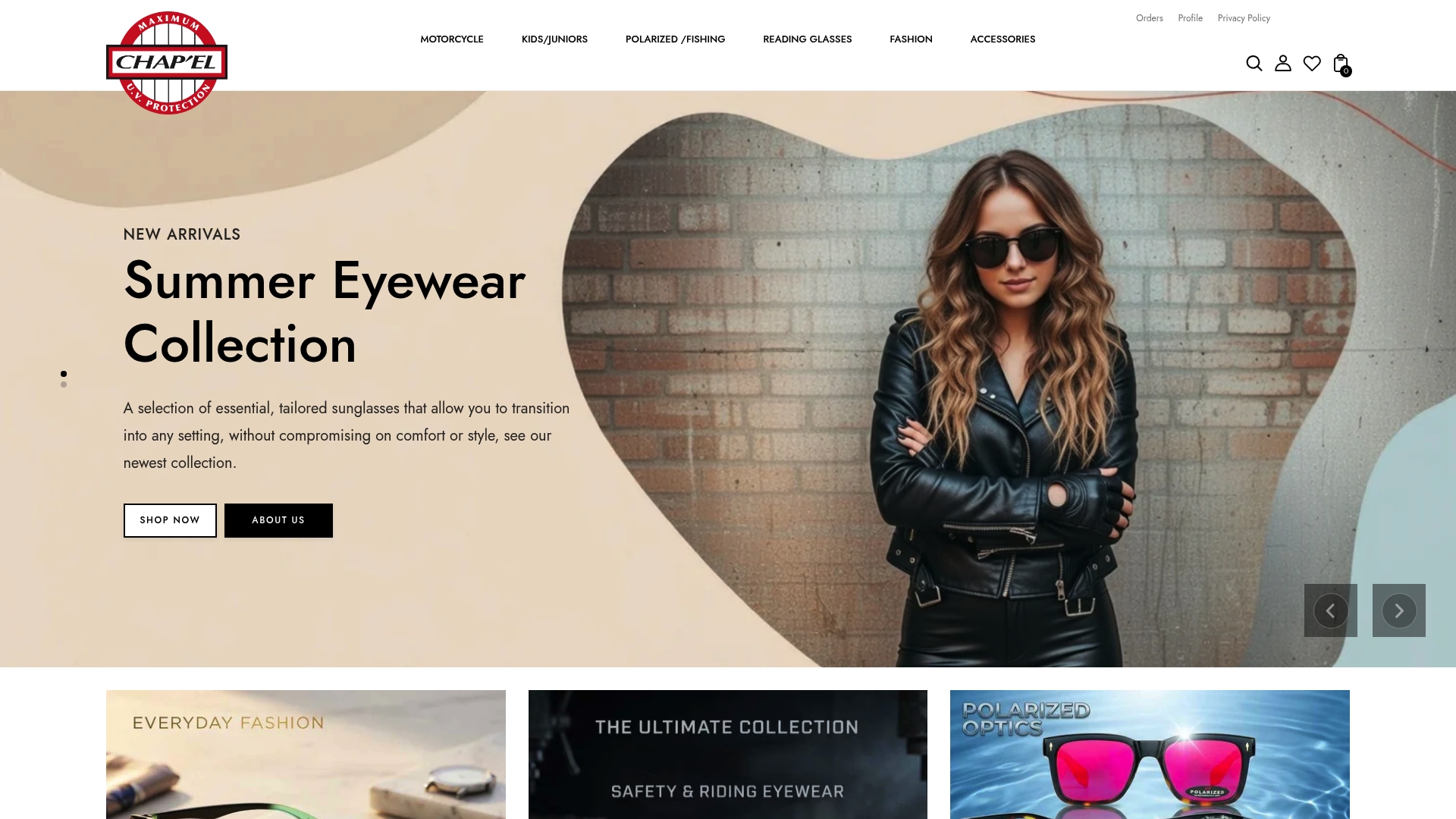
The Sport Polarized collection is the starting point for road runners: polarized polycarbonate lenses, adjustable nosepads, sport-specific temple grip, and 100% UVA/UVB protection. The Photochromic line handles variable light without any manual adjustment. The Designer Polarized collection is for runners who want one pair that works on a long run and looks intentional everywhere else.
Chapeleyewear also carries accessories including zipper cases with snap hooks and belt-loop cases for on-run storage, so your lenses are protected between efforts. Browse the full lineup at chapeleyewear.com and use the return window to test fit on an actual run before committing.
Sources and further reading
- Runner’s World: Best Running Sunglasses of 2026, Tested and Reviewed — Field-tested picks with detailed notes on ventilation, hydrophobic coatings, and wrap coverage; primary source for testing methodology and lens-feature guidance.
- iRunFar: Best Running Sunglasses of 2026 — Category picks across price points with strong photochromic and value-tradeoff commentary; used for lens tech and budget guidance.
- OutdoorGearLab: The Best Running Sunglasses, Tested and Ranked — Lab-style and field testing with emphasis on ultralight weight, stable fit, and wraparound coverage; supports product comparison and how-to-choose sections.
- Chap’el Eyewear: Photochromic vs. Polarized Guide — Internal explainer on the core lens-tech decision; recommended reading before buying.
- Chap’el Eyewear: Sport Polarized Collection — Primary product page for the top-recommended road running pick.
- Chap’el Eyewear: Top Photochromic Options — Detailed look at Chap’el’s photochromic lineup for variable-light runners.
- Jaguar Golf: Sun Protection Guide — UPF ratings and brim styles for complementary sun protection alongside running sunglasses.