

Over Glasses Sunglasses for Style and Performance
Fit-over sunglasses are the right call if you wear prescription glasses and want instant, reliable sun protection without a second pair of prescription lenses. They sit over your existing frames, deliver UV400 protection against 100% of UVA and UVB rays, and work for everything from a weekend drive to a day on the water. Chap’el Eyewear’s polarized fit-over collection is a strong premium option for anyone who wants that protection without looking like they raided a pharmacy display. Best for occasional or activity-specific use; if you’re outdoors all day every day, prescription sunglasses may serve you better long-term.
Table of Contents
- What are over-glasses (fit-over) sunglasses?
- Who benefits most from fit-over sunglasses?
- How do you choose the right fit-over sunglasses?
- How to measure your frames and check the fit
- How to care for and maintain your fit-over sunglasses
- What are the alternatives to fit-over sunglasses?
- How Chap’el Eyewear meets the fit-over selection criteria
- Key Takeaways
- The case for taking fit-overs seriously
- Chap’el Eyewear: premium fit-overs worth trying
- Sources and further reading
What are over-glasses (fit-over) sunglasses?
Fit-over sunglasses are frames engineered with extra internal depth and width so they sit cleanly over prescription eyeglasses without touching the lenses. That extra volume is the defining feature. A standard sunglass frame would press against your prescription lenses and distort your vision; a fit-over clears them entirely.
Key specs to look for on any label:
- UV400 / 100% UVA & UVB protection — the only reliable indicator of full UV blocking; tint darkness tells you nothing about UV filtration
- Polarized lenses — cuts reflected glare from roads, water, and snow; a separate feature from UV protection
- Polycarbonate or impact-resistant lenses — lighter and more shatter-resistant than glass or standard plastic
- Wrap or side-shield coverage — blocks light entering from the top and sides, which flat lenses miss entirely
How do fit-overs compare to the alternatives? Clip-ons attach magnetically or mechanically to your existing frames and sit flush, so they’re lower-profile but offer less side coverage. Prescription sunglasses are a single dedicated pair ground to your prescription, giving the cleanest optics but at a higher cost. Photochromic lenses darken in UV light but often don’t activate inside a car windshield, which filters the UV that triggers the reaction.
The UV400 label is the only reliable way to confirm 100% UVA and UVB protection. Polarization and tint darkness are separate features — a dark lens with no UV coating can actually increase eye risk because your pupils dilate in the shade while UV passes straight through.
— MD Anderson Cancer Center
Who benefits most from fit-over sunglasses?
Fit-overs make the most sense for a specific set of situations. Post-dilation patients leaving an eye exam need immediate sun protection and can’t wear contacts; a fit-over is the obvious solution. Occasional drivers, boaters, hikers, and travelers who don’t want to invest in prescription sunglasses for every activity get solid value from a single fit-over pair. They’re also a practical backup option when contacts aren’t an option.
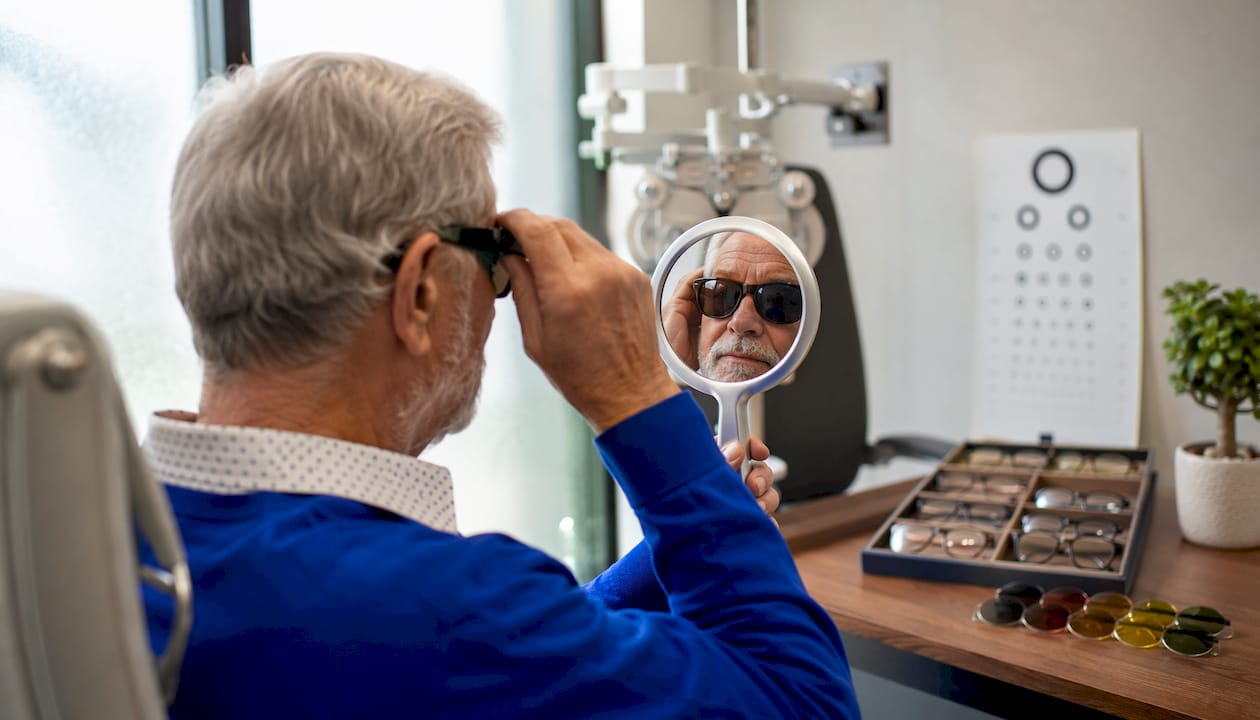
Pro Tip: Optometrists recommend testing any new eyewear in a low-risk setting before driving. Put on your fit-overs in a parking lot first, check your peripheral vision, and confirm there’s no bounce or distortion before taking them on the highway.
The limitations are real, though. Very large or unusually shaped prescription frames can be hard to accommodate, and a fit-over that’s even slightly too narrow will press against your lenses. For people who spend most of their time outdoors, prescription sunglasses or contact lenses paired with dedicated sunglasses usually deliver a more comfortable daily experience. Sports requiring a tight, single-piece fit, like competitive cycling or skiing at speed, may also call for a different solution.
How do you choose the right fit-over sunglasses?
Getting the right pair comes down to five factors: fit, protection, material, activity suitability, and return policy.
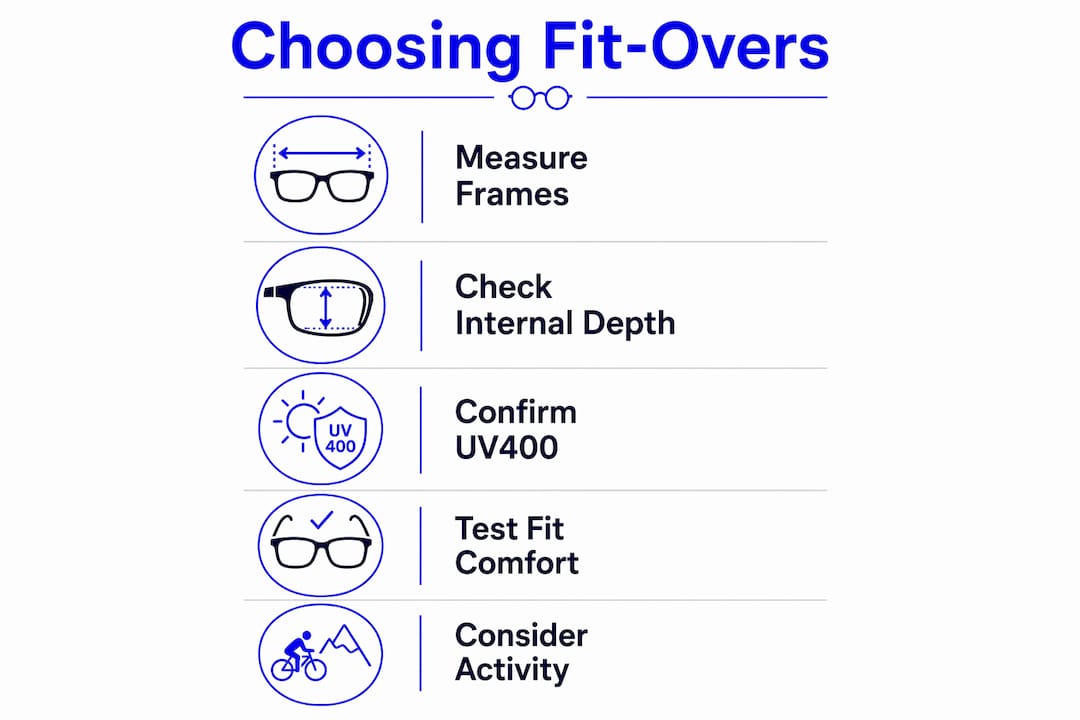
- Sizing first. Measure your current frames’ total width, lens height, and temple length. Compare those numbers to the manufacturer’s size chart. You want clearance, not contact.
- Confirm UV400. Look for “UV400” or “100% UVA/UVB protection” on the label. A polarized lens adds glare reduction on top of that.
- Choose polycarbonate lenses for any active use. They’re impact-resistant and lighter than glass.
- Match the frame style to your activity. Wrap styles block wind and peripheral light. Goggle-style fit-overs with padded seals are built for snow and high-speed sports. Low-profile flat frames work for driving and casual wear.
- Check the return policy. Standard e-commerce fulfillment for fit-overs runs 1–3 business days processing and about 7–9 business days for delivery, as outlined in the retail delivery timelines for apparel and eyewear sellers. A 30-day money-back guarantee is the norm and worth confirming before you buy.
| Dimension | What to look for |
|---|---|
| Fit / internal depth & width | Clears prescription lenses with no contact; matches frame size chart |
| UV protection | UV400 label; 100% UVA/UVB confirmed |
| Polarization | Present for driving, water, snow; optional for casual use |
| Lens material | Polycarbonate for impact resistance; TAC for lightweight casual wear |
| Style / coverage | Wrap or goggle for active use; flat for driving and everyday |
| Activity suitability | Goggle/padded for snow/cycling; wrap for water; low-profile for driving |
| Return policy | 30-day money-back standard; confirm processing and delivery window |
Pro Tip: If you’re buying online, order two size options when the brand offers free returns. Fit-over sizing varies more than standard sunglasses, and a side-by-side comparison on your actual frames takes the guesswork out.
How to measure your frames and check the fit
Getting the measurement right before you order saves a return trip. Here’s the process:
- Measure total frame width at the widest point, temple to temple. This is your primary sizing number.
- Measure lens height at the tallest point of each lens. The fit-over needs to cover this fully.
- Note your temple length if the manufacturer’s chart includes it; some fit-overs have adjustable temples.
- Check nose bridge clearance. Your prescription frames’ bridge should sit inside the fit-over without the two bridges touching.
- Compare to the size chart. Most brands use Small, Medium, Large, and Extra Large categories. Allow a few millimeters of clearance on width so the fit-over doesn’t press inward.
| Frame measurement | Typical size category |
|---|---|
| Up to 135 mm wide | Small |
| 136 mm and above | Medium |
| — | Large |
| — | Extra Large / Oversize |
Once the pair arrives, run a quick try-on check: nod your head firmly and confirm the fit-over doesn’t slide. Press gently on the nose bridge and verify no pressure on your prescription lenses. Look left and right to check peripheral visibility. If you see internal reflections between the two lenses, the fit-over is sitting too close.
How to care for and maintain your fit-over sunglasses
Clean lenses with a microfiber cloth and a drop of mild dish soap in water. Avoid ammonia-based cleaners, which strip lens coatings over time. Never use a paper towel or shirt fabric; both scratch polycarbonate faster than you’d expect.
Storage matters more with fit-overs than with standard sunglasses because you’re protecting two pairs of lenses at once. A zipper case with a snap hook keeps the fit-over from rattling against your prescription frames in a bag. For active use, a belt-loop zipper case keeps them accessible on a trail or boat without tossing them loose in a pack.
A few safety notes worth keeping in mind:
- Don’t drive with fit-overs that bounce, slip, or reduce peripheral vision — check stability before you leave the parking lot
- Replace lenses when you notice scratches in your direct line of sight; scratched polycarbonate scatters light and increases glare
- UV protection doesn’t degrade with visible wear, but coatings do; if the anti-reflective or polarized coating is peeling, it’s time for a new pair
- Quality fit-overs with polycarbonate lenses typically last 2–4 years with regular use before frame fatigue or coating wear warrants replacement
What are the alternatives to fit-over sunglasses?
Each alternative has a real trade-off. Here’s where each one wins and where it falls short:
Clip-on sunglasses attach directly to your prescription frames, so there’s no extra bulk. They’re the lowest-profile option and work well for driving and casual use. The downside: coverage is limited to the lens area, with no side or top blocking, and they only work with frames that have a matching clip-on available.
- Best for: driving, office-to-outdoors transitions
- Weak spot: side glare, water, snow
Prescription sunglasses give you the clearest optics and the most style freedom. For anyone spending serious time outdoors, they’re the long-term answer. The upfront cost is higher, and you need an up-to-date prescription before ordering.
- Best for: daily outdoor use, sports, travel
- Weak spot: cost, requires current prescription
Photochromic lenses darken automatically in UV light, which sounds ideal until you realize most car windshields filter the UV that triggers the reaction. Check out the photochromic vs. polarized comparison for a full breakdown. Specialized driving photochromic options exist but cost more.
- Best for: mixed indoor/outdoor days, walking commutes
- Weak spot: cars, very bright conditions where they don’t darken enough
Contacts plus regular sunglasses give you the widest style selection and the cleanest fit for sports. No layered frames, no fit concerns.
- Best for: high-speed sports, fashion-forward buyers, cycling
- Weak spot: contact lens tolerance, cost of maintaining two solutions
Pro Tip: If you’re on the fence between clip-ons and fit-overs, ask yourself whether you need side coverage. For water, snow, or wind, fit-overs win. For a quick lunch outside, clip-ons are fine.
How Chap’el Eyewear meets the fit-over selection criteria
Chap’el Eyewear’s fit-over lineup is built around the criteria that actually matters for prescription glasses wearers: UV400 protection, polarized lenses, polycarbonate construction, and a frame design that accommodates real-world prescription frames without looking bulky.
Key features across the collection:
- UV400 labeling on all lenses, confirming 100% UVA and UVB blocking
- Polarized lens options in the Designer Polarized and Sport Polarized collections for glare reduction on water, roads, and snow
- Polycarbonate impact-resistant lenses for active and outdoor use
- Adjustable nose pads for a stable fit over prescription frames without pressure points
- Goggle-style options with padded seals for wind and high-speed activities
- Standard shipping: 1–3 business days processing, approximately 7–9 business days delivery
- 30-day satisfaction guarantee on eligible purchases
Pro Tip: Browse the Sport Polarized collection if your priority is outdoor performance, and the Designer Polarized line if you want a pair that looks as good off the trail as on it. Both carry the same UV400 and polycarbonate specs.
Key Takeaways
Fit-over sunglasses work best when UV400 protection, a confirmed fit over your prescription frames, and activity-specific lens features are all in place before you buy.
| Point | Details |
|---|---|
| UV400 is non-negotiable | Confirm the UV400 label; tint and polarization are separate and don’t substitute for UV protection. |
| Measure before you order | Total frame width, lens height, and bridge clearance determine whether a fit-over will work with your prescription glasses. |
| Match lens material to activity | Polycarbonate lenses handle impact and are lighter; choose them for any active outdoor use. |
| Verify return policy | Look for 30-day money-back guarantees and confirm the 1–3 business day processing and 7–9 business day delivery window. |
| Chap’el Eyewear | Offers UV400, polarized, polycarbonate fit-overs in Designer and Sport collections with adjustable nose pads and a 30-day guarantee. |
The case for taking fit-overs seriously
The conventional wisdom treats fit-over sunglasses as a compromise, a stopgap for people who can’t afford prescription sunglasses. That framing is outdated. The real question isn’t whether fit-overs are “as good as” prescription sunglasses; it’s whether they’re the right tool for how you actually live.
For a prescription glasses wearer who hikes on weekends, drives daily, and occasionally gets on a boat, buying three separate pairs of prescription sunglasses is neither practical nor cheap. A quality fit-over with UV400 and polarized polycarbonate lenses handles all three scenarios from one pair. The style gap that existed a decade ago has closed considerably. Premium fit-overs now carry the same optical standards as dedicated sunglasses, and the better-designed ones don’t announce themselves as a workaround.
What still matters is fit. A fit-over that bounces or presses against your prescription lenses is worse than useless, and that’s where most buyers go wrong: they skip the measuring step and order by guesswork. Get the measurements right, confirm the UV400 label, and choose the lens style for your primary activity. The rest is preference.
Chap’el Eyewear: premium fit-overs worth trying
Chap’el Eyewear’s Designer Polarized and Sport Polarized collections give prescription glasses wearers a real upgrade over generic fit-over options. Every pair carries UV400 protection, polarized polycarbonate lenses, and a frame design built to sit over prescription glasses without the bulk or the compromise on style. Orders ship within 1–3 business days and typically arrive in 7–9 business days, with a 30-day satisfaction guarantee to cover fit concerns.
Browse the full collection at Chap’el Eyewear and use the size guide to match your current frames before ordering. If you’re drawn to fashion-forward styles, start with the Designer Polarized line. For trail, snow, or water use, the Sport Polarized collection has the wrap coverage and impact resistance you need. Eyewear cases and accessories are available at Chap’el accessories to keep both pairs protected between uses.
Sources and further reading
- MD Anderson Cancer Center: Are your sunglasses protecting your eyes from UV rays?
- All About Vision: Fit-over sunglasses
- Dulles Eye Associates: Wearing sunglasses over prescription glasses
- Specialty Vision: Can you wear sunglasses over prescription glasses?
- Chap’el Eyewear: Designer Polarized collection
- Chap’el Eyewear: Sport Polarized collection
- Chap’el Eyewear: Full UV protection buying guide
Check product pages directly for current size charts, return policies, and available SKUs before purchasing.