
Golf Lens Color: Best Tints for Reading Greens
Warm tints, copper, rose, brown, and amber, give most golfers the strongest contrast for reading greens and tracking the ball, and the single number to check before buying is Visible Light Transmission, or VLT. Look for a VLT between roughly 20% and 30% for typical bright-to-partly-cloudy rounds, and never buy a lens without full UV protection rated UV400. That combination, warm tint plus correct VLT plus UV400, covers the vast majority of golfers on the vast majority of courses.
Everything else is refinement. Here’s the fast version before the deeper explanation:
- Bright sun or high glare: copper, rose, or brown, VLT around 20% to 30%.
- Overcast or low light: amber or yellow, with a higher VLT suited for low-light conditions.
- Neutral color perception or heavy driving glare: gray, VLT between 10% and 25%.
- Reading greens with aging eyes or light sensitivity: lighter violet variants, which trade some darkness for more transmitted light while keeping a contrast-boosting cast.
- Non-negotiable on every pair: UV400 rating, confirmed by the American Academy of Ophthalmology as the baseline for blocking UVA and UVB rays regardless of tint color.
Chapeleyewear builds its golf-ready sunglasses around exactly this logic, pairing warm, contrast-boosting tints with UV400 protection so the recommendation above isn’t just theory. It’s a buying checklist you can act on today.
Key Takeaways
| Point | Details |
|---|---|
| Default tint choice | Start with copper, rose, or brown for bright to partly cloudy rounds, the widest-recommended family for reading greens. |
| VLT target | Aim for 20% to 30% VLT in typical daylight; shift to — only for overcast or low-light conditions. |
| Feature to add carefully | Choose polarization for glare control, but test it on a real green first since it can dull subtle texture cues. |
| On-course test | Try a tint for a full nine holes in your usual lighting before committing, not just a five-minute store try-on. |
| Non-negotiable safety check | Confirm UV400 rating on every pair regardless of tint or darkness. |
| Where to start shopping | Chapeleyewear’s Sport Polarized and Designer Polarized collections pair warm, contrast-focused tints with UV400 and impact-resistant lenses. |
Table of Contents
- Golf Lens Color Options: A Tint-by-Tint Breakdown
- How Lens Color and VLT Change What You See on the Green
- Which Lens Features Actually Matter Beyond Color
- How to Choose and Test Your Golf Lens Color
- How Chapeleyewear’s Golf Lenses Match This Checklist
- Where to Buy Golf-Ready Lenses Built Around This Guide
- Sources
Golf Lens Color Options: A Tint-by-Tint Breakdown
Not every tint does the same job, and the differences show up the moment you step onto a green with a three-foot breaking putt. Here’s what each one actually does.
Copper and rose. These are the two most-recommended tints for golf, and for good reason. They amplify the contrast between the ball and the turf by boosting red and blue wavelengths while dampening green, which is exactly the wavelength your fairway and rough are throwing at you all day. EMME Visioncare notes that warm tints like these generally deliver the best contrast for reading greens and tracking the ball. The trade-off: some players find the warm cast fatiguing over a four-hour round, especially in already-warm afternoon light, according to testing from Moss and Fog.
Brown. A close cousin to copper, brown tints amplify light-dark differences in greens and are, per Moss and Fog’s breakdown, among the most popular choices for golfers and pros alike. Many pros gravitate toward lenses with VLT between 20% and 30%, and brown commonly sits right in that band.
Amber and yellow. These are low-light specialists. Wear them at high noon in July and you’ll just be squinting through a brighter, yellower version of the same glare.
Gray. The neutral option. Gray lenses reduce overall brightness without shifting color balance, and typical VLT for gray lenses runs 10% to 25%. That neutrality is the appeal if you want true-to-life color rather than a contrast boost, but it also means gray gives you less help spotting subtle breaks on a green. It’s a strong pick for driving to the course or for golfers who find warm tints tiring, less so for the specific task of green-reading.
Green. Green tints preserve natural color balance reasonably well, but the contrast gains are modest compared to warm tints, and green-on-green can occasionally flatten the very turf detail you’re trying to see. It’s a middle-ground tint that rarely wins a head-to-head against copper or brown for golf specifically.
Purple and violet. Darker purple leans toward a stronger contrast effect, similar in spirit to rose, but with a cooler cast. Lighter violet variants transmit more light while still adding some contrast punch, which makes them worth a look for golfers with aging eyes or light sensitivity who find full-strength copper too dark.
Blue. Blue-tinted lenses are the least common choice for golf and for a simple reason: blue does little to separate the ball from grass tones and can actually mute the reds and browns that give a green its texture. There’s rarely a strong case for blue over any of the tints above.
Pro Tip: Don’t trust a tint’s name on a display case. Reviews consistently find that brands market proprietary tint names for chemically similar dyes, so the real differences are in VLT and coatings, not the marketing label. Try two or three tints in the actual lighting you play in most, ideally on the course, before you decide.
How Lens Color and VLT Change What You See on the Green
VLT measures the percentage of visible light that passes through a lens. That single number does more to shape your on-course vision than the tint’s name does.
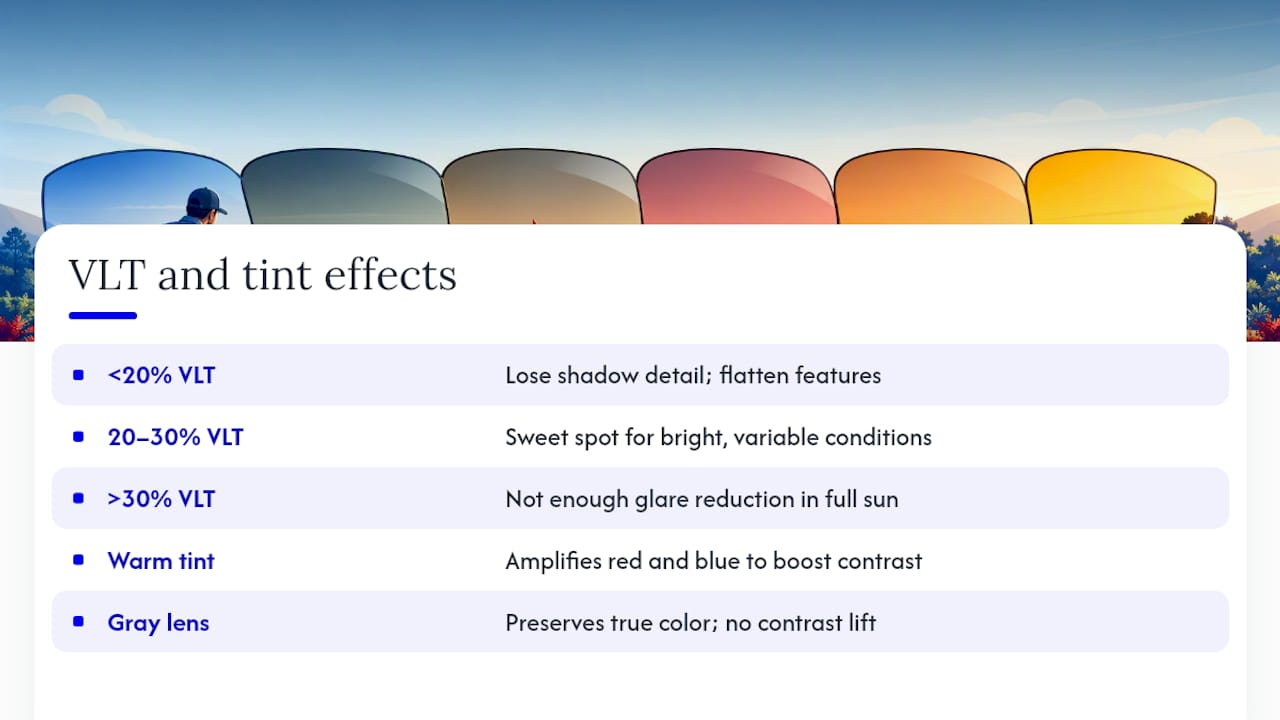
For bright, variable conditions, most golfers and pros land in a VLT range of about 20% to 30%, according to Moss and Fog. Drop much below that and you start losing detail in shadowed areas of the green. Go much above it in full sun and you’re not getting enough glare reduction to matter. It’s boosting what little contrast exists in flat, gray conditions.
Color plays a separate role from darkness. Warm tints work by selectively amplifying red and blue wavelengths relative to green, which increases the perceived contrast between a white or bright-colored ball and green turf, and between different shades of green on a breaking putt. Gray lenses skip that trick entirely. They cut brightness evenly across the spectrum, which is why they preserve true color but don’t give you the same contrast lift.
There’s a real ceiling here, though. Go too dark, and you flatten the same subtle features you’re trying to enhance, particularly in overcast conditions or as the afternoon light fades. Older golfers and anyone with light sensitivity should lean toward the higher end of a tint’s VLT range rather than the lowest, since more light reaching the eye can matter more than maximum contrast once your pupils don’t dilate the way they used to.
Polarization adds another variable on top of tint and VLT. It cuts glare reflecting off wet grass, cart paths, and water hazards extremely well, but that same glare-cutting effect can slightly reduce the textured feedback some golfers rely on to read grain near the cup. That trade-off deserves its own look before you decide on a final pair.
Which Lens Features Actually Matter Beyond Color
Tint gets most of the attention, but the feature list on a pair of sunglasses often decides how well they perform once you’re three holes in and the sun angle has changed twice.
Polarization. This is the single most useful add-on for golf, and also the one with a genuine asterisk. Polarized lenses block horizontally scattered light, which is precisely the kind that bounces off wet fairways, cart paths, and water hazards. The downside: polarization can interfere with your perceived texture on a putting green, and it can interact oddly with digital displays on rangefinders and GPS devices, according to EMME Visioncare. Some pros skip polarized lenses specifically for putting, preferring the unfiltered view even if it means a bit more glare.
Photochromic lenses. These lenses darken and lighten based on ambient UV exposure, which makes them genuinely useful for golfers who play at inconsistent tee times, an 8 a.m. round under bright sun followed by an afternoon nine under clouds. The catch is activation speed. Photochromic lenses can lag a beat behind rapid light changes, and a low visor or wide-brim hat can slow that transition further by blocking the UV trigger. If your course and schedule are predictable, a fixed tint will likely serve you better than a lens still catching up to the light.
Mirror and anti-reflective coatings. Mirror coatings cut glare bouncing off the front surface of the lens, useful in high-glare conditions but mostly cosmetic beyond that. Anti-reflective coatings on the back of the lens matter more for comfort, since they stop light from bouncing off the inside of the lens into your eye, a small but real source of eye strain over a long round.
UV protection and impact resistance. This is the feature that has nothing to do with taste and everything to do with safety. A dark lens without proper UV filtering can actually increase UV exposure, because darkness causes your pupils to dilate while unfiltered UV rays still get through, according to Moss and Fog’s analysis. Polycarbonate lenses add impact resistance, which matters more than most golfers assume until a stray range ball or an errant swing changes their mind.
| Feature | Glare control | Green-reading impact | Best for |
|---|---|---|---|
| Polarized | Strong | Can reduce subtle texture cues | Wet courses, bright open fairways |
| Photochromic | Moderate, variable | Neutral once adjusted | Mixed light, variable tee times |
| Mirror coating | Strong (front glare) | Minimal | High-glare, reflective conditions |
| Anti-reflective coating | Moderate (internal glare) | Minimal | Long rounds, eye comfort |
| UV400 / polycarbonate | Not glare-related | None, it’s a safety layer | Every round, non-negotiable |
How to Choose and Test Your Golf Lens Color
Picking a tint from a chart is one thing. Confirming it actually works for your eyes, your courses, and your swing takes a few extra minutes. Here’s the process worth following.
- Start with your typical lighting, not your favorite color. If most of your rounds happen between 10 a.m. and 3 p.m. on sunny courses, warm tints in the 20% to 30% VLT range are your starting point. If you play mostly early mornings or in a cloudier climate, shift toward amber or yellow.
- Confirm VLT and UV400 before anything else. Ask for the specific VLT percentage, not just a marketing description like “dark” or “medium.” Confirm UV400 is printed on the lens or listed in the spec sheet.
- Test under a hat, in shade, and in full sun. A tint that looks great in a store’s fluorescent lighting can behave very differently under a brimmed hat’s shadow on hole four.
- Read a green with your putter in hand. Stand over a real putt, not a flat patch of carpet, and see if you can pick out the grain and subtle slope near the cup.
- Check compatibility with your rangefinder or GPS screen. Polarized lenses occasionally distort or darken digital displays; look through your actual device before buying.
- Ask about return or trial windows. A tint that felt right for ten minutes on a driving range can feel wrong after three hours of variable clouds.
Pro Tip: If you’re between two tints, order both and use the return window as your real test. Wear one for a full front nine and the other on the back nine of the same round, same lighting, same course. That side-by-side beats any five-minute try-on.
How Chapeleyewear’s Golf Lenses Match This Checklist
Chapeleyewear’s collections map directly onto the profiles above, which makes the checklist easier to apply once you know where to look. A golfer who plays mostly bright, midday rounds and wants maximum contrast on the green fits best with copper or brown tints in the Sport Polarized line, built around the 20% to 30% VLT range that pros consistently prefer. A golfer who wants that same performance but with a sharper, dressier frame for the clubhouse afterward will find similar tint options in the Designer Polarized collection.
Every pair carries UV400 protection and impact-resistant polycarbonate lenses, which covers both of the non-negotiable safety checks from the earlier sections. Golfers who want a lighter, more neutral everyday option, for driving to the course or for rounds where color accuracy matters more than a contrast boost, will find that balance in the Classic Polarized line.
If your rounds swing between bright mornings and cloudy afternoons, it’s worth reading how photochromic and polarized lenses compare before committing to one or the other. And if you’re deciding between a warm brown tint and a cooler neutral, the breakdown of black versus brown lens performance covers that exact trade-off in more depth. Buying two tints for two different tee-time scenarios, then using a return window to keep the one that actually performs on your home course, is a smart way to apply everything above without guessing.
A Practical Note on Testing Tints on Course
The most reliable way to judge a lens is to take it to the tee box, not just the mirror. Watching how a ball pops against light rough versus deep rough on the same hole tells you more about a tint’s real contrast boost than any spec sheet. Approach shots into a shadowed green reveal whether a tint holds up once the lighting gets uneven, and a few practice putts on a single green, paying attention to grain near the cup, will tell you fast whether a tint is actually helping you read a break or just changing the color of the picture.
The small cues matter more than the big ones. It’s not whether the fairway looks different, it’s whether you can call a subtle two-percent grain shift near the hole that you’d have missed with your bare eyes. Fatigue after three or four hours matters too; a tint that looked perfect on hole one but leaves your eyes tired by hole fifteen isn’t the right long-term choice, no matter how good the early contrast felt. Testing on your own home course, in your own typical light, and using a trial or return window to confirm the choice, beats any general recommendation, including the ones in this guide.
Where to Buy Golf-Ready Lenses Built Around This Guide
Chapeleyewear designs its sunglasses around the exact combination this guide recommends: warm, contrast-boosting tints paired with real VLT control and UV400 protection on every pair, not just the premium ones.
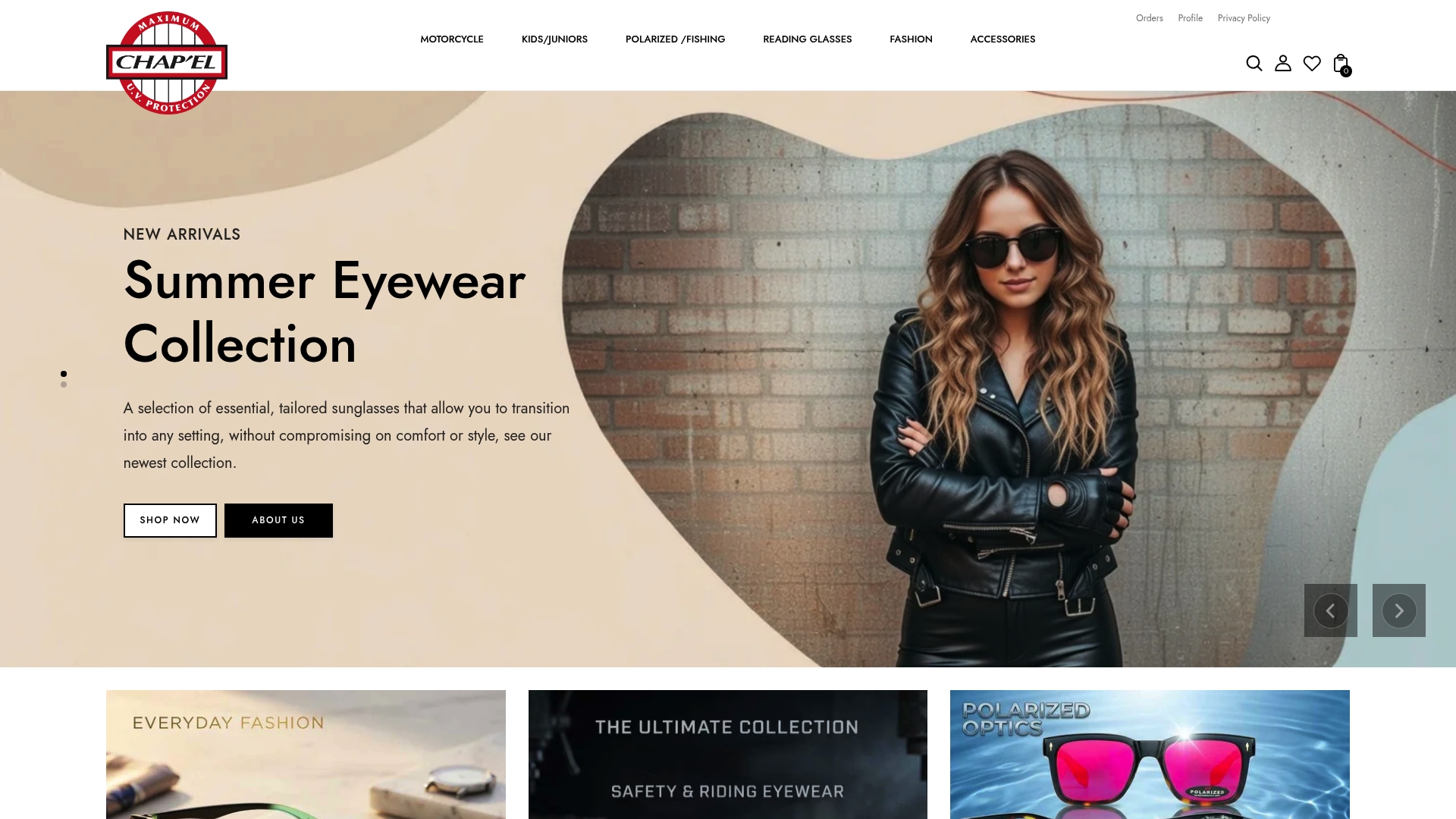
For golfers who play mostly bright, sunny courses and want the strongest ball-and-green contrast, the Sport Polarized collection is built specifically around that need, with polarized lenses that also cut glare off wet fairways and cart paths. Golfers who split time between the course and everywhere else in life, and want a frame that looks as good at the 19th hole as it does on the fairway, will find that balance in Designer Polarized. Every pair ships with impact-resistant polycarbonate lenses, so a stray shot on the range doesn’t become a bigger problem than it needs to be.
If you’re still deciding between two tints, order the pair that matches your most common lighting and test it for a full round. Check the Chapeleyewear collections directly to compare tint and VLT options side by side before you buy.
Sources
- Golf Sunglasses Lens Color Guide Perfect Explanation
- What Actually Makes a Pair of Golf Sunglasses Worth Wearing | Moss and Fog
- What Colour Lens Is Best for Golf? | EMME Visioncare