

Cylindrical vs Spherical Goggles: Pick the Right Lens Shape
If you ride mostly bright, sunny resorts and want the widest, clearest view, buy spherical. If you’re a casual weekend skier watching your budget, cylindrical does the job fine. If you’re chasing personal records on a racecourse, spherical’s glare control is worth the extra money.
- Optics vs. cost: Spherical lenses curve on both axes, cutting glare and widening peripheral vision, but they cost more. Cylindrical lenses curve horizontally only, keep the price down, and can show more edge distortion and glare.
- Fit vs. ventilation: Spherical shapes generally add more air volume behind the lens, which helps with fogging, while cylindrical goggles sit lower profile and pair more predictably with certain helmets.
Casual beginners: cylindrical. All-mountain regulars: either works, lean spherical if budget allows. Sunny-day racers: spherical, no contest.
Key Takeaways
Spherical lenses reduce glare and widen field of view through dual-axis curvature, while cylindrical lenses trade some optical clarity for a lower price and profile.
| Point | Details |
|---|---|
| Match shape to light | Choose spherical for bright, high-glare days and cylindrical for overcast or mixed conditions. |
| Budget drives shape | Cylindrical goggles typically run cheaper; spherical and toric lenses cost more for better optics. |
| Fogging depends on more than shape | Venting, anti-fog coatings, and face-seal fit matter as much as lens curvature. |
| Check helmet clearance first | Spherical lenses can need deeper brow cutouts; cylindrical sits lower profile on most helmets. |
| Chapeleyewear covers both needs | Sport Polarized suits performance riders chasing glare control, while Designer Polarized fits style-focused resort days. |
Table of Contents
- Cylindrical vs Spherical Goggles: What the Shapes Actually Mean
- How Do Cylindrical and Spherical Goggles Compare Head to Head?
- How Do You Choose the Right Lens Shape for Your Riding?
- How Can You Tell Which Lens Shape You Own?
- Why Do Spherical Lenses Cut Glare Better Than Cylindrical Ones?
- A Publisher’s Take on Lens Shape Debates
- Finding Your Match in the Chap’el Eyewear Lineup
- Frequently Asked Questions
- Sources
Cylindrical vs Spherical Goggles: What the Shapes Actually Mean
The terms describe how the lens curves, and that curve changes what your eye actually sees.
A cylindrical lens curves left to right but stays flat top to bottom. It’s curved in only one direction, which means it focuses light along a single axis instead of a point. That single-axis behavior is the same principle used in eyeglasses to correct astigmatism, and it’s why cylindrical goggles can introduce mild visual distortion near the edges.
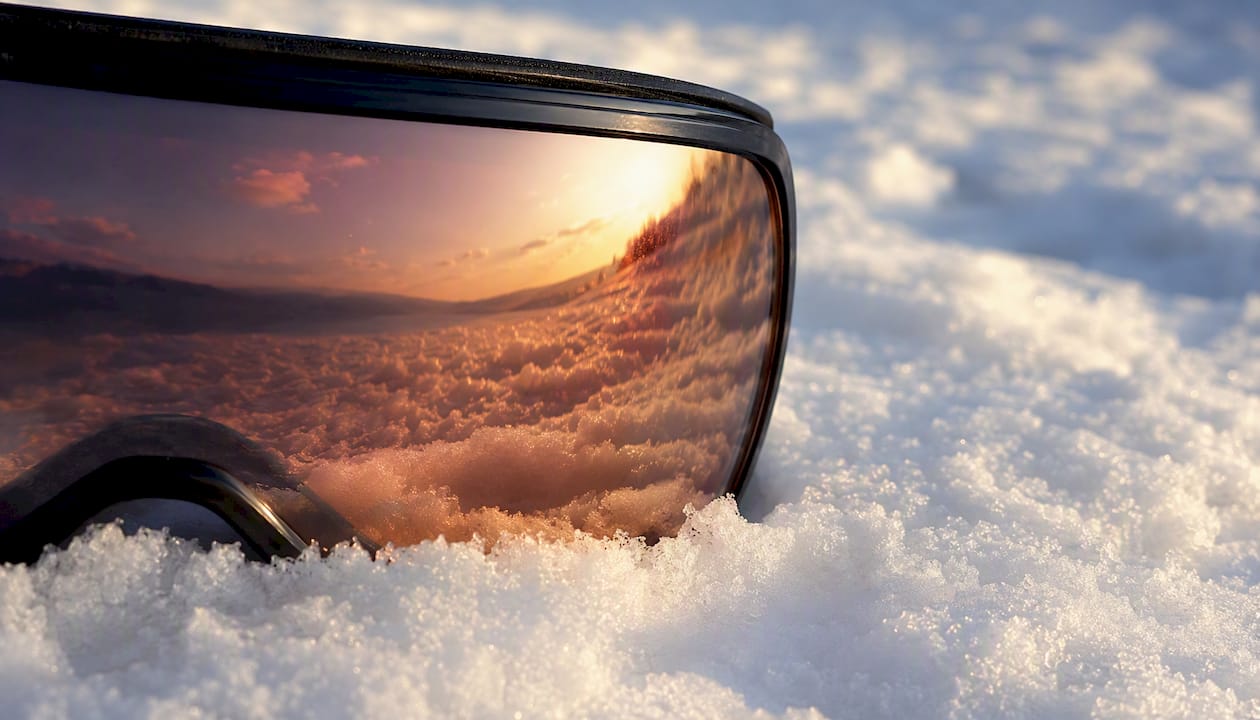
A spherical lens curves on both the horizontal and vertical axes, like a slice of a ball. That dual curvature spreads light more evenly across the lens surface, which is why spherical designs tend to reduce glare and open up your field of view.
A toric lens splits the difference: it curves on both axes, but with a flatter vertical radius than a true sphere. Think of it as spherical optics without the bulging spherical shape. Toric lenses typically sit in the mid-to-upper price tier, between cylindrical budget goggles and top-shelf spherical models.
- Cylindrical = one-axis curve, flatter profile, lower cost
- Spherical = two-axis curve, wraparound shape, better optical clarity
- Toric = hybrid curve, subtler dome, middle price point
How Do Cylindrical and Spherical Goggles Compare Head to Head?
Shape alone doesn’t decide everything (lens coatings and build quality matter too), but it does set the baseline for how a goggle performs across the traits riders actually notice on the hill.
| Performance axis | Cylindrical | Spherical |
|---|---|---|
| Field of view | Narrower, flat vertical plane | Wider, wraps with peripheral vision |
| Glare and contrast | More reflection off the flat surface | Reduced glare from angled dual-curve surface |
| Peripheral distortion | More noticeable at the vertical edges | Minimal, more consistent clarity |
| Fogging and air volume | Lower internal volume, tighter fit | More air volume, generally better fog resistance |
| Price and market position | Budget to mid-range | Mid-range to premium |
| Style and profile | Flatter, lower-profile look | Rounder, bubble-style silhouette |
| Helmet compatibility | Predictable gap on most vents | Can require a helmet with a deeper brow cutout |
A few things worth flagging beyond the table:
- Manufacturing quality still matters. A well-made cylindrical lens from a reputable brand can outperform a cheap spherical one, so shape is a starting filter, not the whole decision.
- Toric lenses aim to capture spherical-style clarity in a lower, cylindrical-like profile, which is why they’ve become popular in the $100 to $180 range.
- Budget cylindrical pairs typically run at a lower price point. Premium spherical lenses with anti-fog coatings and UV treatments are generally more expensive.
Pro Tip: Fogging is more about venting, anti-fog coatings, and how snugly the foam seals against your face than it is about lens shape alone. A spherical lens with poor venting will still fog on a hard climb up the ridge.
How Do You Choose the Right Lens Shape for Your Riding?
Ask yourself these before you swipe your card:
- What’s my typical light? Bluebird days and high-alpine glare favor spherical. Overcast, tree-run days make cylindrical perfectly adequate.
- How fast and how often do I ride? Racers and daily riders benefit most from spherical’s wider field of view at speed.
- What’s my budget for this pair? If you’re stretching for boots and a helmet too, cylindrical frees up cash elsewhere.
- What helmet do I already own? Some helmets have shallow brow clearance that fits cylindrical goggles more comfortably.
- Do I need a prescription insert or OTG fit? Bulkier spherical lenses sometimes reduce room for glasses underneath.
Scenario shortcuts:
- Sunny alpine racer: spherical, full stop. Glare control at 40 mph matters more than saving $100.
- Mixed-condition resort rider: either shape works; a toric lens or a spherical model with a rose or amber tint covers both flat light and sun.
- Casual weekend skier: cylindrical, especially as a second or backup pair.
Red flags that should steer you away from a shape: persistent fog despite good venting (check the foam seal before blaming the lens), a visible gap between goggle and helmet brow, or noticeable warping at the lens edges when you look sideways.
How Can You Tell Which Lens Shape You Own?
Hold the goggle at arm’s length and look at the lens edge-on. A cylindrical lens shows a flat top-to-bottom line with only side-to-side curve. A spherical lens bulges outward like the surface of a ball. Toric lenses curve gently in both directions but sit noticeably flatter than a true sphere.
Fit matters as much as shape once you’re on snow:
- Spherical lenses generally increase distance between your face and the lens, which helps ventilation but can push against certain helmet brows.
- Cylindrical goggles’ lower profile tends to leave a smaller peripheral gap against most helmet shells, which some riders actually prefer.
- For prescription inserts or over-the-glasses fit, check the internal depth before buying. A shallow spherical lens can crowd frame arms; a cylindrical lens sometimes offers more room but less peripheral coverage.
Why Do Spherical Lenses Cut Glare Better Than Cylindrical Ones?
The physics comes down to what happens when light hits a curved surface. A cylindrical lens focuses light along one axis rather than a single point, which is the same effect that causes astigmatism in eyeglasses. That flat vertical plane reflects sunlight more directly back at certain angles.
A spherical lens spreads that reflection across two curves, scattering glare instead of bouncing it straight at your eyes. Picture staring across a flat lake versus a rippled one: the flat surface throws a sharp glare line, while the textured surface diffuses the same light. That’s roughly the difference you’re seeing between a cylindrical and spherical lens on a bright bluebird afternoon.
- Cylindrical: light bends on one axis, can create edge distortion
- Spherical: light bends on two axes, spreads glare more evenly
- Result: spherical typically wins on bright, high-glare days
A Publisher’s Take on Lens Shape Debates
Having spent years around goggle and sunglass design at Chapeleyewear, the shape debate gets oversold. Fit, coatings, and venting decide comfort more than curvature alone does. Our guides on polarized optics and interchangeable lens systems dig deeper into how tint and swap systems affect real-world glare control.
Finding Your Match in the Chap’el Eyewear Lineup
Once you know which lens shape fits your riding, the next step is finding a frame and lens combo that matches your face shape, helmet, and how often you’re actually on the mountain.

If you ride hard and want spherical-grade clarity on bright days, the Sport Polarized collection is built for glare control and all-day comfort under a helmet. If you split time between the lodge and the lift line and want eyewear that looks as good as it performs, Designer Polarized covers that resort-to-street transition without a second pair. Both collections carry UV protection and impact-resistant lenses as standard, not an upsell. Browse the full lineup at Chapeleyewear and find the pair that matches your slope, your helmet, and your budget.
Frequently Asked Questions
Is spherical always better than cylindrical for skiing? Not always. Spherical wins on glare and field of view, but a well-made cylindrical lens still performs fine for casual or overcast-condition riding, and it costs less.
What is a toric goggle lens? A toric lens curves on both axes like a spherical lens, but with a flatter vertical curve, giving you a hybrid of spherical optics and cylindrical style.
Do cylindrical lenses fog more than spherical ones? They can, since spherical shapes generally hold more air volume, but venting and anti-fog coatings affect fogging more than shape alone.
Which lens shape works best for narrow or small face shapes? Cylindrical and toric lenses often fit narrower faces better since their lower profile reduces gaps at the temples and brow.
Can I put a spherical lens in a goggle designed for cylindrical? No. Lens shape is frame-specific, so replacement lenses must match your goggle’s original curvature and mounting points.
Sources
- Cylindrical lens — Wikipedia
- Cylindrical lenses — RP Photonics Encyclopedia
- Ski Goggle Lenses: Cylindrical vs. Spherical vs. Toric | Better Trail