
Brown vs Gray Lenses: The Right Tint for Every Activity
Gray lenses win for driving and anything where true color matters; brown lenses win for fishing, golf, and hazy conditions where contrast counts more than accuracy. If you split your time between the car and the water, that’s your whole decision tree right there.
For a quick cheat sheet: driving and everyday errands lean gray, fishing and boating lean brown, golf leans brown, snow sports go either way depending on glare versus terrain detail, and everyday wear is genuinely a toss-up. One caveat before you buy anything: polarization and photochromic (Transitions) technology are separate features from tint color, and stacking them changes the calculus below.
Key Takeaways
Gray lenses preserve true color for driving and precision tasks, while brown lenses boost contrast for outdoor sports and variable light, and both need full UV protection to actually protect your eyes.
| Point | Details |
|---|---|
| Gray for color accuracy | Choose gray when traffic signals, screens, or true color matter most. |
| Brown for contrast | Choose brown for fishing, golf, hiking, and hazy or overcast conditions. |
| Polarization is separate | Polarization cuts glare and pairs with either tint; pick tint based on activity, not glare needs. |
| VLT matters as much as color | Match tint darkness to your typical light conditions to avoid overly dark lenses at dusk. |
| UV protection is non-negotiable | Confirm 100% UVA/UVB block regardless of which tint you choose. |
| Chap’el covers both tints | Chapeleyewear’s polarized and photochromic collections offer gray and brown options built for driving, sport, and everyday wear. |
Table of Contents
- Brown vs Gray Sunglasses: A Quick Comparison
- How Do Gray and Brown Tints Change What You See?
- Which Tint Is Best for Your Activity?
- Polarized and Photochromic Options: What to Know
- How to Choose Between Brown and Gray Lenses
- What Do Eye Doctors Say About Lens Color?
- Why Chap’el Builds Both Tints Into Its Lineup
- Find Your Match in Chap’el’s Polarized Collections
- Sources
Brown vs Gray Sunglasses: A Quick Comparison
Here’s how the two tints stack up when you put them side by side.
| Dimension | Gray | Brown |
|---|---|---|
| Color perception | Neutral, true-to-life | Warm cast, slight shift |
| Contrast/depth | Moderate | Stronger |
| Glare reduction (with polarization) | Excellent, preserves color | Excellent, boosts contrast |
| VLT/light transmission | Wide range, 3–80% depending on darkness | Similar range, often paired with medium tints |
| Best activities | Driving, everyday wear | Fishing, golf, hiking, hazy days |
| Visual comfort | Reduces brightness evenly | Reduces eye strain in variable light |
| Aesthetic | Cool, understated | Warm, classic |
A few things jump out once you see it laid out this way:
- Gray is the safer default when you need traffic lights and screens to look correct.
- Brown earns its keep the moment terrain, foliage, or water texture matters more than color fidelity.
- Neither tint replaces the need for full UV protection, that’s a separate spec entirely.
Pro Tip: Try this at home before you buy: put on each tint and look at a green lawn or a stop sign from across the room. If the color shifts noticeably with brown, that’s the warm cast doing its job, not a flaw. Decide if you want that shift or not.
How Do Gray and Brown Tints Change What You See?
Gray lenses cut light evenly across the spectrum, so colors look almost exactly like they do without lenses. Brown lenses filter more blue light, which warms everything and sharpens the edges between objects.
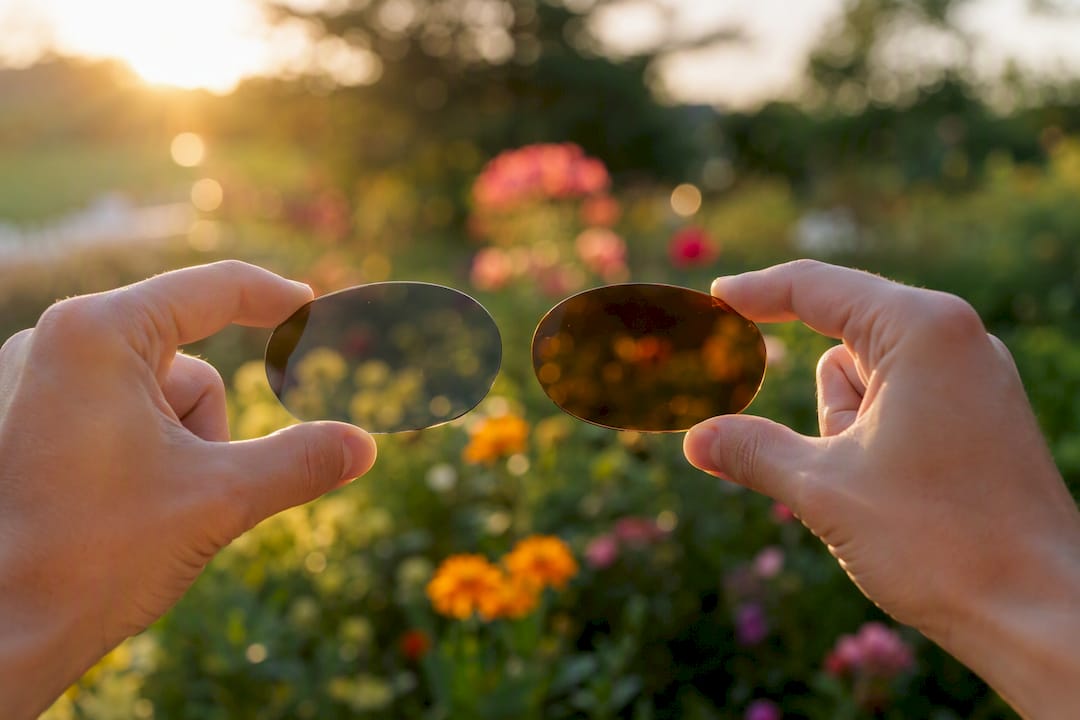
That difference isn’t cosmetic. Gray lenses preserve true color perception because they don’t play favorites with any wavelength, which is why they’re the go-to for driving where a shifted traffic light color could actually matter. Brown does the opposite on purpose: by knocking down blue light, it boosts contrast and depth perception, and it tends to mute greens and blues while making browns, oranges, and reds pop.
That trade-off shows up in specific ways:
- On the golf course, brown makes the ball stand out against a green fairway.
- On the water, brown helps you read subtle color changes that signal depth or structure, though it does shift how blue the water actually looks.
- Behind the wheel, gray keeps signal colors honest.
Visible light transmission (VLT) matters here too. Guides generally group tints into very dark (3-8%), dark (10-20%), medium (20-40%), and light (40-80%) bands, and picking the right band for your typical light conditions matters more than tint color alone, especially at dusk or under heavy overcast.
Which Tint Is Best for Your Activity?
Match the tint to what you’re actually doing, not just what looks good in the mirror.
- Driving: Gray, because color accuracy on road signs and signals matters more than contrast.
- Fishing and boating: Brown, paired with polarization, for reading water and spotting fish against glare. Check out polarized optics built for water if this is your main use case.
- Golf: Brown, for contrast against grass and better depth perception on the green.
- Cycling: Either works, but brown edges ahead for trail riding where terrain detail matters.
- Snow sports: Gray if you want true snow color and less visual noise; brown if you want more terrain contrast in flat light.
- Beach and general boating: Brown or gray with polarization, both handle glare well.
- Overcast work outdoors: Brown, since it keeps contrast up even when light is flat and dull.
- Everyday wear: Genuinely a coin flip. Pick whichever look you prefer, since color enhancement isn’t critical for a coffee run.
If your work or hobby depends on reading colors precisely, printing, design, medical work, gray stays the safer call regardless of activity.
Polarized and Photochromic Options: What to Know
Polarized gray and polarized brown both kill glare, but polarization and tint color solve two different problems, and you can combine either tint with it.
Polarization works by filtering out horizontally polarized light, the kind that bounces off water, wet asphalt, and snow and blasts straight into your eyes. That’s a mechanical filter, unrelated to color. Photochromic lenses, on the other hand, darken and lighten based on UV exposure. Brown photochromic lenses tend to stay warmer-toned across the light range, while gray photochromic lenses stay neutral but can lag slightly in low light before darkening back up.
- Pick polarized brown for fishing, golf, or hiking where contrast and glare both matter.
- Pick polarized gray for driving where color truth and glare control both matter.
- Watch for two limitations: polarized lenses can make some LCD screens (gas pumps, some car dashboards) hard to read, and photochromic lenses respond more slowly in cold weather or behind a windshield.
Pro Tip: If you drive at dawn or dusk often, test any photochromic pair indoors first, some brands lag by several seconds when transitioning from bright to dim.
How to Choose Between Brown and Gray Lenses
Start with your primary activity, then your typical light conditions, and only then let personal color preference break the tie.
Work through this checklist before you commit:
- What’s your primary activity, driving, water sports, golf, or general wear?
- What lighting do you deal with most, bright sun, overcast, or mixed conditions?
- Do you need precise color accuracy for work, traffic signals, or screens?
- How sensitive are your eyes to glare off water, snow, or pavement?
- Do you need polarization, photochromic behavior, or a prescription built in?
Watch for these red flags before you buy:
- A tint that visibly shifts red or green traffic light colors, that’s a problem for driving.
- A VLT rated too dark for the light you’ll actually be in, very dark tints under 8% VLT struggle in low light or dusk.
- Polarized lenses that black out a screen you rely on at work.
For style and function trade-offs beyond tint alone, our guide comparing black and brown frames covers how frame color factors into the decision too.
What Do Eye Doctors Say About Lens Color?
UV protection has nothing to do with tint color. A light gray lens can block 100% of UVA and UVB rays just as well as a dark brown one, and a dark lens with no UV coating protects you less than a clear one that’s properly rated.
That’s the core guidance from the American Academy of Ophthalmology, and it’s the one rule that overrides tint preference entirely.
Pro Tip: Test any pair before buying: look at a traffic light for color accuracy, check a distant sign for contrast, and glance at a car windshield or window for glare reduction. Thirty seconds tells you most of what you need to know.
Why Chap’el Builds Both Tints Into Its Lineup
We stock polarized and photochromic polycarbonate lenses in both tints because your fishing trip and your commute have different needs, and one pair rarely covers both well. Impact-resistant lenses with full UV protection matter more than which tint you land on, durability and eye safety don’t change based on color.
Find Your Match in Chap’el’s Polarized Collections
Once you know whether you’re a gray person or a brown person, the next step is finding a frame that fits how you actually live. Chapeleyewear’s Designer Polarized collection covers gray and brown options built for everyday wear and travel, while the Sport Polarized line is built for golf, fishing, and cycling with the same tint logic covered above.
If you want something versatile enough for both the boat and the office, the Classic Polarized line splits the difference with balanced tint options and durable polycarbonate construction. Browse the full Chap’el Eyewear lineup and filter by tint to find the pair that matches your main activity.
Sources
- American Academy of Ophthalmology — Sunglasses
- VersusGuy — Polarized grey vs brown: which lens is right?