

Polarized vs Mirrored Lenses: Which Should You Choose?
Polarized lenses cut reflected glare from water, pavement, and wet roads. Mirrored lenses reduce overall brightness by reflecting light before it enters the lens. For most people, polarized is the smarter default — especially for driving, fishing, and boating. Add a mirror coating when you’re dealing with extreme brightness like snow or high-altitude sun. Better yet, you can have both on the same lens.
Two things matter regardless of which coating you pick:
- UV400 protection is non-negotiable. The NEI recommends sunglasses that block 99–100% of UVA and UVB — dark tints and mirror finishes do not automatically provide this.
- AAO and AOA guidance consistently backs polarization for glare-heavy outdoor activities and mirror coatings for intense sun environments.
Key Takeaways
Polarized lenses are the right default for most buyers; mirror coatings add value specifically in extreme brightness, and UV400 is non-negotiable regardless of which coating you choose.
| Point | Details |
|---|---|
| Polarized for glare | Polarized lenses block reflected horizontal light from water, roads, and wet surfaces. |
| Mirror for brightness | Mirror coatings lower overall light transmission — most valuable in snow and high-altitude sun. |
| Combine when needed | Mirror-polarized combos give maximum protection for skiing, boating, and open-water use. |
| UV400 always | Neither mirror nor polarization provides UV protection — confirm UV400 on every pair. |
| Chapeleyewear collections | Sport, Designer, and Classic Polarized lines cover fishing, fashion, and everyday driving with UV400 standard. |
Table of Contents
- What mirrored lenses actually do to light
- How polarized lenses filter reflected glare
- The real trade-offs of mirrored lenses
- The real trade-offs of polarized lenses
- Can lenses be both mirrored and polarized?
- Which lens works best for your activity?
- How to choose the right lens before you buy
- How to keep coated lenses in good shape
- The Chap’el Eyewear perspective on matching lenses to your life
- Chapeleyewear’s polarized and mirrored collections
- Sources
What mirrored lenses actually do to light
A mirror (sometimes called a “flash”) coating is a thin metallic layer applied to the outside surface of a lens. It works like a one-way mirror: it reflects a portion of incoming light before it ever reaches your eye, lowering the visible light transmission (VLT) of the lens. Lower VLT means less total light gets through, which is why mirrored sunglasses feel noticeably darker in bright conditions.
The tint underneath the mirror coating matters too. A silver mirror over a gray base gives you a neutral, low-distortion view. A blue or green mirror over a brown base shifts contrast, which some people find helpful for depth perception on the water. The mirror finish itself doesn’t change color accuracy — the base tint does.
What mirror coatings do not do: they don’t filter reflected horizontal glare the way polarization does, and they don’t provide UV protection on their own. UV400 is a separate spec applied to the lens material or a dedicated coating. According to the AOA, mirror-coated lenses can be useful in very bright light, but buyers should always confirm the UV rating independently.
Key facts about mirror coatings:
- Reduce VLT, making the visual field appear darker overall
- Applied to the outer lens surface — more exposed to scratching than internal coatings
- Available in silver, gold, blue, green, red, and other colors
- Do not inherently block reflected glare from horizontal surfaces
- Do not provide UV protection without a separate UV coating or UV-blocking lens material
Pro Tip: Ask specifically about the hard coat on any mirrored lens. Mirror coatings on soft substrates scratch easily and visibly — a good anti-scratch hard coat underneath the mirror layer extends the lens life significantly.
| Feature | Mirror Coating |
|---|---|
| Primary effect | Reduces overall brightness (lowers VLT) |
| Glare from reflections | Partial — reduces total light but not specifically horizontal glare |
| UV protection | Not automatic — requires separate UV400 spec |
| Durability concern | Outer coating is scratch-prone without a hard coat |
| Best environments | Snow, high-altitude, midday desert sun |
How polarized lenses filter reflected glare
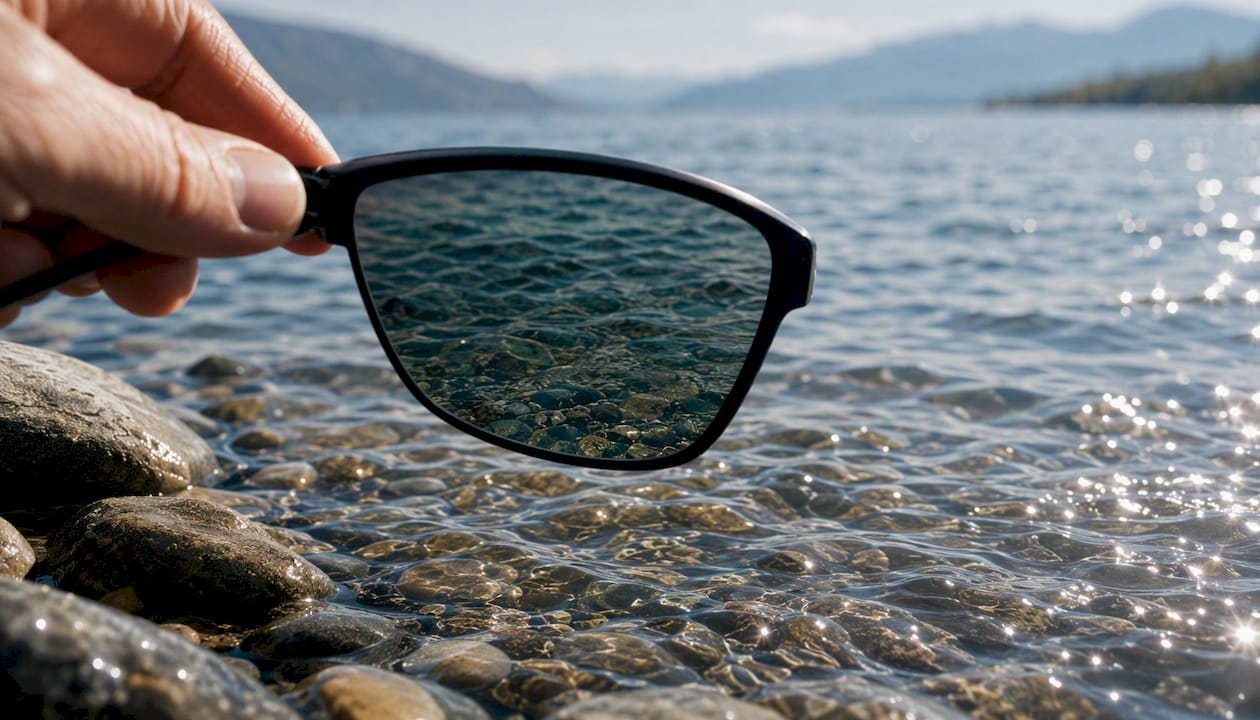
Polarization works differently from a mirror coating. Inside a polarized lens is a chemical filter oriented vertically. Reflected light from flat surfaces — water, pavement, car hoods, wet roads — bounces back predominantly as horizontal light waves. The vertical filter blocks those horizontal waves almost entirely. The result is a dramatic reduction in glare without necessarily darkening the overall scene.
The AAO confirms that polarized lenses reduce glare from reflected surfaces, improving comfort and visual clarity for outdoor activities. Anglers notice it immediately: the surface glare that hides fish disappears, and they can see into the water. Drivers notice it on wet roads, where polarization eliminates the blinding white reflection that standard dark lenses only partially reduce.
Polarization is the single highest-impact upgrade for anyone who spends time driving on wet roads or near water. The difference between polarized and non-polarized isn’t subtle — it’s the difference between squinting and seeing clearly.
Polarization does have real limitations worth knowing before you buy:
- LCD screens: Polarized lenses can make phone screens, ATM displays, and some car dashboard screens appear dark or completely black at certain angles.
- Pilots: Aviation authorities generally advise against polarized lenses in cockpits because they can interfere with reading certain instrument displays and spotting other aircraft.
- Car HUDs and some windshields: Some head-up displays and laminated windshields have a polarizing effect of their own, which can create visual interference with polarized sunglasses.
- Night driving: Polarized lenses are not appropriate for night driving — they reduce light transmission and offer no benefit when there’s no reflected glare to filter.
Polarization is an internal filter, not a surface coating, so it doesn’t wear off the way a mirror finish can. It’s also independent of UV protection — a polarized lens still needs UV400 to protect your eyes from sun damage.
The real trade-offs of mirrored lenses
Mirror coatings have a genuine place in the lineup. The advantages are real, but so are the limits.
Advantages:
- Strong brightness reduction in extreme light — snow, sand, open water at midday
- Aesthetic appeal: the reflective finish is a style choice many people actively want
- Pairs well with lighter base tints for situations where you want brightness control without heavy darkening of the lens
Disadvantages:
- Doesn’t target reflected horizontal glare the way polarization does — you get dimmer overall, not cleaner contrast
- The outer mirror surface is the most vulnerable part of the lens; scratches show up clearly on a reflective finish
- Color rendering shifts depending on the mirror tint, which some wearers find disorienting
Snow is where mirror coatings earn their keep. Snow reflects up to about 80% of UV radiation, and the sheer brightness of a sunny ski slope is a different problem from road glare. A mirror coating paired with a UV400 lens handles both the brightness and the UV load.
| Scenario | Mirror Coating Performance |
|---|---|
| Ski slopes / snow | Excellent — reduces intense brightness and glare |
| High-altitude hiking | Strong — handles broad, hard sunlight |
| Wet road driving | Moderate — dims overall but doesn’t cut surface glare |
| Fashion / everyday | Good — style-forward with brightness control |
| Night or low light | Poor — avoid entirely |
Pro Tip: Silver and gray mirror tints preserve the most natural color rendering. Colored mirrors (blue, gold, red) look striking but shift how you perceive contrast — test them in the actual conditions you’ll wear them in before committing.
The real trade-offs of polarized lenses
Polarization is the workhorse of outdoor eyewear. For most activities involving reflected light, it outperforms a mirror coating on pure optical performance. But it’s not perfect for every situation.
Advantages:
- Dramatically reduces reflected glare from water, pavement, and glass
- Improves contrast and depth perception in glare-heavy scenes
- Reduces eye strain on long drives or days on the water
- Internal filter doesn’t wear off with normal use
Disadvantages:
- Can make LCD screens difficult or impossible to read at certain angles
- Not suitable for pilots or anyone who needs to read polarized instrument displays
- Offers no advantage at night — and shouldn’t be worn for night driving
- Doesn’t reduce overall brightness the way a mirror or dark tint does
For fishing and boating, polarization isn’t a luxury — it’s a functional tool. The ability to see beneath the water’s surface changes how you fish. No other lens technology does that.
The AAO’s guidance on polarized lenses supports their use for outdoor activities where surface reflections are the primary visual problem. For drivers, the LensDirect comparison makes the distinction clearly: polarization targets reflected glare from pavement and water, while mirror coatings reduce overall brightness — two different problems requiring different solutions.
Before buying polarized driving glasses: Sit in your car and look at your dashboard, GPS screen, and any HUD display through the lenses. Some displays go dark or show rainbow patterns through polarized lenses. Better to find out in the parking lot than on the highway.
Can lenses be both mirrored and polarized?

Yes — and for certain conditions, the combination is genuinely worth it. Mirror coatings and polarization solve different optical problems, so stacking them gives you a two-stage defense: the mirror reflects away a portion of incoming light before it reaches the lens, and the polarizing filter inside the lens blocks the reflected horizontal glare that gets through.
The LensDirect guide confirms that the two technologies can be combined for complementary benefits. Think of it this way: mirror handles the volume of light, polarization handles the quality of light.
When the combination makes sense:
- Skiing and snowboarding on bright days — high UV reflection from snow plus intense overall brightness
- Open-water fishing or boating in direct midday sun
- High-altitude activities where both brightness and glare are extreme
Trade-offs to expect:
- Higher cost than single-feature lenses
- Screen interactions from polarization still apply
- Mirror coating still needs a hard coat to resist scratching
- VLT drops significantly — not ideal for variable or low-light conditions
Pro Tip: If you want one pair that adapts across light conditions, photochromic lenses like Transitions are worth considering. They won’t match a mirror-polarized combo in peak brightness, but they handle the transition from indoor to outdoor without a lens swap.
Which lens works best for your activity?
| Activity | Best Lens Choice | Key Reason |
|---|---|---|
| Driving (daytime) | Polarized | Cuts road and windshield glare; check dashboard compatibility |
| Fishing / boating | Polarized | Removes water surface glare; improves underwater visibility |
| Skiing / snowboarding | Mirror + Polarized | Snow reflects up to 80% UV; extreme brightness needs both |
| Cycling (road) | Polarized | Road glare and wet surface reflections |
| Casual / fashion | Mirror or personal preference | Style-forward; confirm UV400 regardless |
| High-altitude hiking | Mirror or Mirror + Polarized | Broad intense sunlight; brightness control is priority |
| Night driving | Neither | Standard clear or lightly tinted lens only |
Quick picks by activity:
- Driving: Polarized, gray base tint, UV400 confirmed. Test your dashboard before buying.
- Fishing/boating: Polarized with a brown or copper base tint — enhances contrast on the water. See polarized sunglasses advantages for more on why anglers prefer this combination.
- Skiing/snowboarding: Mirror-polarized combo or a high-VLT mirror with UV400. The EPA notes snow reflects up to 80% of UV — don’t skip the UV spec.
- Cycling: Polarized for road riding; consider photochromic for variable light on trails. Compare options at photochromic vs polarized.
- Casual/fashion: Mirror for the look, but always confirm UV400. Style and eye safety aren’t mutually exclusive.
- Light sensitivity: Darker mirror tints or mirror-polarized combos reduce both brightness and glare simultaneously.
For open-water swimming, USMS notes that mirrored goggles reduce overall brightness while polarized goggles reduce surface glare — the right call depends on whether you’re fighting sun intensity or surface reflections.
How to choose the right lens before you buy
Work through these questions in order:
- What’s your primary activity? Driving and water sports push you toward polarized. Snow and high-altitude push you toward mirror or a combo.
- Do you use digital screens outdoors? If you regularly check your phone, GPS, or dashboard while wearing sunglasses, test polarized lenses with those specific screens first.
- How bright is your typical environment? Extreme brightness (ski slopes, open ocean at noon) benefits from a mirror coating. Standard outdoor use usually doesn’t need it.
- Do you have a prescription? Not all mirror coatings are available in every prescription format — confirm with your optician.
- Is UV400 confirmed? Ask directly: “Does this lens block 100% of UVA and UVB?” A dark tint or mirror finish is not a UV rating.
- Does the lens have a scratch-resistant hard coat? Especially critical for mirror coatings, which show scratches prominently.
- What’s the return or exchange policy? Polarized lenses in particular can surprise buyers with screen interactions — a no-hassle return window matters.
Red flags when shopping:
- Dark tints sold with no UV rating listed
- “UV protection” claimed without specifying UV400 or 100% UVA/UVB blockage
- Mirror coatings with no mention of a hard coat
- Vague polarization claims with no demo or test policy
- No return window on prescription or specialty lenses
For a deeper comparison of polarized versus standard lenses, Chapeleyewear’s polarized vs non-polarized guide covers the practical differences in detail.
How to keep coated lenses in good shape
Mirror coatings and polarization layers both last longer with consistent, simple care. The mistakes that shorten lens life are almost always the same ones.
Daily cleaning:
- Rinse lenses with clean water before wiping — dry-wiping grinds dust particles across the coating
- Use a clean microfiber cloth only; paper towels, tissues, and shirt fabric are abrasive enough to scratch coatings over time
- A drop of mild dish soap on wet lenses works well for oily smudges; rinse thoroughly after
Storage:
- Always use a hard case — soft pouches protect against dust but not impact
- Never set glasses lens-down on any surface
- Keep them out of hot cars; temperatures inside a parked car can reach levels that cause coatings and adhesives to delaminate or bubble
Coating-specific care:
- Mirror coatings live on the outer surface and are the most vulnerable — a hard coat is your first line of defense
- Polarization is an internal filter and won’t peel or wear off with normal use, but the lens substrate still needs gentle handling
- UV coatings are typically embedded in the lens material or applied as a stable layer — they don’t require special maintenance beyond avoiding harsh solvents
Pro Tip: If your mirror coating develops a scratch that catches light, check your warranty before buying a replacement pair. Many quality eyewear brands offer coating warranty coverage for manufacturing defects — a scratch from a hard case failure may qualify.
A protective hard case is the single most effective investment for extending the life of any coated lens.
The Chap’el Eyewear perspective on matching lenses to your life
Most people overthink the polarized vs mirrored decision and underthink the UV400 question. After working with customers across fishing, driving, skiing, and everyday wear, the pattern is consistent: the people who are happiest with their sunglasses picked the lens for their primary activity, confirmed the UV spec, and didn’t compromise on fit.
At Chapeleyewear, the Sport Polarized collection is built for people who are on the water or road regularly — anglers, cyclists, and drivers who need glare control as a functional requirement, not a bonus. The Designer Polarized line is for buyers who want that same optical performance in a frame they’d wear to dinner. Both carry UV400 protection and polarized lenses as standard. For customers who want the classic look with reliable everyday performance, the Classic Polarized collection covers that ground without overcomplicating the choice.
The honest answer on combining mirror and polarized: it’s worth it for skiing and open-water use. For everyday driving or casual wear, polarized alone does the job.
Chapeleyewear’s polarized and mirrored collections
Chapeleyewear carries polarized sunglasses built for the activities this guide covers — with UV400 protection, impact-resistant polycarbonate lenses, and clear labeling on every pair so you know exactly what you’re buying.
- Sport Polarized: Lightweight, durable frames for fishing, cycling, and water sports. Polarized lenses with UV400 as standard.
- Designer Polarized: Premium styles for buyers who want performance optics in a fashion-forward frame.
- Classic Polarized: Everyday polarized sunglasses at an accessible price point — the right starting point for drivers and casual outdoor wearers.
Every pair lists its UV rating and lens specs on the product page. If you have questions about prescription compatibility, screen interactions, or which collection fits your activity, contact Chapeleyewear directly through the storefront — the team can help you match the right lens to your actual use case.
Sources
The claims in this guide are grounded in guidance from the following organizations:
- AAO — Polarized lenses
- AOA — Sunglasses guidance
- EPA — Sun safety tips
- LensDirect — Polarized vs Mirrored vs Photochromic